
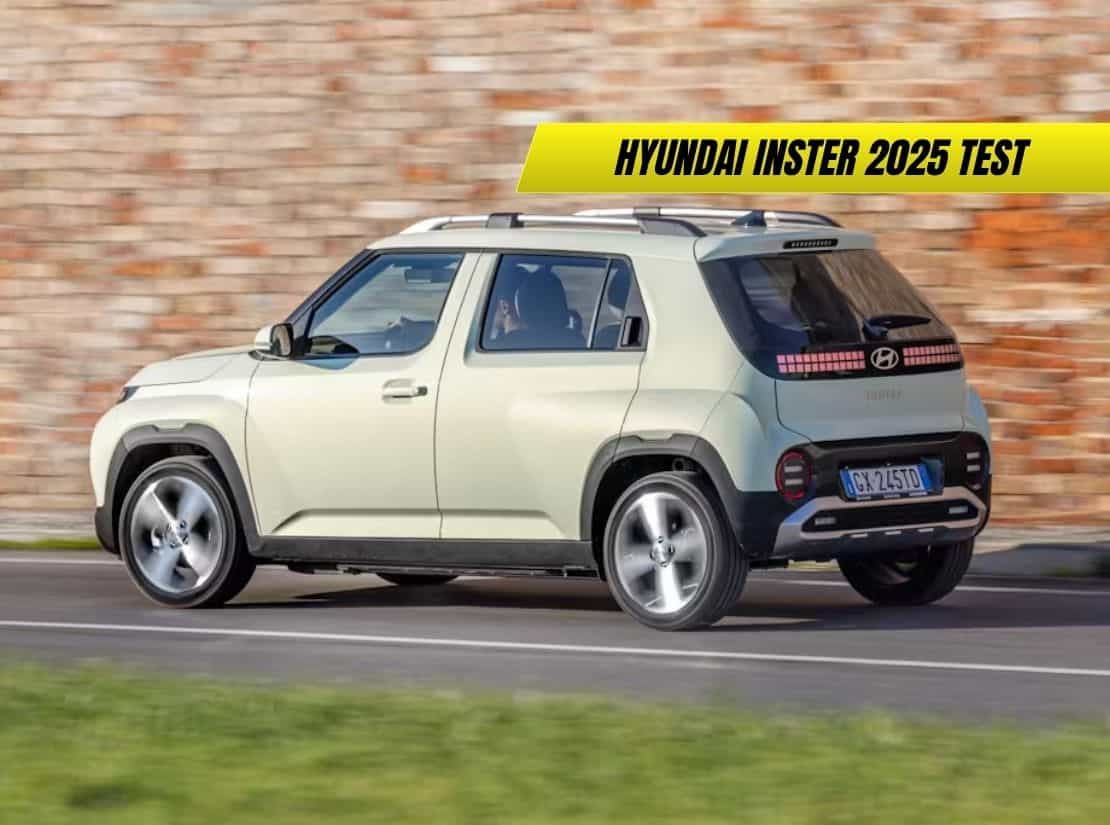
The Hyundai Inster 2025 is a compact fully electric SUV measuring just 3.83 metres in length, yet delivering up to 370 km of WLTP range, 15 standard ADAS systems and a genuinely spacious rear cabin — all at a starting price of €24,900, making it one of the most compelling electric city car propositions available today.
Hyundai Inster 2025: Key Highlights
- 115 hp synchronous electric motor with 147 Nm of torque, paired to a 49 kWh battery
- Declared WLTP range of 370 km — real-world test returned 350 km at 12 kWh/100 km
- DC fast charging at up to 120 kW: 10–80% in approximately 30 minutes
- 15 standard ADAS safety systems from the entry trim level
- Boot capacity from 238 to 1,059 litres with adjustable and foldable rear seats
- Continental pricing from €24,900 (42 kWh) to €30,700 (49 kWh XClass + Tech Pack)
Design and Exterior: Compact, Clean and Distinctive
At 3.83 metres long, 1.61 metres wide and 1.58 metres tall with a 2.58-metre wheelbase, the Inster is genuinely compact — well suited to the narrow urban streets and tight car parks that British city drivers encounter daily. Despite its small footprint, the design is assertive rather than anonymous. The front end is defined by a circular LED daytime running light signature and a pixel-style LED indicator graphic, creating a recognisable face that stands apart from the uniform language of most competitors in the segment. The closed lower grille is standard on electric models and reinforces the zero-emission identity.
The side profile features pronounced wheel arches, roof rails and body-coloured cladding that lend the Inster a mild SUV character despite its city car dimensions. Rear door handles are integrated into the window surround — a detail that sharpens the side profile and keeps the doors slim. The rear is squared-off, with a light graphic that mirrors the front circular theme, and the model name is displayed in italic script across the tailgate. Wheel options range from 15 to 17 inches depending on specification. Available in both four- and five-seat configurations, the Inster has also been homologated for micro-mobility use in some European markets.
Interior and Technology: Spacious Beyond Its Class
The Inster’s interior is one of its most impressive attributes, particularly given the car’s external dimensions. The short centre console and flat floor liberate a meaningful amount of cabin space, and the sliding rear bench — adjustable fore and aft — allows passengers to customise the balance between legroom and boot space. Rear headroom and knee room are genuinely good for the segment: two adults of average height can sit comfortably without feeling compromised, a remarkable achievement in a 3.83-metre vehicle.
The twin 10.25-inch digital screens — one for the instrument cluster, one for infotainment — are the cabin’s technological centrepiece. The interface is well-organised, with a modern graphic design and clearly accessible menus covering media, navigation (with live traffic services), ADAS management and telephone functions. Apple CarPlay and Android Auto are supported, though at this stage via cable only rather than wireless. Physical shortcut buttons below the central display provide direct access to the climate control, volume and key drive settings — a practical choice that avoids the frustration of navigating sub-menus in motion. Wireless Qi charging, two USB ports (one Type-C) and door pocket storage are all present.
Material quality reflects the car’s price bracket honestly: the dashboard and door panels are predominantly hard recycled plastics — PET and bioplastic composites — which are visually pleasant and sustainably sourced, but lack the soft-touch feel of premium rivals. The overall cabin impression is of thoughtful engineering rather than luxury — entirely consistent with the Inster’s mission.
Boot Space and Practicality
The Inster’s boot range of 238 to 351 litres — depending on the position of the sliding rear seat — is modest but functional for urban use. A dual-height boot floor allows the load space to be configured flat with the rear seat or stepped to maximise vertical storage. With the rear bench folded, total capacity reaches 1,059 litres — a genuinely useful number that enables the Inster to handle larger weekly shops, flat-pack furniture or cycling gear on occasional longer trips. A small frunk (front storage compartment) is not available on this version, though under-boot storage houses the charging cables neatly.
The adjustable rear seat is a genuine highlight — sliding it fully forward frees up a surprisingly deep boot for a car of this size, while moving it rearward creates rear passenger legroom that rivals some B-segment hatchbacks. For urban buyers who split their time between solo commuting and occasional family or cargo duties, this flexibility is practically valuable and well implemented.
Powertrain and Driving Experience
The Inster is powered by a permanent magnet synchronous electric motor producing 115 hp and 147 Nm, driving the front wheels. Acceleration from 0–100 km/h takes 10.6 seconds — unspectacular by EV standards — and the delivery is smooth and progressive rather than sharp and abrupt. A Sport driving mode is available and does offer a marginally more responsive throttle, though the difference in character is subtle. For the car’s intended urban use, the power delivery is perfectly calibrated: brisk enough to clear junctions and execute confident overtakes on extra-urban roads, without the nervous energy of a more powerful EV in congested traffic.
Ride comfort is a genuine strength. The Inster absorbs urban road imperfections — potholes, speed humps, cobbles — with commendable composure, and motorway refinement at UK legal speeds is surprisingly good, with wind and tyre noise kept well in check. The auto hold function activates automatically when stationary at traffic lights, removing the need to keep a foot on the brake in city queues — a small but genuinely appreciated feature for stop-start urban commuting. Regenerative braking is managed across four levels via steering column paddles, up to and including full one-pedal driving — a standard and well-implemented feature that extends real-world range in city conditions.
In our real-world range test across a mixed urban, extra-urban and motorway route, the Inster 49 kWh returned 350 km from a full charge at a consumption of 12 kWh/100 km — impressively close to the declared 370 km WLTP figure and a strong result for a compact electric SUV of this size and price.
| Specification | Detail |
|---|---|
| Motor | Permanent magnet synchronous, 115 hp / 147 Nm |
| Battery | 49 kWh (also available 42 kWh) |
| Drivetrain | Front-wheel drive |
| 0–100 km/h | 10.6 seconds |
| Top speed | 150 km/h |
| WLTP range (declared) | 370 km |
| Real-world range (tested) | 350 km |
| Real-world consumption | 12 kWh/100 km |
| AC charging | Up to 11 kW (4.5 hours, 0–100%) |
| DC fast charging | Up to 120 kW (10–80% in ~30 min) |
| Boot volume | 238–1,059 litres |
| Length | 3.83 m |
| Price (from) | €24,900 (42 kWh XTech) |
Safety: 15 ADAS Systems as Standard
One of the Inster’s most remarkable attributes is the breadth of its standard safety equipment. All 15 ADAS systems are included from the entry XTech trim, with no need to pay for safety packages or optional extras. The suite covers automatic emergency braking with pedestrian and cyclist recognition, adaptive cruise control, lane-keeping assist, traffic sign recognition, driver fatigue monitoring, intersection collision avoidance assist, rear and front parking sensors (the latter on XClass trim) and a reversing camera. For a car priced from under €25,000, this represents a genuinely exceptional standard of passive and active protection.
For UK buyers, safety certification matters for insurance costs as well as peace of mind. The Thatcham Research database holds the latest insurance grouping and autonomous emergency braking performance data for all new UK-market vehicles. Additionally, UK drivers concerned about navigating ULEZ zones and urban clean air zones with a zero-emission vehicle will find the Inster automatically exempt from all current charges — a meaningful running cost advantage explored further in our guide to UK toll roads and charges 2025.
Hyundai Inster 2025 vs. Key Rivals
| Model | Range (WLTP) | Boot | Power | DC Charging | Price (from) |
|---|---|---|---|---|---|
| Hyundai Inster 49 kWh | 370 km | 238–1,059 l | 115 hp | 120 kW | €24,900 |
| Renault Twingo Electric 2026 | 263 km | 260–1,010 l | 82 hp | 50 kW | €19,500 |
| Dacia Spring 2025 | 220 km | 308–1,004 l | 65 hp | 30 kW | €16,900 |
| Citroën ë-C3 | 326 km | 310 l | 113 hp | 100 kW | €23,300 |
| Leapmotor B10 | 375 km | 380 l | 170 hp | 80 kW | ~€25,000 |
The Inster leads this group in real-world range and DC charging speed, while the Twingo Electric and Dacia Spring undercut it on price. For UK buyers who need genuine daily usability without range anxiety, the Inster’s 350 km real-world capability and 30-minute fast charge make it the most credible all-round city EV in this comparison. It is also worth reading our full review of the Dacia Sandero 2026 for a budget-conscious petrol alternative.
Is the Hyundai Inster 2025 Available in the UK?
Yes. The Hyundai Inster is available in the UK through Hyundai’s national dealer network. UK pricing starts from £22,995 for the 42 kWh Standard Range variant, with the 49 kWh Long Range from £26,495. The Inster qualifies for exemption from all current UK ULEZ and Clean Air Zone charges. Full specification, pricing and a dealer locator are available at hyundai.com/uk. For those comparing the Inster against the wider small SUV market, our roundup of the 20 best SUVs to buy in 2025 under £40k provides essential context.
FAQ
What is the real-world range of the Hyundai Inster 49 kWh?
In our mixed urban, extra-urban and motorway road test, the Inster returned 350 km from a full charge, consuming 12 kWh/100 km. This is one of the closest real-world to WLTP correlations in the compact electric SUV segment and makes the Inster genuinely suitable for occasional longer journeys beyond the daily commute.
How fast does the Hyundai Inster charge?
The Inster supports AC charging at up to 11 kW — a full charge from empty takes approximately 4.5 hours on a home wallbox. DC fast charging is supported at up to 120 kW, enabling a 10–80% top-up in around 30 minutes at a compatible rapid charger.
Is the Hyundai Inster a five-seat car?
The Inster is available in both four-seat and five-seat configurations. The five-seat version has recently been introduced alongside the original four-seat homologation. Rear space is generous for the car’s class, aided by the sliding rear bench and flat floor.
How does the Hyundai Inster compare to the Renault Twingo Electric?
The Twingo Electric is cheaper (from €19,500 vs €24,900) and more agile in tight urban environments, but the Inster offers significantly more range (370 km vs 263 km WLTP), faster DC charging (120 kW vs 50 kW) and a larger boot. For buyers who venture beyond the city regularly, the Inster is the more capable choice.
Does the Hyundai Inster have one-pedal driving?
Yes. The Inster supports one-pedal driving through its four-level regenerative braking system, managed via paddle shifters on the steering column. At the maximum regeneration setting, the car decelerates briskly enough on the overrun to bring it to a complete stop without using the brake pedal in most urban situations.
What ADAS systems does the Hyundai Inster include as standard?
All 15 driver assistance systems are standard from the entry XTech trim. These include automatic emergency braking with pedestrian and cyclist detection, adaptive cruise control, lane-keeping assist, intersection collision avoidance, driver fatigue monitoring, traffic sign recognition, blind-spot monitoring and front and rear parking sensors.
Is the Hyundai Inster good for UK city driving?
Yes — in my experience, the Inster is exceptionally well suited to British urban environments. Its compact 3.83-metre footprint, tight turning circle, smooth one-pedal driving capability, automatic hold function and comprehensive safety suite make it one of the most stress-free city EVs currently available at this price point.
The Hyundai Inster 2025 is a city electric SUV that takes its brief seriously and delivers against almost every metric that matters. Its real-world range of 350 km removes the principal objection to compact EV ownership, its 120 kW fast charging capability keeps journey interruptions brief, and its 15 standard ADAS systems set a benchmark for safety provision at this price level. The cabin materials are honest rather than premium, and the AC charging limit of 11 kW is a minor shortcoming — but neither detracts from a package that, from my point of view, represents one of the strongest arguments for electric city car ownership available in the UK today.





