
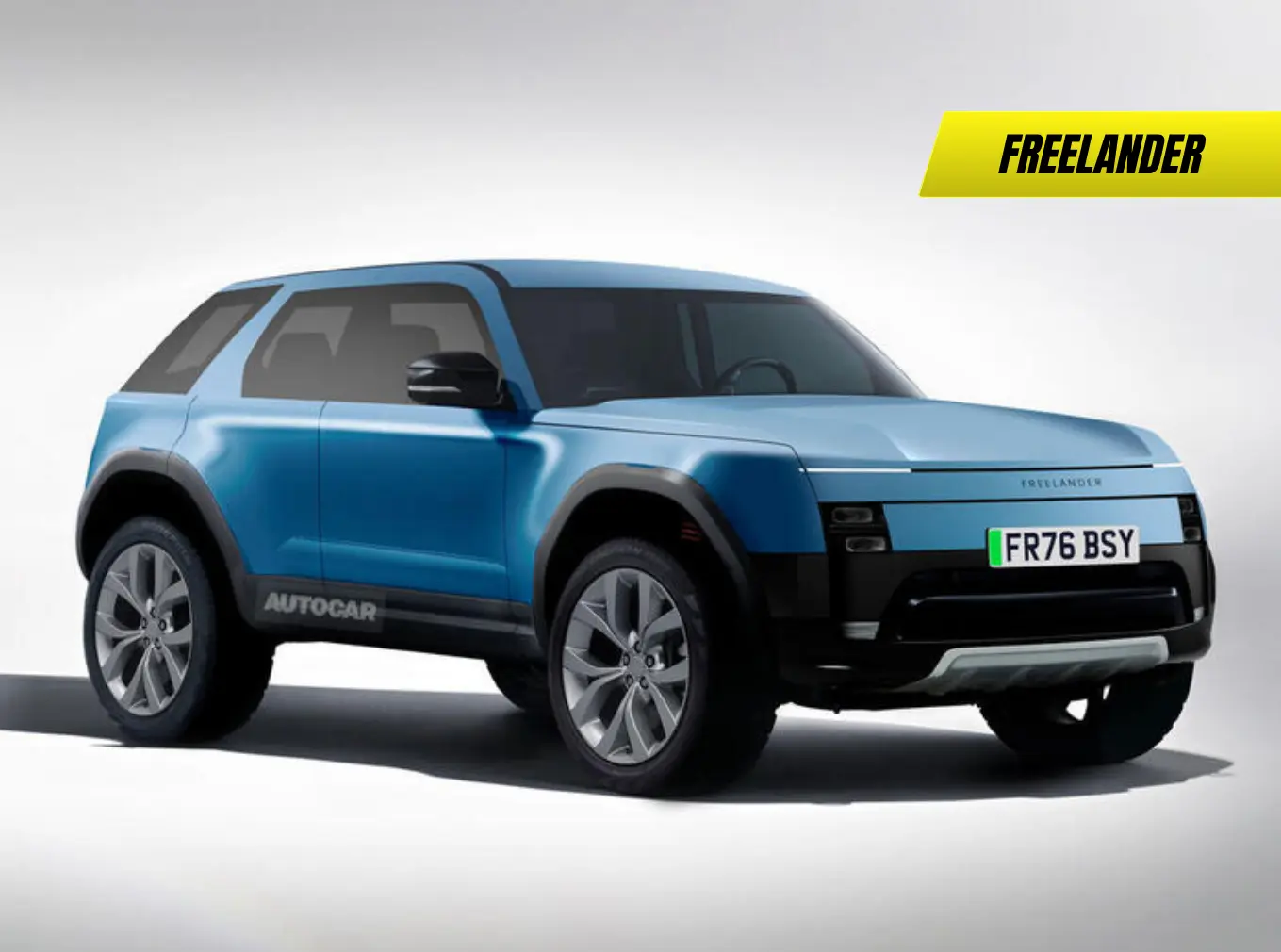
The Land Rover Freelander returns to Europe in 2027 — a full decade after production ended in 2014 — as a plug-in hybrid and electric SUV built in China through a new strategic partnership between JLR and Chery Automobile, carrying Land Rover design language and a starting price expected around £40,000–£45,000.
The Land Rover Freelander was one of the defining vehicles of 1990s and 2000s British motoring — the compact SUV that made Land Rover accessible to a broader audience without sacrificing the brand’s off-road credentials. Built at Solihull from 1997 to 2014 and replaced by the Discovery Sport, the Freelander sold over 1.7 million units globally — making it one of the UK’s best-loved 4x4s of any generation. Its return in 2027 is therefore a significant cultural and commercial moment — but also a controversial one, given that the new Freelander will be manufactured in China through JLR’s joint venture with Chery Automobile, the Anhui-based manufacturer that has become one of the world’s fastest-growing OEMs. For UK buyers evaluating the new Freelander against the broader compact premium SUV market, our 20 best SUVs under £40k UK 2025 and best PHEV guide UK 2025 provide essential context.
Land Rover Freelander 2027: Key Highlights
- Nameplate revival: first Freelander since 2014 — returns as a premium compact hybrid/electric SUV
- JLR-Chery partnership: produced in China by Chery Automobile — JLR’s strategic Chinese joint venture partner
- Land Rover design: full JLR design language — recognisably Land Rover inside and out
- Powertrain options: PHEV at launch (2027), all-electric and range-extender (REx) variants to follow
- Platform: JLR-designed EMA architecture (same as Defender Sport) — optimised for electrification
- PHEV powertrain: 1.5-litre 3-cylinder petrol + 75 kW electric motor — approximately 280 hp combined
- Electric range (PHEV): approximately 70–80 km (43–50 miles) — more than sufficient for most UK daily commutes
- Full EV variant: 75–90 kWh battery — estimated 300–320 miles WLTP
- UK price (PHEV): estimated £40,000–£45,000 — significantly undercutting the Discovery Sport PHEV (£53,000+)
- UK launch: 2027 — initially PHEV only; EV version 2028
- Rivals: Range Rover Evoque PHEV (£51,475), Discovery Sport PHEV (£53,375), BMW X3 PHEV (£56,640), Volvo XC40 PHEV (£45,455)
Why China, and What This Means for UK Buyers
The decision to manufacture the new Freelander in China is driven by commercial pragmatism — JLR’s Chery partnership gives the brand access to Chery’s world-class Chinese manufacturing infrastructure, competitive cost structures and established supply chains for battery and electric powertrain components. For UK buyers, the key questions are:
Quality and reliability: Chery-built vehicles are now routinely subject to the same Euro NCAP, WVTA and UK type approval standards as UK-assembled cars. The partnership also requires JLR to maintain full quality control oversight at the Chinese factory — the same process used by BMW (China-built iX3), Volvo (Chinese-built XC40) and SAIC-MG for all European-market models.
Warranty and dealer support: The new Freelander will be sold through the standard Land Rover UK dealer network — with the same 5-year warranty as UK-built Land Rover models. All servicing, warranty claims and recalls will be handled through UK dealerships as with any other Land Rover.
Tariffs and import costs: The UK’s post-Brexit trade arrangements with China mean that Chinese-built EVs and PHEVs currently attract a 6.5% import tariff — a cost that JLR will absorb in the Freelander’s pricing strategy rather than passing directly to the consumer.
Freelander 2027 vs. Discovery Sport PHEV: The Critical Comparison
The Freelander’s most direct internal rival within the JLR family is the Discovery Sport PHEV— a car it will likely cannibalise significantly, given that the Freelander is expected to start approximately £10,000–£13,000 cheaper:
| Model | Powertrain | Electric range | Boot | 0–62 mph | UK Price (from) |
|---|---|---|---|---|---|
| Land Rover Freelander PHEV | 1.5T + 75 kW EV | 43–50 miles | ~480 litres | ~6.8 sec | ~£40,000 |
| Discovery Sport PHEV | 1.5T + 109 kW EV | 34 miles | 472 litres | 6.4 sec | £53,375 |
| Range Rover Evoque PHEV | 1.5T + 109 kW EV | 34 miles | 591 litres | 6.4 sec | £51,475 |
| BMW X3 xDrive30e | 2.0T + EV | 34 miles | 570 litres | 5.6 sec | £56,640 |
| Volvo XC40 Recharge PHEV | 1.5T + 60 kW EV | 30 miles | 452 litres | 7.3 sec | £45,455 |
At £40,000–£45,000, the Freelander PHEV undercuts every comparable premium compact PHEV SUV by a minimum of £5,000 — while matching the Discovery Sport’s electric range and interior quality. For UK company car drivers, the PHEV’s BiK rate under 50g/km CO₂ will deliver significant tax savings.
EMA Platform: The Technical Foundation
The new Freelander is built on JLR’s EMA (Electric Modular Architecture) — the same platform underpinning the upcoming Defender Sport and next-generation Range Rover Velar. EMA is specifically designed for electrification from the ground up, offering:
- 800V-ready architecture — enabling ultra-fast DC charging at up to 250 kW on the full EV variant
- Scalable battery: 70 kWh, 82 kWh and 90 kWh options — the PHEV uses a 20 kWh battery, the EV version the larger packs
- Terrain Response 3 — the latest generation of Land Rover’s world-famous all-terrain management system, with EV-specific modes for off-road electric driving
- Air suspension: standard on higher trims — adjustable ride height for off-road approach/departure angles
- Wade sensing: integrated water depth measurement — up to 600 mm wading depthconfirmed
Freelander Design: Recognisably Land Rover, Specifically Freelander
JLR has confirmed that the new Freelander will carry full Land Rover design language — the same DNA as the Defender, Range Rover and Discovery Sport — rather than being a rebadged Chery product. Key design elements:
- Land Rover front face: the rectangular lamp units, flat bonnet and upright stance of the current family
- Freelander-specific details: a deliberately more playful, less utilitarian character than the Defender — referencing the original Freelander’s approachability
- Two-box profile: shorter rear overhang than the Discovery Sport, giving the Freelander a more compact, dynamic silhouette
- Wheelarch cladding: body-coloured lower panels standard, contrast cladding optional — a visual link to the original Freelander 2’s styling
FAQ
When is the new Land Rover Freelander coming to the UK?
2027 — initially as a PHEV; the full EV variant follows in 2028.
Is the new Freelander built in the UK?
No — it is manufactured in China by Chery Automobile through JLR’s joint venture partnership.
How much will the Freelander cost?
Estimated £40,000–£45,000 for the PHEV — approximately £10,000–£13,000 cheaper than the Discovery Sport PHEV.
What is the Freelander’s electric range as a PHEV?
Approximately 43–50 miles — enough for most UK daily commutes without using the petrol engine.
Is the Freelander still capable off-road?
Yes — Terrain Response 3 and 600 mm wading depth are confirmed on the EMA platform.
How does the Freelander relate to the Defender Sport?
Both use the EMA platform — the Freelander is smaller, cheaper and PHEV-first; the Defender Sport is EV-only from launch at £40,000–£50,000.
Conclusion
The Land Rover Freelander’s return is a genuinely significant moment for British motoring — a beloved nameplate revived for the electric era with JLR design quality, a competitive PHEV powertrain and a starting price that brings premium Land Rover ownership within reach of a much wider UK audience. The Chinese manufacturing decision is commercially understandable and technically sound — EMA platform quality will be consistent regardless of production location. From my point of view, the Freelander PHEV at £40,000–£45,000 will be the most important Land Rover launch of 2027 for the UK market — it is the model that will finally replace the Discovery Sport in volume terms, attract a new generation of Land Rover buyers and demonstrate that JLR’s electrification strategy can be commercially as well as technically successful.





