
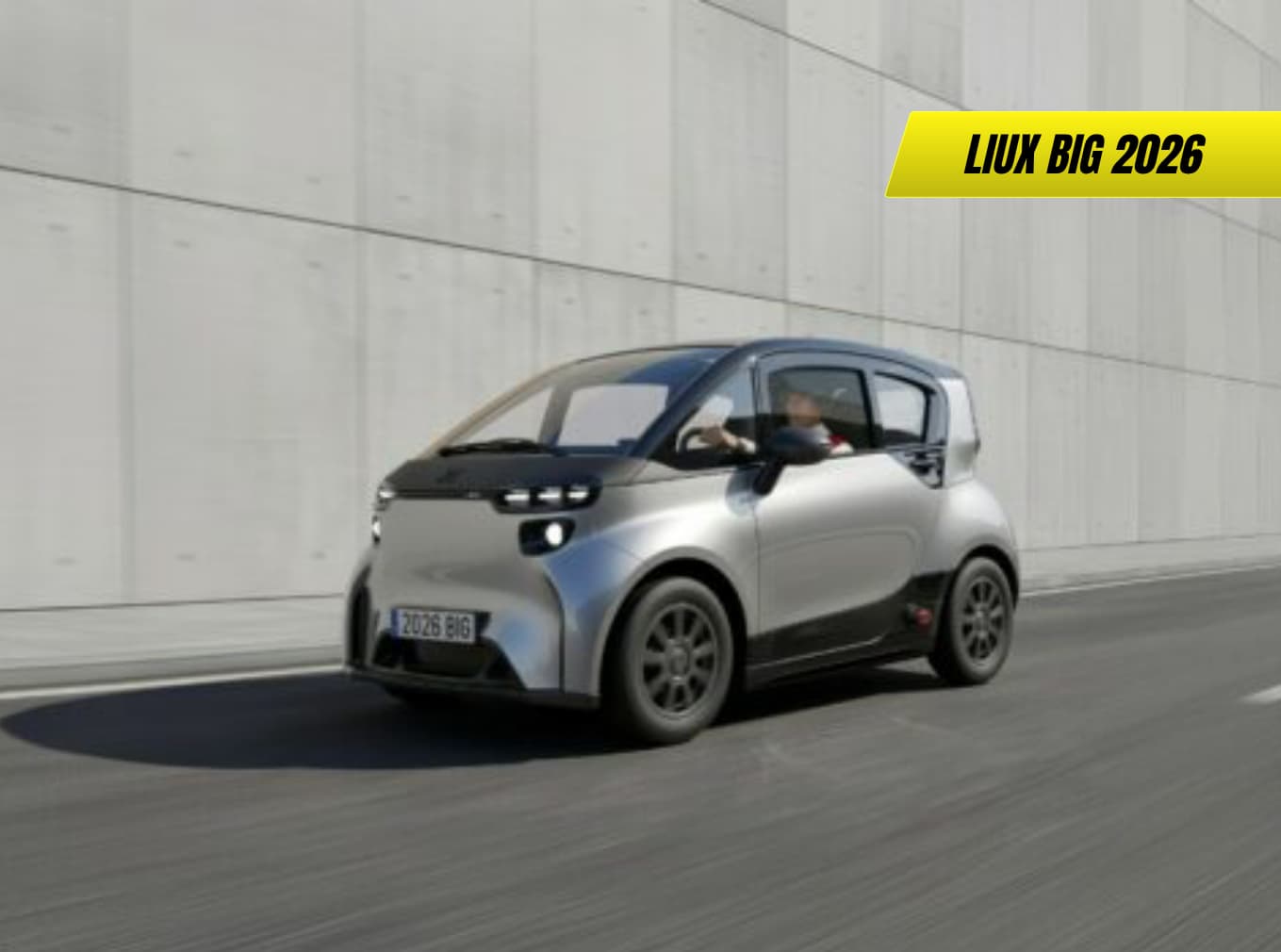
The Liux Big is a two-seat electric microcar with an upper body structure made from flax-fibre composite — weighing just 45 kg — and a range of up to 270 km (168 miles) from a 20 kWh battery. Developed by Spanish start-up Liux, it is positioned as a lightweight, sustainable urban mobility solution at an estimated price of approximately €15,000–€18,000.
Liux is a Spanish electric vehicle start-up based in Barcelona — founded with the explicit mission of producing the world’s lightest, most sustainable production microcar. The Liux Bigis the company’s first production model — a two-seat electric city car classified as a quadricycle (L7e) in European regulations, which allows it to be driven in some European markets with a lighter driving licence category. The Big’s defining innovation is its flax-fibre composite upper body structure — the entire upper half of the car, including the roof, doors and body panels, is manufactured from a woven flax-fibre reinforced polymer that is lighter than fibreglass, more sustainable than carbon fibre and fully recyclable. For UK readers comparing the Liux Big to other city EVs, our Renault 5 E-Tech guide provides context on the broader entry-level electric market.
Liux Big 2026: Key Highlights
- Category: L7e quadricycle (European classification) — compact two-seater
- Dimensions: 2.7 metres long — shorter than a Smart EQ ForTwo (2.69 m) but with a taller, more SUV-like stance
- Upper body: flax-fibre composite — the entire upper structure weighs just 45 kg, enabling exceptional weight distribution
- Motor: 35 kW peak power, 15 kW continuous — top speed electronically limited to 90 km/h (56 mph)
- 0–50 km/h: 4.6 seconds — adequate for urban use
- Battery options: 15 kWh (up to 215 km / 134 miles range) or 20 kWh (up to 270 km / 168 miles range)
- Removable batteries: both battery packs can be removed and charged at home via a standard household socket
- Charging: 3.3 kW single-phase — 4 hours (15 kWh) or 6 hours (20 kWh)
- Weight: approximately 450 kg — exceptionally light for an EV of any type
- Seating: two seats — driver and one passenger
- Estimated price: approximately €15,000–€18,000 in France; UK pricing TBC
- French market: available from mid-2026 — UK availability not yet confirmed
Flax Fibre: The Material That Makes the Big Different
The Liux Big’s use of flax-fibre composite is not a marketing flourish — it is a fundamental engineering choice that shapes every aspect of the car’s character:
What is flax-fibre composite?
Flax is a natural plant fibre — the same material used to make linen textile. When woven into sheets and impregnated with a bio-resin binder, it forms a structural composite that is:
- Lighter than fibreglass by approximately 15%
- More sustainable than carbon fibre — flax is a natural crop, sequestering CO₂ during growth; carbon fibre requires energy-intensive manufacturing and is currently non-recyclable
- Fully recyclable — at end of life, the flax-fibre composite can be separated and returned to natural fibre processing
- Good vibration damping — flax has better natural vibration absorption than glass or carbon fibre, improving NVH (noise, vibration and harshness) in the cabin
The 45 kg upper body structure is the practical result — compared to approximately 70–90 kg for an equivalent fibreglass or steel upper body, saving up to 45 kg of total vehicle weight. For a car targeting a total weight of ~450 kg, this saving is enormous — improving range, performance and tyre wear simultaneously.
Battery: Removable Packs — No Public Charging Required
The Liux Big’s removable battery system is its most practical urban feature — the 15 kWh and 20 kWh packs can be physically detached from the car and carried to a standard household socket for charging. This eliminates the need for:
- A home wallbox installation
- A private parking space with charging access
- Public rapid charging — the Big’s 90 km/h top speed and 270 km range mean that on-route rapid charging is never necessary for urban use
The removable pack system also allows battery swapping — a model Liux is exploring for its retail network, enabling full-battery-level restoration in under five minutes at a Liux partner location.
Liux Big vs. Urban Electric Microcar Rivals
| Model | Length | Range | Top Speed | Battery | Price (from) |
|---|---|---|---|---|---|
| Liux Big (20 kWh) | 2.7 m | 270 km (168 miles) | 90 km/h | 20 kWh removable | ~€18,000 |
| Citroën Ami | 2.41 m | 75 km (47 miles) | 45 km/h | 5.5 kWh | €8,490 |
| Renault Duo | 2.43 m | 80 km (50 miles) | 45 km/h | 5.5 kWh | €9,490 |
| Microlino 2.0 | 2.52 m | 228 km (142 miles) | 90 km/h | 14 kWh | €19,900 |
| Smart EQ ForTwo | 2.69 m | 155 km (96 miles) | 130 km/h | 16.7 kWh | £22,450 |
The Liux Big’s 270 km range at 90 km/h top speed positions it uniquely — it has far more range than the Citroën Ami or Renault Duo, matches the Microlino’s performance envelope but exceeds its range, and is significantly cheaper than the Smart EQ ForTwo.
FAQ
What is the Liux Big?
A two-seat electric microcar with a flax-fibre composite upper body — 270 km range, 90 km/h top speed, removable 20 kWh battery.
What makes the flax-fibre body unique?
The entire upper body structure weighs just 45 kg — lighter than fibreglass, more sustainable than carbon fibre and fully recyclable.
Can the Liux Big be charged at home without a wallbox?
Yes — the removable battery can be taken indoors and charged from a standard household socket in 6 hours.
Is the Liux Big available in the UK?
Not yet confirmed — the French market launch is mid-2026; UK availability is under evaluation.
How does it compare to the Citroën Ami?
The Liux Big has 3.6× more range (270 km vs 75 km), double the top speed (90 km/h vs 45 km/h) but approximately double the price.
Conclusion
The Liux Big is one of the most technically interesting city EVs ever conceived — not because of its powertrain specifications, which are modest by intention, but because of its flax-fibre composite body structure, which represents a genuinely new approach to sustainable lightweight automotive construction. The 45 kg upper body, 270 km range and removable battery combine to create the most practical sub-3-metre electric city car available. From my point of view, the Liux Big is the city microcar that UK urban dwellers without home charging access have been waiting for — if Liux confirms UK availability, it will be a genuinely compelling proposition for central London and other city-centre markets where public charging infrastructure remains patchy.





