
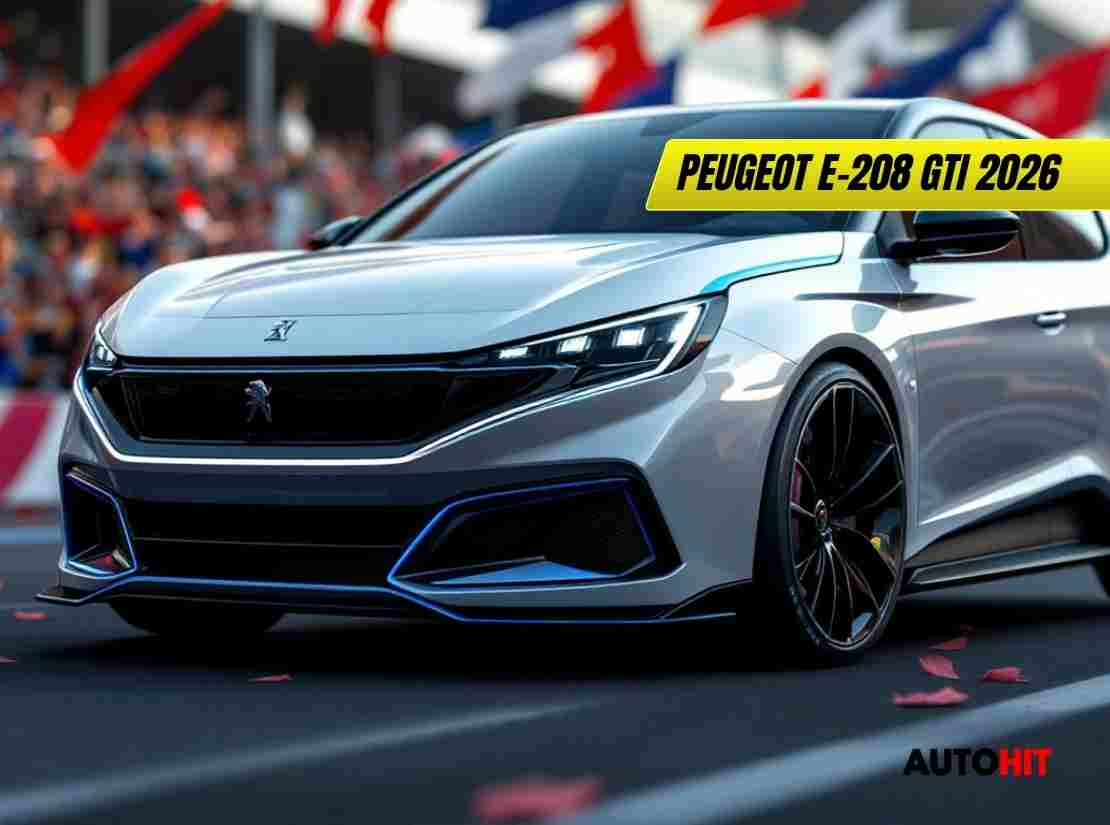
Peugeot e-208 GTI 2026 debuts at Le Mans with 280bhp electric power, red styling cues, and hot hatch heritage. The Alpine A290’s fiercest French rival arrives.
The automotive world is about to witness something genuinely special. On 14-15 June 2025, alongside Peugeot’s 9X8 hypercar competing for outright victory, the brand will unveil its most significant performance car in years: the all-electric e-208 GTI. After a seven-year absence, the legendary GTI badge returns to Peugeot’s lineup – and according to our analysis at AutoHit, this could be the electric hot hatch that finally makes EVs exciting for driving enthusiasts.
The timing couldn’t be more symbolic. Le Mans represents the pinnacle of motorsport innovation, where manufacturers push technology to its absolute limits. By choosing this hallowed ground for the e-208 GTI’s debut, Peugeot is making a bold statement: electric performance isn’t about sacrifice – it’s about evolution.
With electric hot hatches becoming increasingly competitive, the French manufacturer is reviving its most celebrated performance badge for the EV era. The e-208 GTI will pack 280bhp of instant electric torque, aggressive styling upgrades, and a heritage that stretches back to the iconic 205 GTI of the 1980s.
Key Highlights: Why the e-208 GTI Matters
• 280bhp Electric Power: Shared with Alfa Romeo Junior Veloce and Lancia Ypsilon HF using proven Stellantis technology • Le Mans Heritage Launch: World debut at the legendary 24 Hours of Le Mans in June 2025 • Classic GTI Styling: Red accents, aggressive bumpers, and exclusive badging honouring Peugeot’s hot hatch legacy • Short Production Run: Limited availability from early 2026 before next-generation 208 arrives in 2027 • Alpine A290 Rival: Direct competitor to France’s other electric hot hatch sensation • UK Market Ready: Expected pricing around £38,000-£42,000 based on current e-208 positioning
Design Philosophy: Electric Evolution of GTI Heritage
The e-208 GTI represents more than just an electric powertrain swap – it’s a carefully considered evolution of Peugeot’s hot hatch DNA. Having examined the teaser images and insider information, this car promises to honour its heritage while embracing electric performance.
Exterior Aggression
Expect the classic GTI visual treatment that made the 205 and 206 so memorable. Red accents will feature prominently across the front grille, wheel centres, and badging – a direct homage to the original GTI identity. The front bumper receives more pronounced openings and a functional splitter, while the side skirts and rear diffuser emphasise the car’s sporting intentions.
The stance should be noticeably more aggressive than the standard e-208, with lowered suspension and larger wheels – likely 18-inch alloys to accommodate upgraded brakes. LED lighting signatures will incorporate the distinctive “triple-claw” design that’s become synonymous with modern Peugeot styling.
Interior Focus
Inside, expect supportive bucket seats with red stitching and GTI-specific trim pieces. The digital instrument cluster will likely feature sport-specific displays for power delivery, battery temperature, and lap timing functions. Peugeot may introduce gamification elements that appeal to younger digital natives – think g-force meters and performance data logging.
The controversial small steering wheel and high-mounted instrument cluster from the standard e-208 will carry over, though GTI-specific tuning should enhance the overall driving experience.
Revolutionary Electric Powertrain
The e-208 GTI’s most significant development lies under its bonnet – or rather, in its sophisticated electric drivetrain that shares components with Stellantis’ most powerful small EVs.
280bhp Emotors System
The heart of the e-208 GTI is the proven Emotors M4 electric motor producing 280bhp, already successfully deployed in the Abarth 600e, Alfa Romeo Junior Veloce, and Lancia Ypsilon HF. This front-mounted unit delivers instant torque that traditional hot hatches simply cannot match.
While official performance figures remain unconfirmed, expect 0-62mph in around 5.8-6.2 seconds – significantly faster than the current Alpine A290’s 6.4-second time. More importantly, the electric torque delivery provides crushing mid-range acceleration that makes overtaking effortless and city driving surprisingly exhilarating.
Battery and Range Considerations
The e-208 GTI faces the same packaging constraints as the standard e-208, likely limiting it to the current car’s 50kWh battery pack. This represents a challenge for Peugeot’s engineers – how do you extract maximum performance while maintaining reasonable range?
Expect real-world range around 180-200 miles in mixed driving, dropping to 120-150 miles under enthusiastic use. While this isn’t class-leading, it reflects the compromises inherent in adapting an existing platform for high-performance electric duty.
Fast charging capability should match the standard e-208’s 100kW maximum, allowing 20-80% charging in approximately 25 minutes at rapid charging stations.
Performance Tuning
Beyond raw power, the e-208 GTI will benefit from comprehensive chassis tuning. Expect recalibrated suspension with lower, stiffer springs, upgraded dampers, and potentially a limited-slip differential to manage the instant torque delivery.
The steering calibration should provide sharper responses than the standard car, while the brake system will likely receive upgrades to handle the additional performance and manage regenerative braking integration.
UK Market Analysis: Pricing and Competition
Expected UK Pricing Strategy
Based on current e-208 pricing and the performance upgrades involved, expect the GTI to command a significant premium over standard models. With the current e-208 GT starting around £35,000, the GTI will likely launch between £38,000-£42,000.
This positioning places it directly against the Alpine A290 (from £36,500) while undercutting premium alternatives like the forthcoming Mini John Cooper Works Electric. The pricing strategy reflects Peugeot’s need to balance exclusivity with accessibility – staying true to GTI tradition.
Competitive Landscape Analysis
The e-208 GTI enters a rapidly expanding electric hot hatch segment, facing both French and international competition.
Detailed Market Comparison
| Specification | Peugeot e-208 GTI | Alpine A290 | Mini JCW Electric | Abarth 600e |
|---|---|---|---|---|
| Power Output | 280bhp | 218bhp | ~300bhp (Est.) | 280bhp |
| Torque | 345Nm (Est.) | 300Nm | TBC | 345Nm |
| 0-62mph | ~6.0sec (Est.) | 6.4sec | ~5.5sec (Est.) | 5.85sec |
| Range (WLTP) | ~200 miles (Est.) | 236 miles | TBC | 207 miles |
| Price (UK) | £38-42k (Est.) | £36,500 | £45k+ (Est.) | £37,500 |
| Platform | CMP | CMF-B | UKL | CMP |
| Launch Date | Q1 2026 | Available now | 2026 | Available now |
| Our Rating | TBC | ★★★★☆ | TBC | ★★★☆☆ |
Our Take: The e-208 GTI’s 280bhp advantage over the Alpine A290 could prove decisive, though the French rival’s superior range and current availability give it first-mover advantage. Success will depend entirely on dynamic execution.
Strategic Context: The Carlos Tavares Effect
The e-208 GTI’s resurrection story reveals fascinating insights into Stellantis’ changing priorities. Originally planned as the “208 PSE” (Peugeot Sport Engineered), the project was cancelled in 2021 under former CEO Carlos Tavares’ cost-cutting regime.
New Leadership, New Priorities
The departure of Tavares and arrival of new Peugeot CEO Alain Favey has transformed the brand’s performance strategy. Favey explicitly confirmed the GTI revival, stating his intention to “nurture driving sensations” in Peugeot products – a marked departure from the previous purely commercial focus.
This strategic shift recognises that performance variants serve as crucial brand image builders, attracting younger customers and reinforcing sporting heritage. The GTI badge carries enormous emotional weight for enthusiasts who remember the 205 and 206’s dominance of European hot hatch sales.
Platform Sharing Benefits
The e-208 GTI benefits enormously from Stellantis’ platform sharing strategy. The CMP architecture already supports the 280bhp motor in other applications, dramatically reducing development costs and accelerating the timeline from concept to production.
This component sharing explains how Peugeot can offer such a short development cycle – the underlying technology is proven, requiring only integration and calibration work specific to the 208’s characteristics.
Timeline and Production Reality
Limited Production Window
The e-208 GTI faces an unusually compressed production timeline. Sales begin in early 2026, but the current-generation 208 ends production in June 2027 when the all-new model arrives on the STLA Small platform.
This creates a brief 18-month sales window, likely limiting total production to 5,000-8,000 units globally. For UK buyers, this scarcity could prove both frustrating and beneficial – frustrating for availability, but beneficial for residual values.
Production Timeline Overview
| Phase | Timeline | Key Events |
|---|---|---|
| World Debut | June 2025 | Le Mans 24 Hours presentation |
| UK Reveal | Q3 2025 | Specification and pricing confirmation |
| Order Books Open | Q4 2025 | Limited allocation for UK market |
| First Deliveries | Q1 2026 | Initial customer cars arrive |
| Production Ends | Q2 2027 | Current generation discontinued |
| Next-Gen GTI | 2028 | STLA Small platform successor |
Le Mans Debut Strategy
The choice of Le Mans for the world premiere reflects sophisticated marketing psychology. The 24 Hours represents the ultimate expression of automotive performance and innovation – exactly the values Peugeot wants associated with the GTI revival.
Peugeot will also reserve special parking areas for classic GTI owners’ clubs, creating a visual timeline from the original 205 GTI through to the electric future. This emotional connection between past and present could prove crucial for convincing traditionalists about electric performance.
Real-World Considerations for UK Buyers
Running Costs and Practicality
The e-208 GTI should deliver excellent cost efficiency for performance car ownership. Electric vehicles benefit from significantly lower BiK rates, making the GTI attractive for company car drivers seeking excitement without tax penalties.
Daily running costs will depend heavily on charging habits. Home charging on overnight tariffs should cost around 6-8p per mile, while rapid charging increases this to 15-20p per mile. Even rapid charging represents excellent value compared to premium petrol costs for equivalent performance.
Insurance and Servicing
The 280bhp power output will likely place the e-208 GTI in insurance group 35-40, reflecting both the performance and the car’s likely appeal to younger drivers. However, the electric drivetrain’s inherent safety systems and lack of theft-prone components should help moderate premiums.
Servicing requirements will be minimal compared to traditional hot hatches. No oil changes, spark plugs, or exhaust system maintenance – just brake fluid, cabin filters, and software updates. This represents a genuine advantage for TCO-conscious buyers.
Charging Infrastructure Reality
UK rapid charging infrastructure continues expanding rapidly, but the e-208 GTI’s limited range requires planning for longer journeys. The car works best as a second vehicle for enthusiasts or primary transport for urban and suburban driving.
For weekend track days or country road exploring, the 200-mile range provides adequate flexibility, though route planning around charging stops becomes essential for extended drives.
Frequently Asked Questions
Q: How does the e-208 GTI’s 280bhp compare to classic petrol GTI models?
A: The 280bhp represents a massive increase over historical GTI models – the original 205 GTI produced just 130bhp, while the final 208 GTI managed 208bhp. However, raw power figures don’t tell the whole story. Electric motors deliver maximum torque instantly from standstill, providing acceleration characteristics that traditional engines simply cannot match. The instant throttle response and seamless power delivery create a completely different but equally exciting driving experience.
Q: Will the limited 18-month production run make the e-208 GTI a future classic?
A: Potentially, yes. The combination of iconic GTI heritage, first electric application of the badge, and extremely limited production numbers could create significant collector appeal. However, remember that EV collectability remains largely untested – battery degradation and software obsolescence present unique challenges. Our advice is to buy for driving enjoyment rather than investment potential, though rarity should support strong residual values in the medium term.
Q: How does the 200-mile range work for track day enthusiasts?
A: Track driving will significantly reduce range – expect 80-120 miles depending on circuit layout and driving intensity. This limits track day accessibility unless circuits offer rapid charging facilities. Most UK circuits lack adequate charging infrastructure currently, making the e-208 GTI better suited to road-focused enthusiasts rather than track devotees. Weekend backroad exploring remains perfectly feasible with careful route planning.
Q: Is the e-208 GTI better value than the Alpine A290?
A: This depends on your priorities. The e-208 GTI offers significantly more power (280bhp vs 218bhp) and likely superior straight-line performance for similar money. However, the Alpine provides better range (236 vs ~200 miles), immediate availability, and arguably more exclusive appeal. The Alpine also benefits from bespoke development rather than the e-208’s adaptation approach. For pure performance per pound, the Peugeot wins, but the Alpine offers a more complete package.
Q: What happens to GTI buyers when the current 208 ends production in 2027?
A: Peugeot has confirmed that the next-generation 208 (arriving 2027 on STLA Small platform) will also receive a GTI variant around 2028. The new car should offer better packaging, improved range, and potentially even more power. Current e-208 GTI buyers will benefit from exclusivity – they’ll own the first and only electric GTI until the next generation arrives. Support and parts availability should continue through Peugeot’s standard warranty and service network.
Q: Can the e-208 GTI’s small steering wheel work for taller drivers?
A: This remains the e-208’s most divisive feature. The small steering wheel and high-mounted instrument cluster suit drivers up to about 6’2″, but taller individuals often find the driving position compromised. Unlike wheel and pedal adjustments you can make at home, this requires a test drive to determine compatibility. For enthusiast drivers, the precise steering feel compensates for ergonomic quirks, but comfort-focused buyers might prefer alternatives like the Alpine A290’s conventional layout.
Q: How will dealers handle the limited allocation for UK buyers?
A: Expect a combination of customer deposit systems and dealer allocation based on historical GTI sales performance. Peugeot will likely prioritise established performance car customers and may require non-refundable deposits well before delivery. Some dealers might bundle additional accessories or servicing packages to manage demand. Early expressions of interest will be crucial – contact your local Peugeot dealer as soon as order books open to join waiting lists.
Final Verdict: Electric Thunder Strikes Twice
After analysing all available information about the Peugeot e-208 GTI 2026, we believe this represents one of the most significant electric performance car launches in recent memory. Not because it breaks entirely new ground technically, but because it successfully transplants the soul of traditional hot hatch excitement into the electric era.
The combination of 280bhp instant torque, genuine GTI heritage, and Le Mans debut positioning creates a uniquely compelling proposition. While the limited production run and compressed timeline present challenges, they also ensure exclusivity that traditional mass-market hot hatches cannot offer.
What Excites Us:
- 280bhp electric power delivering unmatched instant acceleration
- Authentic GTI styling cues connecting past and future
- Le Mans debut showcasing Peugeot’s performance commitment
- Competitive pricing against premium electric alternatives
- Limited production ensuring collector appeal
- Platform sharing reducing development risk
What Concerns Us:
- Restricted 200-mile range limiting touring capability
- Compressed 18-month production window
- Unproven electric hot hatch resale market
- Traditional GTI buyers’ EV acceptance uncertainty
- Charging infrastructure requirements for track use
The Reality: The e-208 GTI could be the electric hot hatch that finally convinces petrol enthusiasts to embrace EV performance. The instant torque delivery, combined with proper chassis tuning and authentic GTI heritage, creates something genuinely special in the emerging electric performance segment.
Success will depend entirely on dynamic execution – whether Peugeot’s engineers can translate the raw 280bhp into engaging, controllable performance that honours the GTI legacy. Early signs suggest they understand the challenge, but only driving experience will confirm whether electric thunder truly can replace petrol fire.
For UK enthusiasts who’ve been waiting for an electric hot hatch that respects traditional values while embracing future technology, the e-208 GTI represents exactly that opportunity. Whether it can match the Alpine A290’s growing reputation or establish its own electric legend remains to be seen, but the foundations look remarkably promising.
In a world of increasingly homogeneous electric crossovers, the e-208 GTI promises to be beautifully, defiantly different. And that might just make it the most important French hot hatch since the original 205 GTI changed everything four decades ago.





