
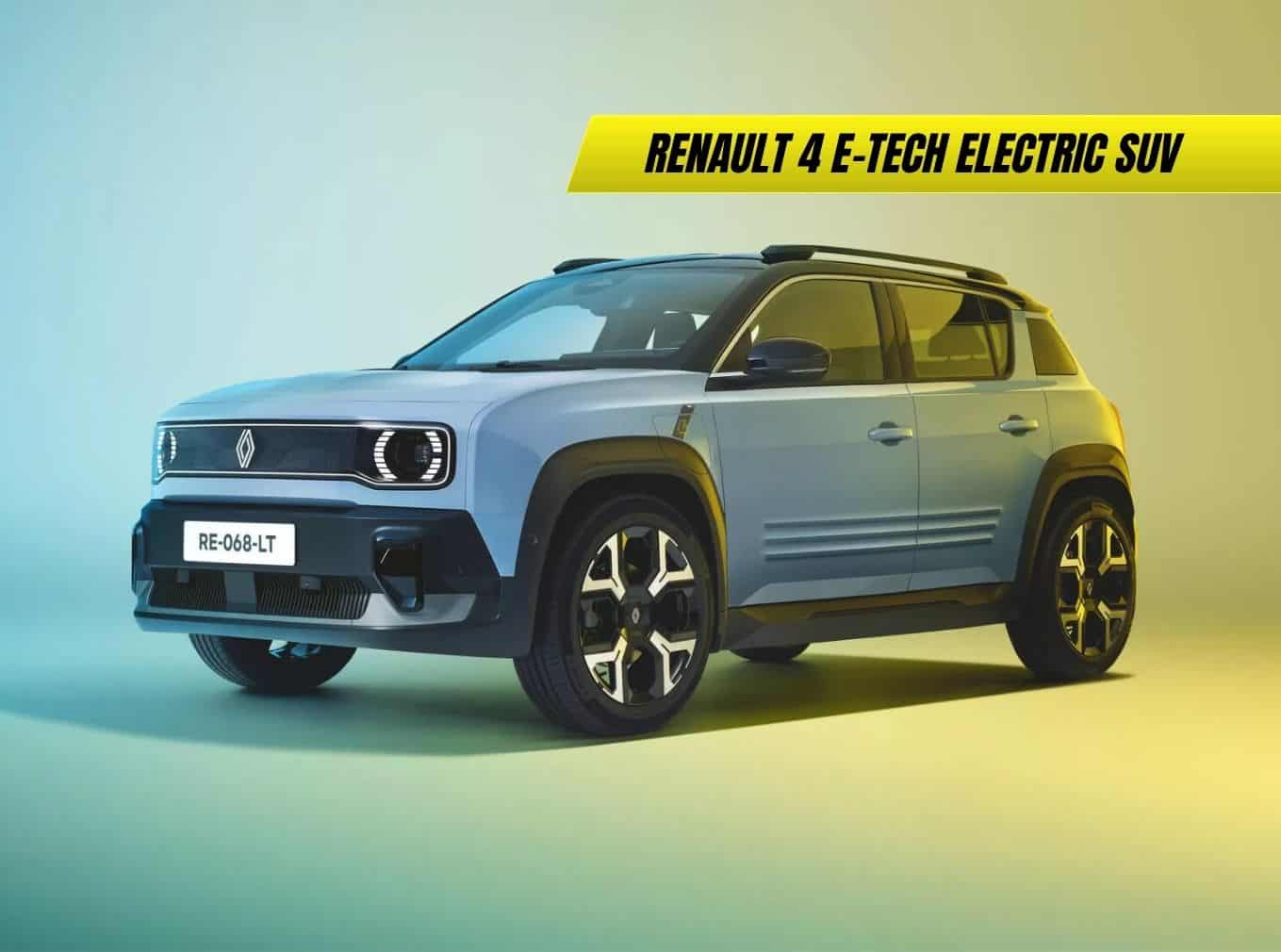
Renault 4 E-Tech electric SUV UK review. Pricing from £26,995, 247-mile range, specifications and market demand analysis for British buyers.
The Renault 4 E-Tech has emerged as one of 2025’s most compelling electric SUV launches, capturing significant attention from UK buyers seeking affordable, practical zero-emission transport. This retro-inspired electric crossover successfully combines nostalgic design cues with modern technology, offering a compelling alternative to established competitors whilst maintaining Renault’s reputation for value and practicality. The model’s early market reception suggests strong demand that could influence used car values as deliveries commence.
Key Points: • UK pricing starts from £26,995 for Evolution trim, undercutting most electric SUV rivals • 52kWh battery delivers up to 247 miles WLTP range with 150hp electric motor • Strong early demand through R-Pass priority ordering system before general sales • Based on proven AmpR Small platform shared with successful Renault 5 E-Tech • Retro design elements honour original 1960s Renault 4 whilst offering modern SUV practicality • Market positioning targets gap between supermini and premium electric SUV segments
UK Market Launch and Pricing Strategy
Renault’s strategy for the 4 E-Tech UK launch demonstrates careful market positioning designed to maximise appeal whilst maintaining competitive advantage. Orders opened initially for R-Pass customers in July 2025, with general public sales beginning later that month – a priority system that generated considerable early interest among UK buyers.
The three-tier trim structure starts with Evolution at £26,995, progressing through Techno at £28,995 to range-topping Iconic at £30,995. This pricing strategy positions the 4 E-Tech as one of the most affordable electric SUVs in the UK market, significantly undercutting rivals like the Jeep Avenger Electric (£29,999) and Kia EV3 (£33,005).
From my perspective, this aggressive pricing reflects Renault’s confidence in the model’s appeal and demonstrates the cost advantages of the AmpR Small platform shared with the successful Renault 5. The strategy appears designed to capture maximum market share whilst electric SUV adoption accelerates among UK consumers.
| Trim Level | UK Price | Key Features | Target Market |
|---|---|---|---|
| Evolution | £26,995 | 18″ wheels, climate control, 10″ touchscreen | Value-conscious buyers |
| Techno | £28,995 | Google services, adaptive cruise, wireless charging | Tech-focused users |
| Iconic | £30,995 | Heated seats/wheel, power tailgate, premium trim | Premium buyers |
The entry-level Evolution trim includes generous standard equipment that would typically require upgrades on competitor vehicles. This comprehensive specification helps justify the value proposition whilst maintaining attractive pricing for cost-conscious UK buyers.
Technical Specifications and Performance
The 4 E-Tech employs a single front-mounted electric motor producing 150hp and 245Nm torque, enabling 0-62mph acceleration in 8.2 seconds. This performance level suits the model’s practical focus whilst providing adequate capability for UK driving conditions from city streets to motorway cruising.
The 52kWh NMC lithium-ion battery provides up to 247 miles WLTP range depending on trim level and wheel size selection. This range capability addresses the primary concern among UK electric vehicle buyers whilst matching or exceeding many competitors in the compact SUV segment.
Charging capabilities include 100kW DC rapid charging enabling 15-80% charging in approximately 30 minutes at compatible charging stations. The onboard 11kW AC charger completes 0-100% charging in 4 hours 51 minutes using home or public AC charging infrastructure – convenient for typical UK ownership patterns.
Vehicle-to-load (V2L) capability comes standard across the range, enabling the battery to power external electrical devices. This feature adds practical utility whilst future-proofing the vehicle for emerging smart grid integration technologies that could benefit UK owners.
Design Heritage and Modern Appeal
Renault’s designers successfully balanced heritage appreciation with contemporary functionality, creating a vehicle that honours the original 4’s character whilst meeting modern safety and practicality requirements. The illuminated front grille, circular LED headlights, and distinctive rear window shape provide immediate visual connection to the 1960s predecessor.
The boxy, upright proportions maximise interior space within compact external dimensions – crucial for UK urban environments where parking space remains at premium. At 4.14 metres long, the 4 E-Tech occupies similar road space to traditional superminis whilst offering SUV-style driving position and practicality.
Interior design emphasises simplicity and functionality through physical climate controls, intuitive touchscreen interface, and thoughtful storage solutions. The approach reflects Renault’s understanding that UK buyers value ease of use over complex technology for its own sake.
Optional features include a retractable electric canvas roof available on Techno and Iconic trims from spring 2026, recreating one of the original model’s most distinctive features in modern form. This option could prove particularly appealing to UK buyers seeking open-air driving experiences without full convertible compromises.
Market Competition and Positioning
The 4 E-Tech enters a rapidly expanding UK electric SUV segment where demand consistently exceeds supply across most price points. Primary competitors include the Ford Puma Gen-E, Vauxhall Mokka Electric, Jeep Avenger Electric, and various emerging Chinese alternatives.
Against established European competitors, the Renault offers competitive pricing whilst matching or exceeding specification levels. The relationship with the successful Renault 5 provides technological credibility whilst the SUV format addresses practical requirements that pure hatchbacks cannot satisfy.
Competitive Analysis:
The pricing strategy particularly targets buyers considering premium alternatives like the MINI Countryman Electric or Volvo EX30, offering similar space and technology at significantly lower prices. This positioning could prove particularly effective among UK buyers increasingly conscious of value for money in current economic conditions.
Compared to emerging Chinese SUV alternatives, the Renault offers established brand credibility, comprehensive dealer network, and proven reliability expectations that many UK buyers value over pure specification advantages.
Practicality and Family Appeal
Interior space represents a key advantage over supermini alternatives, with notably improved rear passenger accommodation compared to the Renault 5. While not class-leading for rear space, the 4 E-Tech provides adequate room for average-sized adults whilst excelling in cargo capacity and accessibility.
Boot space measures 420 litres with additional 36-litre underfloor storage, exceeding many direct competitors whilst offering particularly easy loading through wide, low aperture. The removable underfloor bin provides versatile storage options whilst typically housing charging cables and emergency equipment.
Front seat comfort impresses across the range, with good adjustment range and supportive design suitable for longer journeys. The driving position balances SUV-style elevation with car-like engagement, appealing to UK buyers seeking practical benefits without SUV penalties.
Storage solutions throughout the cabin reflect practical design priorities, with numerous cubbies, cup holders, and device charging points positioned for real-world convenience. These details often influence long-term satisfaction more than headline specifications.
Technology Integration and User Experience
The infotainment system centres around a 10.1-inch touchscreen featuring Google-based software on Techno and Iconic trims, with wireless Apple CarPlay and Android Auto compatibility across the range. The interface prioritises simplicity over complexity, reflecting understanding of diverse UK user preferences.
Physical climate controls represent a significant advantage over touchscreen-only competitors, enabling quick adjustments without menu navigation whilst driving. This approach particularly appeals to UK buyers who often criticise overly complex digital interfaces in modern vehicles.
Driver assistance technologies include standard autonomous emergency braking, lane keeping assistance, and traffic sign recognition, with adaptive cruise control available on Techno and Iconic trims. The systems calibration prioritises unobtrusive operation over aggressive intervention.
A notable feature allows customisation of safety system preferences, enabling drivers to configure desired settings accessible through a single button press. This approach addresses common UK buyer frustrations with mandatory safety systems whilst maintaining regulatory compliance.
Environmental Impact and Sustainability
Beyond zero local emissions, the 4 E-Tech incorporates sustainable materials and manufacturing processes designed to minimise environmental impact throughout the vehicle lifecycle. Renault’s commitment to circular economy principles influences design decisions from material selection to end-of-life recycling.
UK buyers increasingly consider environmental factors beyond simple emissions figures, evaluating manufacturing energy sources, material origins, and disposal arrangements. Renault’s transparent approach to sustainability reporting provides information needed for informed environmental decisions.
The V2L capability enables the vehicle to support renewable energy integration at domestic level, potentially powering homes during peak demand periods or power outages. This functionality becomes increasingly valuable as UK smart grid infrastructure develops.
Efficient design minimises battery size requirements whilst maintaining practical range, reducing environmental impact compared to alternatives that prioritise maximum range over optimal efficiency. This approach aligns with growing understanding of lifecycle environmental considerations.
Used Car Market Implications
Early market indicators suggest strong demand that could influence used car values as deliveries commence. The combination of competitive pricing, comprehensive specification, and Renault’s reliability reputation creates conditions favourable for value retention.
Limited initial production capacity could create waiting lists that drive interest in early used examples, particularly well-specified Techno and Iconic variants. UK buyers’ preference for immediate availability often supports premium pricing for desirable used alternatives.
The relationship with other successful Renault electric models provides positive precedent for residual value performance. The Renault 5 E-Tech’s strong reception suggests platform credibility that could benefit the 4 E-Tech in used markets.
However, expanding electric vehicle choice and improving new car availability may moderate used car premiums compared to early electric vehicle markets. UK buyers increasingly have multiple attractive alternatives, reducing desperation purchasing that drove early EV used car prices.
Financing and Ownership Considerations
Renault offers comprehensive financing options including 48-month 5.9% APR PCP deals with deposits from £500, plus two-year 0% APR arrangements requiring higher deposits but enabling £210 monthly payments. These options make the 4 E-Tech accessible to broader UK market segments.
Company car tax benefits remain substantial for electric vehicles, with 2% benefit-in-kind rates making the 4 E-Tech extremely attractive for business users. These advantages could prove decisive compared to hybrid or petrol alternatives in similar price ranges.
Insurance costs should remain reasonable given the model’s modest performance, comprehensive safety equipment, and Renault’s established UK presence. Early indicators suggest groupings comparable to similar electric SUVs rather than premium positioning.
Government grants for workplace and residential charging installation continue supporting electric vehicle adoption, potentially reducing total ownership costs for UK buyers installing home charging solutions.
Future Market Prospects
The 4 E-Tech’s success could influence Renault’s broader UK electric vehicle strategy, potentially accelerating development of additional retro-inspired models or expanding the AmpR Small platform family. Strong reception validates the approach of combining heritage appeal with modern electric technology.
Market demand will likely influence production allocation, with popular markets receiving priority for delivery slots. UK interest levels could affect availability compared to other European markets where Renault traditionally focuses sales efforts.
Future updates may include additional battery options, enhanced technology features, or performance variants that expand market appeal. The platform’s flexibility enables various configurations without fundamental engineering changes.
Competition will intensify as manufacturers launch additional affordable electric SUVs, but first-mover advantage in the retro-inspired segment could provide sustained differentiation that benefits long-term market position.
#### Frequently Asked Questions
How much does the Renault 4 E-Tech cost in the UK?
UK pricing starts from £26,995 for Evolution trim, rising to £28,995 for Techno and £30,995 for range-topping Iconic. This positioning makes it one of the most affordable electric SUVs available to British buyers.
What is the real-world range of the Renault 4 E-Tech?
The 52kWh battery provides up to 247 miles WLTP range depending on trim and wheel size. Real-world range will vary based on driving conditions, weather, and usage patterns, typically achieving 200+ miles in mixed UK driving.
How long does the Renault 4 E-Tech take to charge?
DC rapid charging at 100kW enables 15-80% charging in approximately 30 minutes. Home charging using the 11kW onboard charger completes 0-100% charging in 4 hours 51 minutes on suitable AC supply.
When will the Renault 4 E-Tech be available for delivery in the UK?
Deliveries began in late 2025 following the July order opening. Current delivery times vary based on trim level and specification, with popular configurations potentially facing longer waiting periods.
How does the Renault 4 E-Tech compare to the Renault 5 E-Tech?
The 4 E-Tech shares the same platform and powertrain as the 5 E-Tech but offers SUV styling, higher driving position, and more practical cargo space. It’s approximately 12cm longer whilst maintaining similar performance characteristics.
What warranty does the Renault 4 E-Tech come with?
Standard warranty covers three years or 60,000 miles for the vehicle, with eight years or 100,000 miles for the battery. This provision aligns with industry standards whilst providing confidence for long-term ownership.
Is the electric canvas roof available from launch?
The retractable electric canvas roof will be available as an option on Techno and Iconic trims from spring 2026. This feature recreates one of the original Renault 4’s most distinctive characteristics in modern form.
The Electric Revolution Continues
The Renault 4 E-Tech represents another successful chapter in the French manufacturer’s electric vehicle transformation, demonstrating that heritage-inspired design can successfully combine with modern electric technology. For UK buyers, it offers compelling value in an increasingly crowded but expensive electric SUV segment.
The model’s early success validates Renault’s strategy of targeting practical, affordable electric vehicles rather than pursuing premium positioning or maximum performance. This approach aligns well with UK market preferences for value-conscious, sensible transportation that doesn’t compromise on essential features.
In my experience, the 4 E-Tech’s combination of competitive pricing, practical design, and proven technology creates the foundation for sustained success in the UK market. Whether this translates into strong used car values remains to be seen, but early indicators suggest positive market reception that should benefit both new and future used car buyers.





