
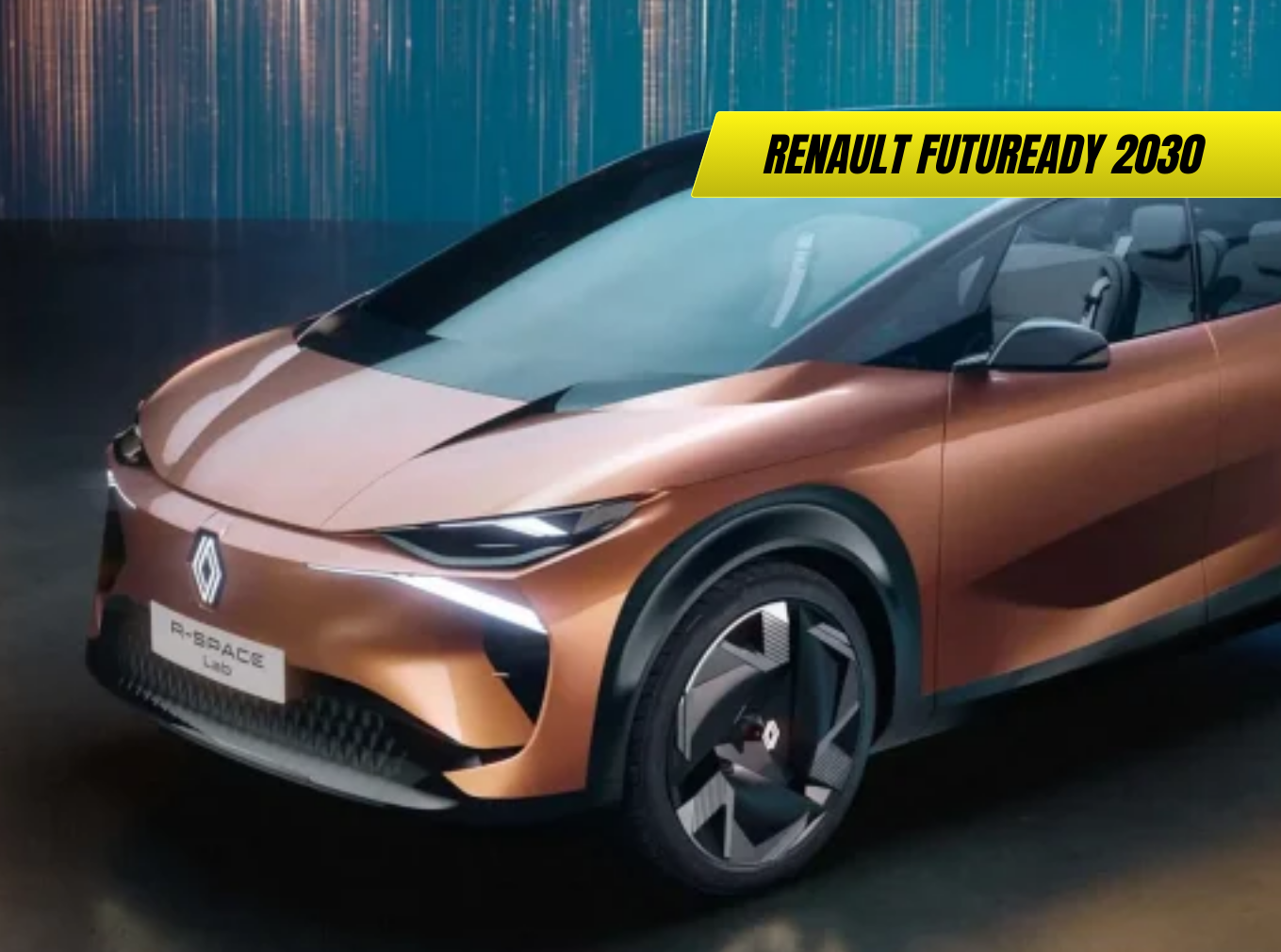
Renault has unveiled its new strategic plan “Futuready” alongside two landmark previews — the Bridger Concept, a rugged urban SUV designed for emerging markets, and the R-Space Lab, a radical vision of future shared mobility — signalling the brand’s direction for the rest of the decade.
Renault has a long history of bold strategic announcements, and the Futuready plan, unveiled in March 2026, is among its most ambitious. The presentation centred on two showpieces: the Bridger Concept — a compact, rugged SUV developed specifically for the Indian market — and the R-Space Lab — a radical autonomous mobility concept that previews Renault’s vision of shared urban transport beyond 2030. Together, they define the boundaries of a brand that is simultaneously pursuing value-focused mobility in developing markets and cutting-edge autonomy in established ones. For context on Renault’s current UK product lineup, our reviews of the Renault Clio 6 2026 and Renault Megane E-Tech 2026 facelift cover the brand’s mainstream direction.
Renault Futuready Plan 2026: Key Highlights
- Futuready is Renault’s strategic roadmap covering 2026–2030
- Bridger Concept: compact rugged urban SUV designed for the Indian market, previewing a production model expected by 2028
- R-Space Lab: autonomous shared mobility concept — previewing Renault’s post-2030 urban transport vision
- Commitment to 14 new or refreshed models by 2027 across the Renault, Dacia and Alpine brands
- Renault’s Indian market return confirmed — Bridger is the centrepiece of this strategy
- Software-defined vehicles across the entire range by 2028 — all models to support OTA updates
- Continued investment in the Ampere electric vehicle division alongside combustion and hybrid development
The Bridger Concept: Renault Returns to India
The Bridger Concept is the most commercially significant reveal of the Futuready plan. India is currently the world’s third-largest automotive market — and one where Renault has historically struggled to find sustained traction. The Bridger is the brand’s most targeted attempt yet to establish a permanent, competitive presence in the subcontinent.
Described by Renault as “a bridge between urban life and outdoor adventure”, the Bridger is a compact SUV — approximately 4.2–4.3 metres in length — designed specifically around Indian consumer preferences and road conditions:
Design: The Bridger Concept adopts a deliberately rugged aesthetic — high ground clearance, bold protective cladding around the wheelarches and sills, an upright windscreen for maximum forward visibility in congested urban traffic, and a short front overhang for obstacle clearance. The overall proportions are reminiscent of the original Dacia Duster — a vehicle that Renault Group knows performs strongly in value-conscious markets.
Powertrain direction: The production Bridger is expected to offer a 1.0-litre turbocharged petrol engine alongside a strong hybrid option — reflecting Indian consumer preferences for fuel economy over pure electric power, given the country’s still-developing charging infrastructure. A compressed natural gas (CNG) variant is also expected, consistent with Indian government incentives for alternative fuel vehicles.
Pricing target: The production Bridger is expected to be priced from approximately ₹10–12 lakh (approximately £9,500–£11,500) in India — positioning it competitively against the Hyundai Creta and Kia Sonet, the dominant players in the Indian compact SUV segment.
UK relevance: The Bridger production model is not expected to be sold in the UK or European markets — it is engineered specifically for Indian road conditions, regulations and consumer expectations. However, learnings from the Bridger’s development are expected to feed into future Dacia models — particularly in terms of cost engineering and emerging-market chassis development.
The R-Space Lab: Renault’s Vision of 2030+ Urban Mobility
The R-Space Lab is the more speculative of the two Futuready showpieces — a concept that Renault describes as “a laboratory on wheels” exploring how shared, autonomous urban transport might function in the early 2030s.
Key concept features:
- Fully autonomous Level 4 operation — no steering wheel, no driver controls in the standard configuration
- Modular interior: The R-Space Lab’s cabin is designed to be reconfigured for different use cases — from shared passenger transport to last-mile delivery to mobile workspace
- Transparent glass architecture: Nearly the entire body surface above the waistline is glazed — creating a 360-degree view for occupants and maximising the sense of connection to the urban environment
- Hydrogen fuel cell power: The R-Space Lab uses a hydrogen fuel cell for propulsion — chosen for its zero-emission credentials and the ability to refuel quickly for continuous commercial operation
- Digital exterior surfaces: The exterior bodywork incorporates programmable display panels — allowing the vehicle’s exterior to communicate its function, occupancy status or operator branding dynamically
The R-Space Lab is explicitly presented as a research exercise and design provocation rather than a near-production preview. Renault has been deliberately clear that elements of the concept are not currently road-legal in any market. However, the modularity philosophy and hydrogen powertrain direction are expected to influence Renault’s commercial vehicle strategy through the Futuready period.
Futuready: The Five Strategic Pillars
Renault’s Futuready plan is structured around five strategic commitments that will govern every product and technology decision across the Renault, Dacia and Alpine brands through 2030:
1. Electrification Leadership in Europe: Renault commits to offering a fully electric option in every vehicle segment it operates in by 2028. This does not mean every model will be electric-only — hybrid and PHEV options will coexist — but no segment will lack an electric choice.
2. Software-Defined Vehicles: All new Renault Group models from 2027 onwards will support full over-the-air software updates — allowing continuous improvement of safety, performance and feature sets throughout the vehicle’s life without dealer visits.
3. Emerging Market Expansion: The Bridger represents the first of several models specifically engineered for high-growth markets — India, Brazil and select African markets — where Renault sees the strongest volume growth opportunity through 2030.
4. Cost Leadership Through Dacia: Dacia will continue as Renault Group’s primary instrument for cost-competitive mobility — with the Striker, Bigster and future models targeting sub-€25,000 price points in segments where rivals charge considerably more.
5. Alpine Performance Electrification: Alpine commits to a fully electric lineup by 2027 — the A290 is already on sale, with the A390 and A110 E to follow. Alpine’s motorsport programme will transition to electric racing series to align with road car direction.
What Futuready Means for UK Buyers
For UK consumers, the Futuready plan has several direct implications:
- More affordable EVs at Dacia prices: The Striker, Bigster and future Dacia models will continue to undercut mainstream rivals by substantial margins — the most direct consumer benefit of Renault Group’s cost engineering strategy
- Better software, longer: OTA update capability across the Renault range means UK buyers’ cars will improve over time — a direct challenge to manufacturers who charge for updates or require dealer visits
- Alpine’s electric transformation: UK Alpine buyers can expect a fully electric lineup by 2027 — with the A290 already available, the A390 GT arriving later in 2026 and the A110 E to follow
- No Bridger for UK showrooms: The India-specific Bridger will not reach UK dealers — though its development legacy will eventually influence future Dacia models
FAQ
What is Renault’s Futuready plan?
Futuready is Renault’s strategic roadmap for 2026–2030, covering electrification, software-defined vehicles, emerging market expansion, Dacia cost leadership and Alpine’s transition to electric performance.
What is the Renault Bridger Concept?
The Bridger Concept is a compact rugged SUV designed specifically for the Indian market, previewing a production model expected by 2028 and priced from approximately £9,500–£11,500 in India.
Is the Renault Bridger coming to the UK?
No. The Bridger is engineered specifically for Indian road conditions and regulations. It is not planned for UK or European markets.
What is the Renault R-Space Lab?
The R-Space Lab is an autonomous hydrogen fuel cell mobility concept — a research exercise exploring how shared urban transport might function post-2030, featuring Level 4 autonomy and a modular reconfigurable interior.
When will all Renault models support OTA updates?
Renault commits to OTA update capability across all new models from 2027 onwards under the Futuready plan.
What does Futuready mean for Alpine?
Alpine commits to a fully electric lineup by 2027 — the A290 is on sale now, with the A390 GT arriving in 2026 and the A110 E to follow.
How does Futuready affect Dacia’s UK pricing?
Dacia will continue to undercut mainstream rivals by substantial margins — the Striker (from ~£23,000), Bigster and future models reflect Renault Group’s ongoing cost engineering commitment under Futuready.
Conclusion
Renault’s Futuready plan is one of the most coherent and commercially grounded strategic announcements from a mainstream manufacturer in recent years. The Bridger confirms Renault’s seriousness about Indian market growth; the R-Space Lab demonstrates that the brand is thinking beyond the current product cycle; and the five strategic pillars — electrification, software, emerging markets, Dacia cost leadership and Alpine electrification — are all credible, achievable commitments rather than aspirational rhetoric. From my point of view, the most significant near-term benefit for UK buyers is the continued aggressive pricing of Dacia models and the OTA update commitment across the Renault range — both of which will directly improve the ownership experience and value proposition of cars already in UK driveways.





