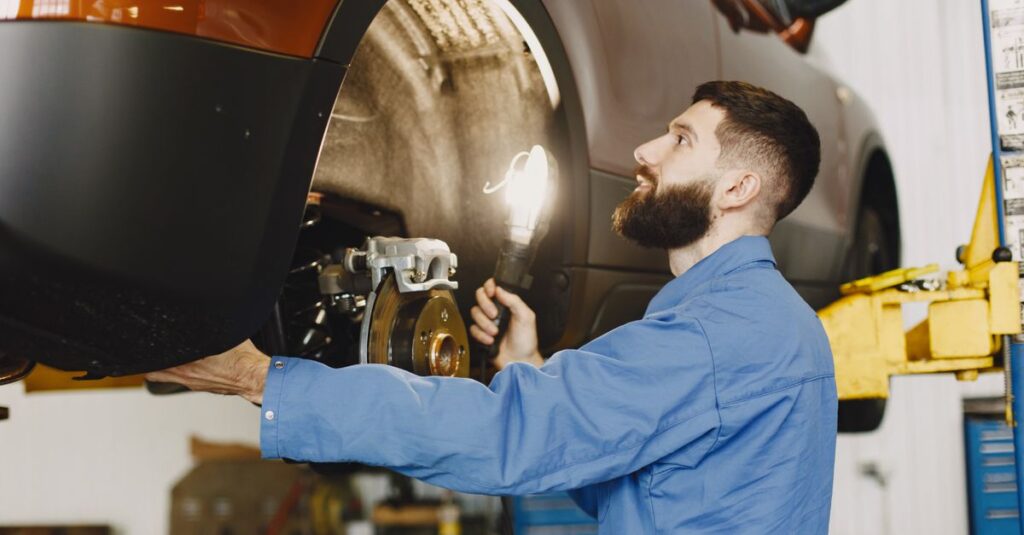
A steering wheel that shudders when you press the brake pedal is a warning sign, not a diagnosis. Brake pulsation caused by disc-thickness variation is one possibility, but loose or worn steering and suspension components can also transmit vibration through the wheel. Other brake or wheel faults may produce a similar sensation.
For UK drivers, the practical answer is cautious: do not ignore the symptom, and do not assume that replacing the brake discs and pads will automatically fix it. If braking, steering or general vehicle control is affected, stop somewhere safe and seek assistance.
Is it safe to keep driving?
There is no reliable yes-or-no answer based on the steering-wheel shake alone. The symptom does not identify the failed component or prove that the car is roadworthy, so even a light vibration should be checked promptly rather than treated as harmless.
If the shaking is strong, suddenly worse or affects the way the car brakes or handles, avoid continuing the journey. Pull over safely when possible and contact a breakdown or recovery service. The AA’s guidance on steering-wheel shaking advises seeking assistance where safety or handling is affected.
A car that still stops and steers normally is not automatically cleared for continued use. Arrange a professional inspection as soon as possible, and avoid deliberately carrying out repeated hard-braking tests to reproduce the vibration.
What can cause the vibration?
Brake pulsation and disc-thickness variation
A brake-pulsation diagnostic bulletin hosted in the NHTSA database identifies disc-thickness variation as a possible cause. The bulletin also notes that driving style, environmental conditions and the vehicle’s service history can influence brake-pulsation concerns. Read the technical service bulletin on brake-pulsation diagnosis.
Drivers often describe this problem as “warped discs”, but the steering-wheel movement alone does not prove that the discs are warped or that they are the only parts requiring attention. It is better to describe the exact symptom to a technician than to request a particular repair based on an assumption.
Steering or suspension wear
A loose or worn component in the steering or suspension can contribute to shaking, or transmit vibration generated elsewhere during braking. That is why a brake-related vibration should not be treated as a brake-disc problem without an inspection of the wider vehicle.
A caliper, wheel or other brake-system fault
Diagnostic guidance from O’Reilly Auto Parts notes that a sticking caliper, a wheel issue or another brake-system fault can create similar symptoms. A replacement set of discs and pads may therefore fail to solve the problem if the underlying cause is elsewhere.
What to tell the garage
Make a note of the conditions in which the shake occurs:
- Does it happen every time the brake pedal is pressed, or only occasionally?
- Is it more noticeable during heavier braking or at a particular speed?
- Is the vibration felt only through the steering wheel, or elsewhere as well?
- Has the car recently had brake, wheel or suspension work?
- Has it been parked for a long period or driven in conditions that might be relevant to the brakes?
These details can help a technician reproduce the concern, but they do not replace an inspection. Ask for the braking system, wheels, steering and suspension to be assessed, rather than assuming that discs and pads are the answer.
The bottom line
A shaking steering wheel under braking is a symptom with several possible causes. It may be related to brake pulsation, disc-thickness variation, a sticking caliper, a wheel problem or wear in the steering or suspension. It cannot be used on its own to judge whether a car is safe to drive.
Arrange prompt diagnosis. If the vibration affects braking, steering or handling, stop driving and seek professional assistance rather than taking the risk of continuing.