
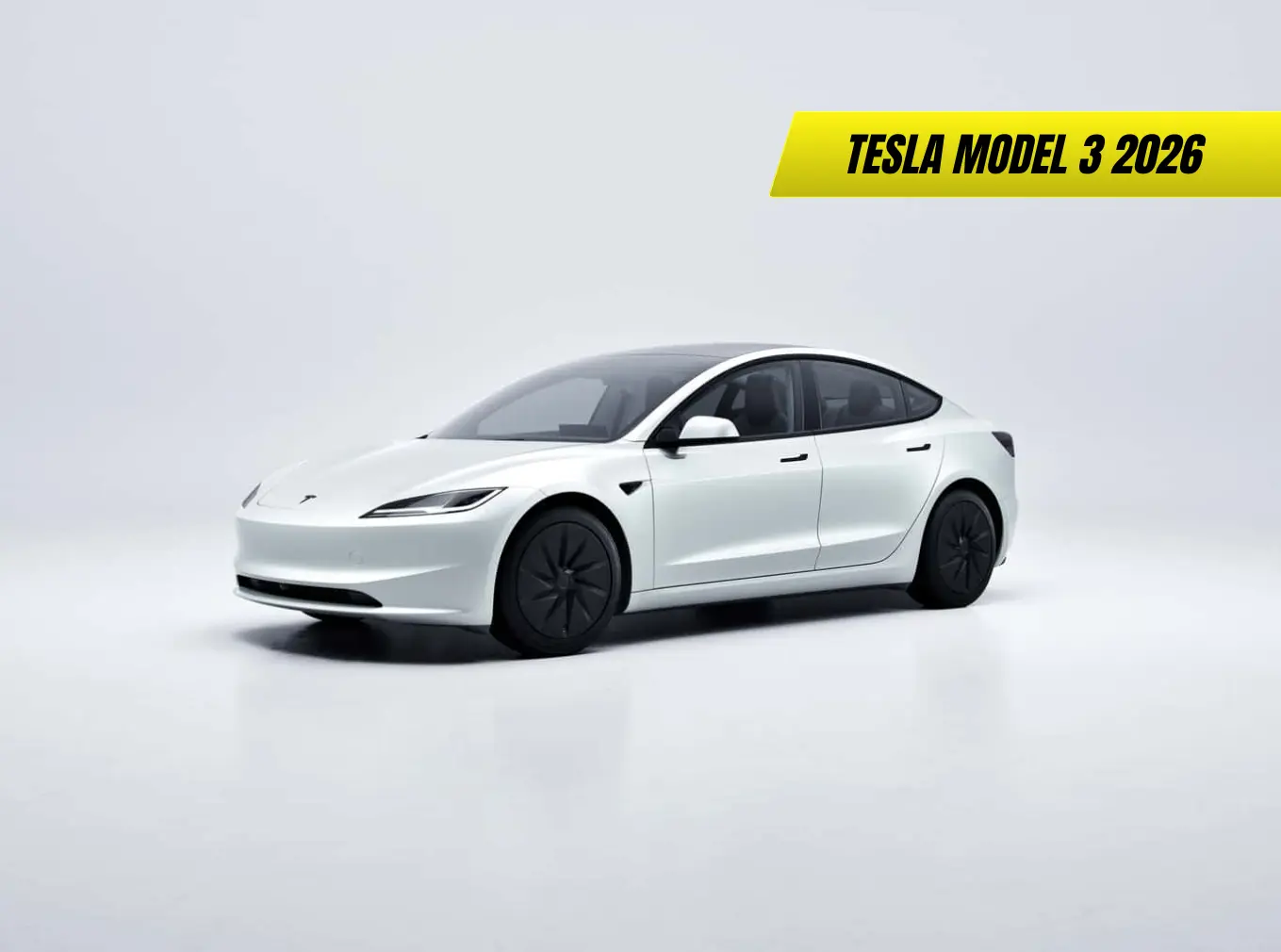
Tesla Model 3 2026 sees major UK price reductions from £39,990. Compare specs, running costs, and how it stacks up against BMW i4, Polestar 2 and BYD Seal in our comprehensive buyer’s guide.
Tesla implements significant price reductions across the Model 3 lineup throughout European markets for 2026, with UK pricing now starting at £39,990 for the Rear-Wheel Drive variant (down from £42,990), whilst Long Range and Performance variants receive £2,000-3,000 discounts. These cuts respond to intensifying competition from Chinese manufacturers including BYD Seal and MG4, plus European alternatives like BMW i4 and Polestar 2 threatening Tesla’s market dominance. Despite pricing pressure, the American EV leader maintains technological advantages including 250 kW Supercharger access, comprehensive over-the-air updates, and Autopilot semi-autonomous driving standard across the range.
Tesla Model 3 2026: UK Pricing and Specifications
American electric vehicle manufacturer Tesla implements substantial pricing reductions across Model 3 variants responding to declining sales volumes and intensifying competitive pressures from established manufacturers launching credible electric alternatives. The Model 3 Rear-Wheel Drive now costs £39,990, reduced from £42,990 launch price, representing £3,000 immediate savings before considering company car tax benefits or employer salary sacrifice schemes potentially reducing net costs further.
The Long Range and Performance variants receive proportional £2,000-3,000 discounts, creating a comprehensive range starting £39,990 (RWD) through £56,990 (Performance). This positions Tesla competitively against the BMW i4 eDrive35 (£60,000+), Mercedes EQE (£75,000+), and Polestar 2 Long Range (£49,950), whilst maintaining technology leadership through a 15.4-inch horizontal touchscreen interface eliminating physical buttons, premium glass roof standard across the range, and Autopilot semi-autonomous driving capability included in the base price.
2026 Model 3 UK Pricing Structure
| Variant | Power Output | 0-62 mph | WLTP Range | Previous Price | New Price | Savings |
|---|---|---|---|---|---|---|
| Rear-Wheel Drive | 283 hp (208 kW) | 6.1s | 318 miles (513 km) | £42,990 | £39,990 | £3,000 |
| Long Range AWD | 366 hp (270 kW) | 4.4s | 391 miles (629 km) | £52,990 | £49,990 | £3,000 |
| Performance | 510 hp (377 kW) | 3.1s | 328 miles (528 km) | £59,990 | £56,990 | £3,000 |
Technical Specifications and Performance
Model 3 Rear-Wheel Drive (Entry-Level)
Powertrain Configuration
Single permanent magnet synchronous motor mounted at the rear axle delivers 283 hp (208 kW) with 420 Nm torque. This rear-wheel-drive layout provides engaging handling characteristics whilst maximizing efficiency, achieving 318 miles (513 km) WLTP combined range from the 60 kWh (estimated) lithium-ion battery pack using LFP (lithium iron phosphate) chemistry prioritizing longevity and cost over maximum energy density.
Performance Metrics
- 0-62 mph: 6.1 seconds
- Top speed: 125 mph (201 km/h) electronically limited
- Real-world range: 260-290 miles mixed driving
- Winter range: 200-230 miles (-5°C with heating active)
Model 3 Long Range AWD (Volume Seller)
Dual-Motor All-Wheel Drive
Front and rear permanent magnet motors combine for 366 hp (270 kW) total output with 493 Nm torque, enabling 4.4-second 0-62 mph acceleration whilst delivering class-leading 391 miles (629 km) WLTP range. The 78 kWh (estimated) NMC (nickel manganese cobalt) battery provides superior energy density versus RWD’s LFP chemistry, justifying £10,000 premium through extended range capability and performance enhancement.
Key Advantages
- All-weather traction through intelligent torque distribution
- Extended touring capability without charging stops
- Dual-motor redundancy (vehicle remains operational if one motor fails)
- Enhanced regenerative braking (dual motors capturing energy)
Model 3 Performance (Flagship)
Track-Focused Capability
Upgraded dual-motor system produces 510 hp (377 kW) with 639 Nm torque, achieving supercar-rivaling 3.1-second 0-62 mph acceleration. Performance-oriented suspension lowering, upgraded brakes with larger discs and red-painted calipers, 20-inch performance wheels with Michelin Pilot Sport 4S tyres, and carbon fiber rear spoiler distinguish Performance from Long Range mechanically and visually.
Track Mode software unlocks advanced dynamics control allowing experienced drivers to adjust torque distribution, stability control intervention, and regenerative braking strength. Lap timer, G-force meter, and thermal management display enable track day optimization, though sustained high-performance driving depletes the battery rapidly, limiting session length versus combustion sports cars.
Competitive Analysis: Premium Electric Sedans
Direct Rivals Comparison
| Model | Power | Range WLTP | 0-62 mph | UK Price |
|---|---|---|---|---|
| Tesla Model 3 RWD | 283 hp | 318 miles | 6.1s | £39,990 |
| BMW i4 eDrive35 | 286 hp | 300 miles | 6.0s | £60,995 |
| Mercedes EQE 300 | 292 hp | 397 miles | 6.4s | £75,550 |
| Polestar 2 Standard Range | 272 hp | 321 miles | 6.2s | £44,950 |
| BYD Seal Premium | 313 hp | 354 miles | 5.9s | £46,990 |
| Hyundai Ioniq 6 Long Range | 229 hp | 381 miles | 7.4s | £51,850 |
Tesla Price Advantage
Model 3 RWD undercuts rivals by £4,960-£35,560 whilst delivering competitive specifications. Only Chinese SUVsand budget-focused alternatives from MG challenge Tesla’s value proposition at this price point, though lacking Supercharger network access and established residual value history.
Where Competitors Excel
BMW and Mercedes offer superior interior materials, traditional dealer networks providing face-to-face customer service, and established brand prestige. Polestar delivers Scandinavian design aesthetic and Google-integrated infotainment. BYD Seal provides longer warranty coverage (7 years versus Tesla’s 4 years vehicle warranty) addressing reliability perception concerns.
Supercharger Network: Tesla’s Key Advantage
UK Charging Infrastructure
Tesla operates over 1,200 Supercharger stalls across 120+ locations throughout the UK, providing the most comprehensive rapid charging network available to any single manufacturer. Version 3 Superchargers deliver up to 250 kW peak charging rates, enabling Model 3 Long Range to add 175 miles range in approximately 15 minutes under optimal conditions.
Charging Cost Structure
- Peak rate: 67p/kWh (typical Supercharger pricing)
- Off-peak rate: 52p/kWh (available certain locations/times)
- Home charging: 24p/kWh average (Economy 7 overnight rates lower)
Plug & Charge Convenience
Tesla’s integrated payment system eliminates need for multiple charging apps or RFID cards. Simply plug in and charging commences automatically, with costs billed directly to the Tesla account. This seamless experience surpasses rival networks requiring app downloads, account creation, and payment setup before charging.
Comparison: Public Charging Networks
Non-Tesla EVs access fragmented public charging infrastructure requiring multiple provider accounts. Networks including Ionity, BP Pulse, and Pod Point offer varying pricing structures, reliability levels, and charging speeds. The UK government’s charging infrastructure continues expanding, though Tesla’s proprietary network maintains convenience advantages.
Interior Design and Technology
Minimalist Cabin Philosophy
Tesla’s controversial interior design eliminates traditional dashboard instrumentation, relegating all information to the central 15.4-inch horizontal touchscreen. Driver speed, navigation, and Autopilot status display in the screen’s upper left corner, requiring peripheral vision glances rather than direct forward viewing traditional instrument clusters provide.
Standard Features Across Range
- 15.4-inch touchscreen with responsive interface
- Premium audio system (14 speakers, subwoofer, dual amplifiers)
- Heated front and rear seats
- Glass roof with UV protection (panoramic, non-opening)
- Wireless smartphone charging (two devices simultaneously)
- Four USB-C ports (two front, two rear)
Notable Omissions
No head-up display option, physical instrument cluster, or traditional gear selector. Steering wheel buttons control indicators, wipers, and voice commands, though some drivers find touchscreen dependency frustrating for frequently-adjusted functions like climate control or seat heating requiring menu navigation whilst driving.
Autopilot and Full Self-Driving
Standard Autopilot (Included)
Basic package provides adaptive cruise control and lane-keeping assistance (termed ‘Autosteer’). System maintains set speed, following distance to vehicles ahead, and centres vehicle within lane markings on motorways and dual carriageways. Requires constant driver attention with hands on steering wheel, monitored through steering torque sensors.
Enhanced Autopilot (£3,400 Optional)
Adds Navigate on Autopilot (automatic lane changes, motorway junction navigation), Auto Lane Change, Autopark, and Summon (vehicle retrieves itself from parking spaces via smartphone app). UK legislation prohibits truly hands-free operation, requiring driver supervision regardless of capability level.
Full Self-Driving Capability (£6,800 Optional)
Despite naming suggesting autonomy, FSD requires continuous driver supervision and intervention. Features include Traffic Light and Stop Sign Control, Autosteer on City Streets (beta testing), and future capabilities delivered via over-the-air updates as regulatory approval permits. Current functionality underwhelms given £6,800 cost, with most UK drivers finding standard Autopilot sufficient for motorway commuting.
Running Costs and Company Car Benefits
Annual Operating Expenses (12,000 Miles)
Electricity Costs
Assuming 70% home charging (24p/kWh) and 30% public rapid charging (67p/kWh):
- Model 3 RWD: Approximately £720 annually (250 Wh/mile average consumption)
- Model 3 Long Range: Approximately £780 annually (270 Wh/mile)
- Model 3 Performance: Approximately £900 annually (310 Wh/mile)
Home-only charging reduces costs significantly to £480-650 annually depending on variant.
Servicing and Maintenance
Tesla recommends service every 12 months or 12,500 miles. Annual inspection costs approximately £150-200 covering brake fluid check, cabin air filter replacement, and general inspection. Major service at 4 years/50,000 miles includes air conditioning service and battery coolant replacement (approximately £500-700).
No oil changes, transmission services, spark plug replacements, or exhaust system repairs reduce long-term ownership costs versus combustion equivalents. Brake wear minimal due to regenerative braking handling majority of deceleration.
Insurance Considerations
Insurance Group 48-50E rating (highest categories) reflects expensive repair costs and performance capability. Estimated annual premiums range £1,200-2,000 depending on driver age, location, and claims history. Tesla’s direct repair network and aluminum-intensive construction increase repair expenses versus conventional steel-bodied vehicles.
Company Car Tax Benefits 2026/27
Benefit-in-Kind Taxation
Electric vehicles attract just 2% BIK rate for 2026/27 tax year, creating substantial savings versus combustion alternatives taxed at 25-37% depending on CO2 emissions.
Model 3 RWD Example (£39,990 P11D value)
- BIK taxable amount: £799.80 annually (£39,990 × 2%)
- 20% taxpayer: £159.96 annual tax (£13.33 monthly)
- 40% taxpayer: £319.92 annual tax (£26.66 monthly)
Equivalent Combustion Sedan (£40,000, 150 g/km CO2, 32% BIK)
- BIK taxable amount: £12,800 annually
- 20% taxpayer: £2,560 annual tax (£213.33 monthly)
- 40% taxpayer: £5,120 annual tax (£426.66 monthly)
Company car drivers save £2,240-4,800 annually through electric vehicle choice, making Model 3 compelling for salary sacrifice schemes or company fleet managers. Similar benefits apply to other plug-in hybrid cars though pure EVs receive most favorable treatment.
Real-World Range Testing Results
Summer Conditions (20°C, Minimal Climate Control)
Model 3 RWD
- Motorway (70 mph steady): 280-300 miles
- Mixed driving (A-roads, urban, motorway): 290-310 miles
- Urban only: 340-360 miles (regenerative braking maximizes efficiency)
Model 3 Long Range
- Motorway: 350-370 miles
- Mixed driving: 380-400 miles
- Urban only: 420-440 miles
Winter Conditions (-5°C, Heating Required)
Cold Weather Impact
Battery chemistry efficiency decreases at low temperatures, whilst cabin heating consumes significant energy. Expect 25-30% range reduction versus summer conditions.
Model 3 RWD
- Motorway: 200-220 miles
- Mixed driving: 220-240 miles
Model 3 Long Range
- Motorway: 270-290 miles
- Mixed driving: 290-310 miles
Preconditioning whilst plugged in (heating cabin and battery before departure) minimizes initial energy drain, extending winter range by 10-15 miles per charge cycle.
Market Context: Why Tesla Cut Prices
Sales Pressure from Chinese Competitors
BYD, MG, and emerging Chinese manufacturers flood European markets with competitively-priced EVs featuring modern technology and comprehensive warranties. BYD Seal undercuts Model 3 specification-for-specification whilst offering 7-year warranty versus Tesla’s 4 years, swaying budget-conscious buyers prioritizing value over brand cachet.
Established Manufacturers Fighting Back
BMW, Mercedes, Audi, and Volkswagen Group invest billions developing electric alternatives matching or exceeding Tesla performance whilst leveraging established dealer networks, customer loyalty, and premium brand positioning. Mercedes Electric GLC and BMW iX1 attract traditional luxury buyers uncomfortable with Tesla’s direct-sales model and minimalist brand experience.
Demand Softening
Electric vehicle adoption rates plateau as early adopters saturate the market, leaving mainstream buyers skeptical about charging infrastructure, range limitations, and residual values. Tesla’s aggressive pricing strategy aims capturing hesitant buyers through reduced financial barriers whilst maintaining technological leadership positioning justifying premium over budget Chinese alternatives.
Frequently Asked Questions
What is the price of Tesla Model 3 in the UK for 2026?
Tesla Model 3 UK pricing starts at £39,990 for the Rear-Wheel Drive variant (reduced from £42,990), £49,990 for Long Range AWD (down from £52,990), and £56,990 for Performance (reduced from £59,990). All variants receive £3,000 discounts compared to previous pricing, representing Tesla’s most aggressive UK pricing strategy since Model 3 introduction.
How much range does Tesla Model 3 have in real-world driving?
Real-world range varies by variant and conditions. Model 3 RWD achieves 260-290 miles mixed driving in summer, reducing to 200-240 miles in winter. Long Range AWD delivers 380-400 miles summer conditions, 290-310 miles winter. Performance manages 300-330 miles summer, 240-270 miles winter. Motorway-only driving at 70 mph reduces range approximately 15-20% versus mixed driving.
Is Tesla Model 3 cheaper to run than petrol cars?
Yes, significantly cheaper for most drivers. Electricity costs £720 annually for 12,000 miles (RWD, 70% home charging) versus £2,400+ for equivalent petrol sedan achieving 45 mpg at £1.50/liter. Servicing costs £150-200 annually versus £400+ for combustion vehicles. However, higher insurance premiums (£1,200-2,000) partially offset savings. Company car drivers save £2,240-4,800 annually through 2% BIK rate versus 25-37% combustion alternatives.
How long does Tesla Model 3 take to charge?
Supercharger V3 (250 kW): 10-80% in approximately 25-30 minutes, adding 175 miles in 15 minutes (Long Range). Home charging via 7 kW wallbox: 8-12 hours full charge depending on variant (RWD faster due to smaller battery). Three-pin domestic plug (3 kW): 20-30 hours full charge, not recommended for regular use. Optimal charging strategy involves topping up at home nightly rather than depleting to empty.
Should I buy Tesla Model 3 or wait for competitors?
Depends on priorities. Buy now if valuing Supercharger network access, proven technology, strong residual values, and immediate delivery (2-8 weeks). Wait if preferring traditional dealer experience, premium interior materials, or expecting further price reductions as competition intensifies. Chinese alternatives like BYD Seal offer better value but unproven UK residual values. German premium alternatives cost £10,000-20,000 more for comparable specifications.
What warranty does Tesla Model 3 have?
Vehicle warranty: 4 years / 50,000 miles covering manufacturing defects and component failures. Battery and drive unit warranty: 8 years / 120,000 miles (RWD) or 8 years / 192,000 miles (Long Range/Performance) guaranteeing minimum 70% capacity retention. Paint warranty: 4 years. Corrosion warranty: 12 years. Extended warranty available for purchase covering additional years beyond standard coverage, though costs often exceed £1,500-2,000 annually.
Can you charge Tesla Model 3 at non-Tesla chargers?
Yes, Model 3 includes CCS2 connector enabling charging at all UK public charging networks including Ionity, BP Pulse, Pod Point, and others. Requires Tesla account configuration to enable third-party charging and payment setup through respective network apps or RFID cards. Supercharger network remains Tesla-exclusive in UK (unlike some European markets opening to non-Tesla EVs), providing competitive advantage through superior coverage and reliability.
Is Tesla Model 3 good in snow and winter conditions?
Long Range and Performance variants with dual-motor AWD provide excellent winter capability through intelligent torque distribution. RWD variant adequate with winter tyres fitted but less confidence-inspiring than AWD alternatives on ice and snow. All variants feature heated seats, steering wheel, and battery preconditioning optimizing winter performance. Range reduction (25-30%) requires planning longer journeys with charging stops. Similar winter considerations apply to other diesel SUVs though combustion vehicles avoid range anxiety concerns.
Verdict: Should You Buy Tesla Model 3 in 2026?
Tesla Model 3 remains the default electric sedan choice for UK buyers prioritizing technology, charging infrastructure, and value. The 2026 price reductions address previous criticism regarding excessive pricing compared to improving competitors, with £39,990 entry price positioning Model 3 competitively against premium combustion sedans whilst delivering superior performance, minimal running costs, and negligible company car taxation.
Buy Model 3 If:
- Prioritizing Supercharger network convenience for regular long-distance travel
- Company car driver maximizing 2% BIK taxation benefits
- Valuing technology and over-the-air updates over traditional luxury
- Comfortable with minimalist interior design and touchscreen controls
- Seeking proven residual values and established ownership experience
Consider Alternatives If:
- Preferring traditional dealer relationships and physical showrooms
- Requiring premium interior materials and conventional ergonomics
- Uncomfortable with Tesla’s controversial CEO and brand associations
- Seeking maximum range (consider Long Range at £49,990)
- Prioritizing warranty coverage (Chinese rivals offer 7 years versus Tesla’s 4)
The Model 3 delivers compelling value at £39,990, particularly for company car drivers saving thousands annually through favorable taxation. Private buyers face tougher decisions as Chinese manufacturers including BYD and established European brands increasingly challenge Tesla’s technological and value propositions, though Supercharger network access remains decisive advantage justifying modest premium over rivals offering comparable specifications but inferior charging experiences.
For most UK buyers, Model 3 RWD at £39,990 provides optimal balance of performance, range, and cost. Long Range suits higher-mileage drivers requiring extended range without frequent charging stops. Performance appeals to driving enthusiasts prioritizing acceleration and handling over practicality, though £56,990 pricing ventures into territory where German premium alternatives merit consideration for traditional luxury brand cachet Tesla cannot replicate despite superior technology.





