
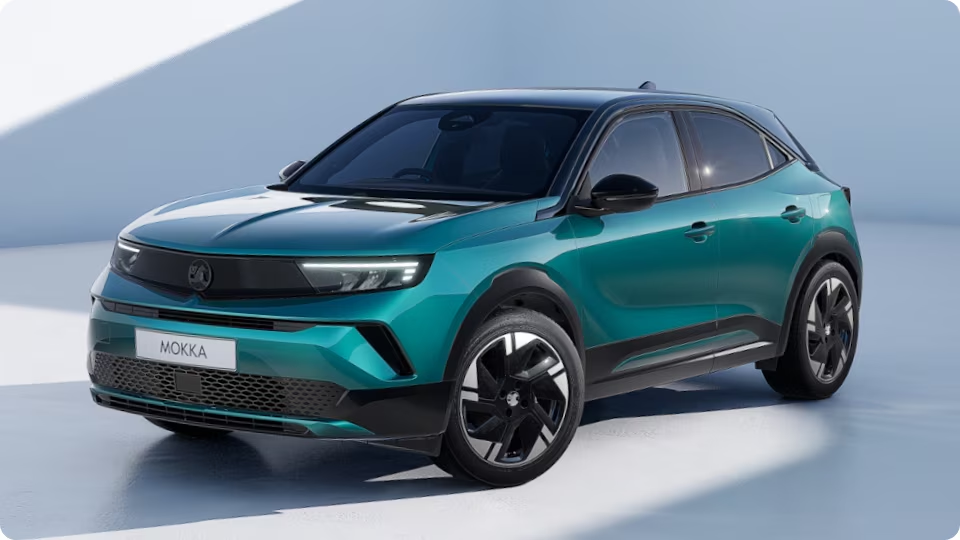
The Vauxhall Mokka is one of the UK’s most popular compact SUVs — but with three distinct powertrain options on offer in 2026, choosing the right one for your needs is less straightforward than it might appear. This guide breaks down the petrol, mild hybrid, and electric versions honestly, so you can make the right decision for your driving pattern and budget.
Vauxhall Mokka 2026: Powertrain Comparison at a Glance
The current Mokka offers three distinct powertrain options: a 1.2-litre turbocharged petrol, a 1.2-litre petrol mild hybrid (48V system), and a fully electric version with a 54kWh battery and up to 252 miles of WLTP range. Diesel was discontinued from the Mokka range in late 2022 and is no longer available new — any diesel Mokka on the market will be a used example from 2021–2022.
| Powertrain | Power | 0–62mph | WLTP Economy/Range | Road Tax | Starting Price (approx.) |
|---|---|---|---|---|---|
| 1.2 Turbo Petrol 100hp | 100hp | 10.2 sec | 51.4mpg | £180/year | £24,000 |
| 1.2 Turbo Petrol 130hp | 130hp | 8.9 sec | 49.6mpg | £180/year | £26,500 |
| 1.2 Mild Hybrid 136hp | 136hp | 8.9 sec | 54.3mpg | £180/year | £28,000 |
| Mokka Electric | 154hp | 9.0 sec | 252 miles | £0 (2026) | £31,680 |
The 1.2 Petrol: The Rational Everyday Choice
The 1.2-litre turbocharged petrol engine — shared with the Vauxhall Corsa and Peugeot 208 — is a well-proven, smooth unit that suits the Mokka’s character well. Available in 100hp and 130hp outputs, Motorpoint’s independent long-term review concludes that it delivers “motorway competence you’d get from a bigger engine, and the fuel economy of a fairly modern diesel.”
The 130hp version is the standout recommendation within the petrol range. It adds genuine confidence on overtakes and motorway merges without a significant fuel economy penalty over the 100hp variant, and the six-speed manual gearbox is one of the more satisfying to use in this segment. An automatic gearbox option is available but costs 6hp and adds a price premium — the manual is the more engaging and slightly more economical choice.
The petrol Mokka suits you if:
- You cover fewer than 10,000 miles per year and have no home charging capability
- You primarily drive mixed routes — a combination of town and motorway
- You want the lowest entry price with the most familiar ownership experience
- You regularly need to travel beyond 200 miles without charging infrastructure certainty
The Mild Hybrid: Better Figures, Modest Real-World Benefit
The Mild Hybrid 136 uses a 48V belt-integrated starter-generator alongside the familiar 1.2-litre engine, recovering braking energy into a small battery and providing brief electric assistance at very low speeds. Cinch’s independent assessment is candid: “it can drive the wheels for very short bursts,” with the genuine benefit being “around one-third of your short town trips without the petrol engine firing.”
Motorpoint notes that Vauxhall markets this as a hybrid, which should “be taken with a pinch of salt — while the addition of 48-volt mild-hybrid tech is welcome, you’ll only notice the electric bit at walking pace.” The official fuel economy figure of 54.3mpg is noticeably higher than the pure petrol’s 51.4mpg — but real-world differences on mixed routes will be modest.
The mild hybrid’s genuine advantage is its automatic gearbox as standard — the eight-speed automatic suits town use particularly well and is smoother than the manual in heavy traffic. For urban drivers who want a more relaxed driving experience without committing to full EV ownership, the mild hybrid is a reasonable middle ground.
The mild hybrid suits you if:
- You primarily drive in town and want the smoothest available combustion experience
- You appreciate the automatic gearbox as standard
- You want marginally better fuel economy without the range or charging commitment of the full EV
The Mokka Electric: The Strongest Case in 2026
The Mokka Electric has been significantly improved for 2026 — a 54kWh battery and 154hp motor now deliver up to 252 miles of WLTP range, up from the original 50kWh/201-mile specification. The RAC’s six-month long-term test returned a real-world efficiency of 4.4 miles per kWh — translating to approximately 230–240 miles of real-world range in mixed conditions, which comfortably covers most UK weekly driving patterns.
The financial case for the electric Mokka is compelling for eligible drivers. Vanarama’s direct comparison notes that a company car driver in the petrol 1.2 Turbo pays approximately £120 per month in BiK tax — the Mokka Electric driver pays £5.80 per month. Road tax on the electric version is currently £0 versus £180 for any combustion variant. Running costs at home charging rates (approximately 7p per mile) compare very favourably with the petrol’s 12–14p per mile at 2026 fuel prices.
Top Gear’s review notes the Mokka Electric “has been deliberately tuned to feel a bit like a petrol engine — it doesn’t quite have the shove-you-in-your-seat rapidness of many EVs, but it’ll be a seamless transition if you’re used to petrol cars.” This is a thoughtful engineering choice for the Mokka’s primarily mainstream, non-enthusiast buyer profile.
Boot space is marginally reduced versus the petrol — 310 litres versus 350 litres with seats up, and 1,060 litres versus 1,105 litres folded — a consequence of the battery pack layout that is unlikely to be a practical concern for most buyers.
The Mokka Electric suits you if:
- You have home charging or reliable workplace charging
- You cover up to 200 miles per day in typical use
- You are a company car driver — the BiK advantage alone justifies the premium
- You want the lowest running cost of any Mokka variant over a three-year ownership period
- You already drive a hybrid and want to take the next step toward full electrification — for comparison, the Toyota Aygo X hybrid and Toyota Corolla Cross offer a bridge between mild electrification and full EV
The Diesel Question: Is It Worth Seeking a Used Mokka Diesel?
Diesel was discontinued from the Mokka range in late 2022. The 1.5-litre BlueHDi diesel offered 109hp and solid long-distance economy but was never the most dynamic choice in the range. Used examples are now three or more years old — any used diesel Mokka will need DPF health verification and Euro 6 compliance confirmation before purchase.
Given that the current 130hp petrol delivers comparable real-world economy to the discontinued diesel on most route types, and that the mild hybrid outperforms it in urban use, there is no compelling case to seek out a used diesel Mokka in 2026 unless the purchase price represents a significant saving over petrol equivalents.
For broader guidance on whether diesel as a fuel type makes sense for your situation, our should you buy diesel in 2026 guide covers the full analysis for UK drivers.
Which Mokka Should You Buy?
- Best all-round choice: 1.2 Turbo Petrol 130hp manual — the most satisfying to drive, well-proven engine, adequate economy, lowest price of entry
- Best for company car drivers: Mokka Electric — BiK advantage makes it the only rational choice on a company car scheme
- Best for urban driving: Mild Hybrid 136 automatic — smoother in traffic, marginally better economy, no charging required
- Best for running costs: Mokka Electric — lowest cost per mile for home-charging drivers over any ownership period beyond 18 months
The official Vauxhall Mokka specifications, pricing, and available trims are maintained at vauxhall.co.uk, where the full configurator allows direct comparison of all powertrain and trim combinations.
For drivers comparing the Mokka Electric against other compact electric SUVs, our best SUVs under £40,000 guide places it in context alongside the Renault Megane E-Tech, MG ZS EV, and other key rivals in the segment.
Is the Vauxhall Mokka reliable?
The current-generation Mokka (2021 onward) uses a platform and engine family shared across the Stellantis group — including Peugeot, Citroën, and Opel. Owner satisfaction data from What Car? and Auto Express places it in the middle of the compact SUV reliability rankings. The 1.2 PureTech petrol engine has a known timing chain sensitivity in early examples that has been addressed in updated production; later cars are generally reliable. The Mokka Electric has fewer mechanical components to fail and has received positive long-term reliability reports.
How far does the Vauxhall Mokka Electric go on a full charge?
The official WLTP range is 252 miles. Real-world range in mixed UK driving is approximately 220–240 miles in mild weather, reducing to 180–200 miles in cold winter conditions with heating in use. For most UK drivers whose daily mileage is 30–40 miles, this represents four to seven days of driving between charges.
Is the Vauxhall Mokka good for motorway driving?
The 130hp petrol is the most capable combustion Mokka on motorways — it cruises with sufficient refinement and power reserve for relaxed overtaking. The Mokka Electric is equally composed at motorway speeds but range consumption increases significantly at sustained 70mph compared to mixed driving. The 100hp petrol can feel slightly breathless on long uphill sections with a full load.
Does the Vauxhall Mokka have fast charging?
The Mokka Electric supports DC rapid charging at up to 100kW, which adds approximately 80 miles of range in 30 minutes at a compatible charger. Home charging via a 7.4kW wallbox charges from 20% to 80% in approximately five hours — suitable for overnight charging in most cases.
How does the Mokka compare to the Peugeot 2008?
The Mokka and Peugeot 2008 share the same Stellantis platform and powertrain family — their mechanical performance is near-identical. The key differences are in interior character: the 2008 offers Peugeot’s distinctive i-Cockpit with a small steering wheel and elevated instrument cluster; the Mokka has a more conventional layout that some drivers find more intuitive. The 2008 is generally priced slightly higher at equivalent specification. Both are strong choices in the segment.
From my point of view, the Mokka Electric is the most compelling version of the range for any driver with reliable home or workplace charging — the running cost advantage over the petrol variants, combined with the BiK benefit for company car drivers, makes it the rational choice for the majority of buyers who can accommodate the charging requirement. For those without charging access, the 130hp petrol manual remains the most rewarding and complete Mokka to drive on a daily basis.





