
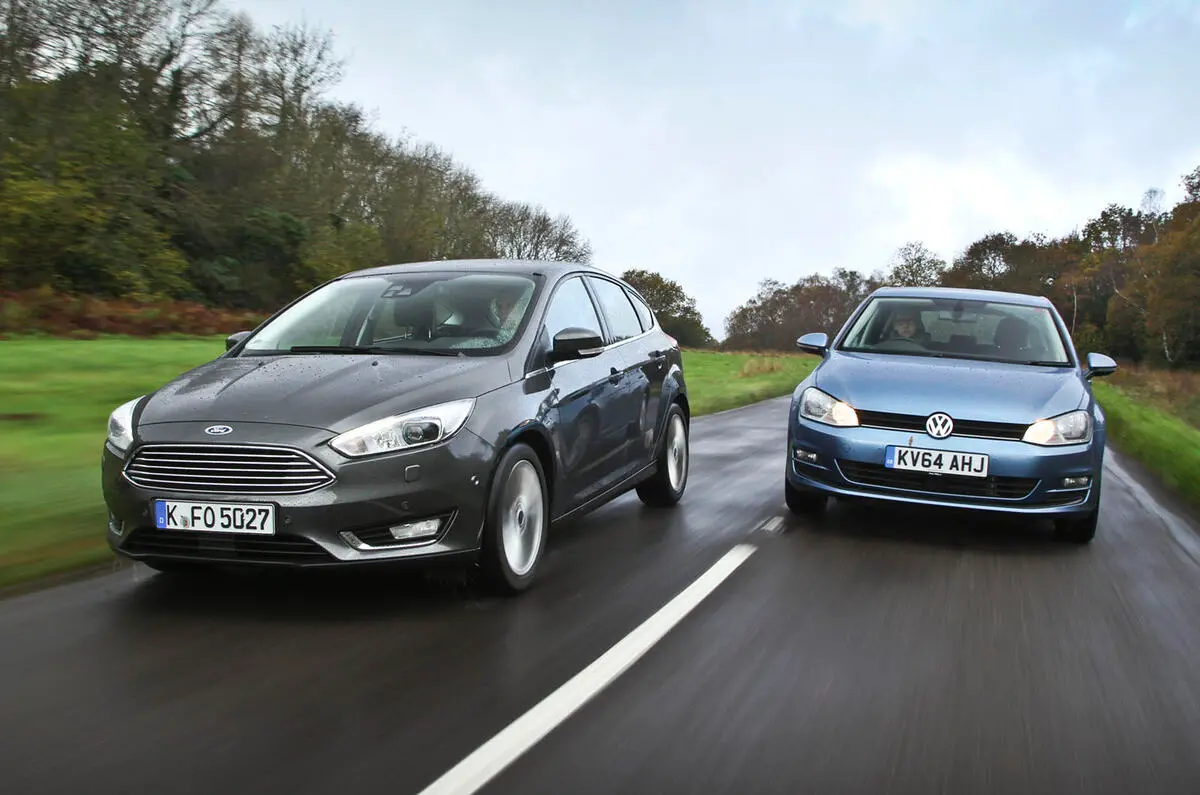
The Volkswagen Golf and Ford Focus have defined the UK family hatchback market for decades. In 2026 they still target the same buyers – those who want a compact car that can handle commuting, family duties and motorway trips – but they approach the job differently. The Golf leans on refinement, technology and image; the Focus majors on driving fun and value. If you are choosing between them, it’s worth looking closely at engines, space, running costs and how they feel on real British roads.
Key points (summary)
- The Golf offers a broader mix of petrol, mild‑hybrid, plug‑in hybrid and performance variants, with strong refinement and tech.
- The Focus focuses on efficient 1.0 EcoBoost mild‑hybrid petrol engines and a more dynamic driving feel.
- Boot space is similar, with the Golf generally a touch larger on paper and the Focus offering a very usable 390‑ish litre area.
- Interior quality and perceived prestige favour the Golf; value and equipment often favour the Focus.
- For comfort and long‑distance refinement, the Golf usually has the edge; for driver enjoyment, the Focus often feels more alive.
Engines and performance
Volkswagen Golf
The 2026 Golf range in the UK typically includes:
- Petrol and mild‑hybrid (eTSI) engines around 116–150 PS, paired with manual or DSG automatic gearboxes.
- Plug‑in hybrid GTE‑style variants with significantly more power and electric‑only range, ideal for company‑car drivers and regular commuters who can charge at home.
- Diesel options for high‑mileage drivers in some trims.
- Performance models such as GTI and R, with power outputs up to around 330+ PS in the Golf R.
This breadth means almost every UK buyer can find a Golf version that fits their performance and economy needs, from relaxed commuters to enthusiasts.
Ford Focus
The Focus in its later UK form concentrates mainly on:
- 1.0‑litre EcoBoost three‑cylinder engines with mild‑hybrid (mHEV) assistance, typically around 125–155 PS depending on trim.
- Manual gearboxes dominate, with some automatic options depending on spec.
There’s less variety than in the Golf range, but the EcoBoost hybrid units are efficient and punchy for their size. ST‑Line and ST‑Line X trims add a sportier flavour without going full hot‑hatch, while the full Focus ST caters to performance buyers.
Interior quality, design and tech
Golf cabin
The Golf interior emphasises:
- Clean design with a digital instrument cluster and central touchscreen.
- A generally solid, high‑quality feel in materials and switchgear.
- Extensive connectivity and driver‑assistance systems.
It can take a little time to get used to the touch‑sensitive controls on some versions, but the impression is of a tech‑rich, upmarket cabin. This is one of the reasons the Golf enjoys such strong image and resale value in the UK.
Focus cabin
The Focus interior is:
- More conventional in layout, with physical buttons and a central screen.
- Well built and robust, but usually a step behind the Golf in perceived material quality.
- Very functional, with clear ergonomics and straightforward controls.
What the Focus lacks in plushness it often makes up in practicality and ease of use. In many deals, you can get more equipment for your money in a Focus than in an equivalent Golf.
Space and practicality
Both cars are very usable as family hatchbacks, with only small differences that may matter to certain buyers.
| Feature | Volkswagen Golf | Ford Focus |
|---|---|---|
| Boot space (approx.) | Around 380 litres seats up | Around 390–392 litres seats up |
| Rear passenger space | Good leg and headroom | Also good; slightly airier feel in back |
| Cabin storage | Plenty of cubbies and door bins | Similarly strong, family‑friendly |
In practice, both will handle:
- Weekly shops.
- Pushchairs and school bags.
- Weekend luggage for a family of four.
Estate versions of both models (Golf Estate and Focus Estate) are excellent options for those who prioritise maximum load capacity, but as five‑door hatches, there’s little to separate them in day‑to‑day use.
Driving experience on UK roads
Golf: calm, composed, refined
The Golf’s strengths on the move include:
- Refinement: excellent suppression of road and wind noise, particularly on the motorway.
- Ride comfort: well‑judged suspension that soaks up bumps without feeling floaty.
- Stability: reassuringly planted at higher speeds, ideal for frequent long‑distance work.
It’s not always the most exciting car to hustle down a twisty B‑road, but it feels highly competent and safe, with performance models like the GTI and R adding serious pace and engagement for those who want more.
Focus: agile, involving, responsive
The Focus has long been praised for its dynamics, and the later UK models continue that tradition:
- Steering feel: sharper and more communicative than most rivals, giving confidence on twisty roads.
- Chassis balance: the car feels eager to change direction and composed in corners.
- Ride: generally comfortable, though sportier trims with big wheels can feel firmer.
For many UK buyers who drive on a mix of B‑roads and urban routes, the Focus simply feels more “fun”, especially in ST‑Line or ST form. The trade‑off is that it may feel slightly less isolated and plush than a well‑specced Golf on long motorway hauls.
Running costs, tax and ownership
Both cars offer:
- Competitive fuel economy in their mild‑hybrid petrol guises.
- Reasonable insurance groups for mainstream models.
- Sensible servicing intervals and parts availability in the UK.
However:
- The Golf’s plug‑in hybrid options can significantly cut Benefit‑in‑Kind and fuel costs for company‑car drivers and high‑mileage commuters with access to home or workplace charging.
- The Focus tends to offer stronger value at purchase, with more kit for the price, which may offset slightly fewer powertrain options.
Depreciation generally favours the Golf due to its stronger image and perceived quality, while the Focus often costs less to buy in the first place, particularly with discounts and dealer offers.
Golf vs Focus: which suits which buyer?
| Priority | Better choice (usually) |
|---|---|
| Long‑distance refinement | Volkswagen Golf |
| Fun on twisty B‑roads | Ford Focus |
| Broad choice of engines (incl. PHEV) | Volkswagen Golf |
| Best value at purchase | Ford Focus |
| Interior quality and image | Volkswagen Golf |
| Straightforward, no‑nonsense daily car | Ford Focus |
In simple terms:
- Choose the Golf if you want a polished, refined hatchback with strong resale value, a premium‑leaning cabin and the option of plug‑in hybrid or high‑performance variants.
- Choose the Focus if you care more about steering feel, driving enjoyment and equipment‑for‑money, and you’re happy with an efficient 1.0 EcoBoost mild‑hybrid petrol rather than a broad engine line‑up.
FAQs
Which is more comfortable on UK motorways: Golf or Focus?
The Golf generally feels more refined and quieter on long motorway runs, with slightly softer, more polished ride quality, especially on standard‑size wheels.
Which car is more fun to drive?
The Focus typically offers sharper steering and a more playful chassis, making it more enjoyable on twisty roads and for keen drivers in everyday conditions.
Which has the better interior?
The Golf’s interior generally wins on material quality, perceived prestige and tech integration, while the Focus is more straightforward and robust, with easier physical controls.
Which is cheaper to run?
For pure petrol mild‑hybrid models, running costs are similar. If you choose a plug‑in hybrid Golf and can charge regularly, it can be significantly cheaper to fuel than a Focus, especially for shorter commutes.
Which holds its value better in the UK?
The Golf usually has stronger residual values due to brand image and perceived quality, though a well‑priced Focus can still represent excellent overall value when purchase price is considered.
Conclusion
Both the Volkswagen Golf and Ford Focus remain excellent choices for UK drivers, but they appeal to slightly different tastes. The Golf is the safe, refined, premium‑leaning all‑rounder that excels on longer journeys and in daily use, while the Focus is the more engaging driver’s car that often offers stronger value and more equipment per pound. Deciding between them ultimately comes down to whether you prioritise comfort and polish (Golf) or driving fun and value (Focus) in your next hatchback.





