
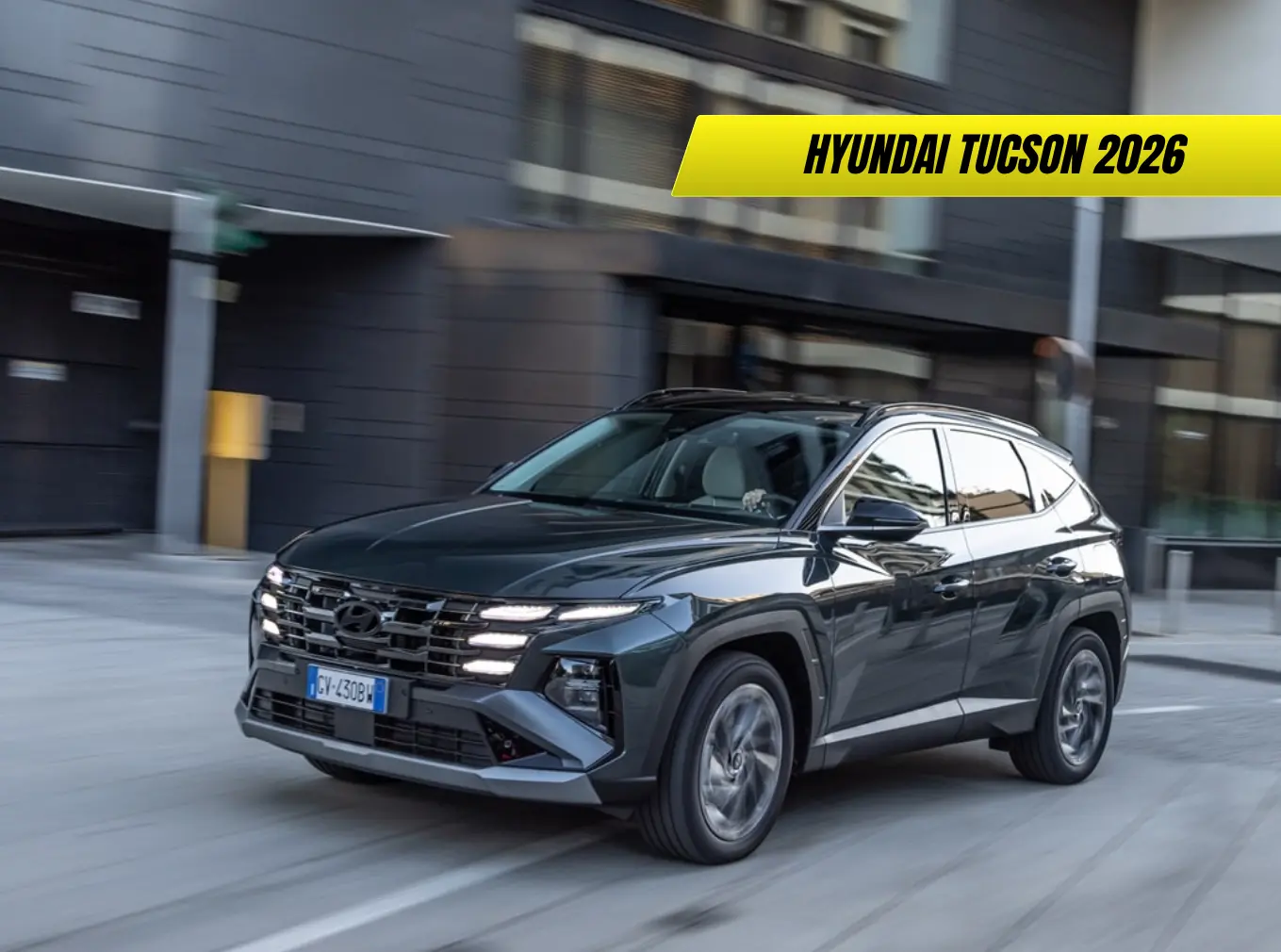
Hyundai’s fifth-generation Tucson (codename NX5) debuts mid-2026 with radical transformation featuring boxier proportions, dual 12.3-inch display screens, and next-generation TMED-II hybrid system delivering improved performance and fuel economy targeting 37-40 mpg combined.
The next-generation Hyundai Tucson coded NX5 launches third quarter 2026 (July-September) in South Korea with global rollout including UK market following months later, representing comprehensive redesign departing from current model’s smooth curves toward boxier, more muscular proportions featuring bold pixel-inspired split headlamps, armor-like front bumper, prominent fenders, and rugged roof racks embodying Hyundai’s “Art of Steel” design philosophy emphasizing strength and capability. Interior receives equally dramatic upgrade with dual 12.3-inch displays (digital instrument cluster and central touchscreen) creating panoramic digital cockpit, enhanced materials quality, and refined connectivity addressing customer feedback about previous generation’s cabin finishing. Powertrain lineup spans gasoline, hybrid (HEV), and plug-in hybrid (PHEV) options, headlined by new 1.6-litre turbocharged TMED-II hybrid system increasing torque from 367Nm to 380Nm (270 to 280 lb-ft) while improving fuel efficiency over 4% through upgraded P1 motor, smart regenerative braking, and enhanced e-AWD with rear motor enabling sophisticated torque vectoring. UK pricing estimated £28,000-42,000 spanning base gasoline through flagship PHEV variants, positioning against Nissan Qashqai, Kia Sportage, and Toyota RAV4 in fiercely competitive compact SUV segment where Tucson’s combination of bold styling, advanced technology, and comprehensive powertrain choice aims maintaining Hyundai’s strong market position established through current generation’s success.
Design Revolution: From Curves to Angles
The NX5 Tucson represents philosophical shift in Hyundai’s design language, abandoning the current generation’s fluid surfacing for more angular, geometric forms emphasizing ruggedness and visual presence.
Exterior Design Evolution
| Design Element | Current Tucson (NX4) | Next-Gen Tucson (NX5) |
|---|---|---|
| Overall shape | Flowing, organic curves | Boxier, more angular proportions |
| Front lighting | Parametric jewel hidden lights | Pixel-inspired split headlamps (visible LED array) |
| Grille | Wide parametric pattern | Bold geometric frame with pixel elements |
| Fenders | Subtle wheel arch bulges | Prominent muscular fenders creating wider stance |
| Side profile | Smooth surfacing with character line | Groove patterns on doors, more sculpted surfaces |
| Roof | Clean, unadorned | Rugged roof racks standard or available across range |
| Rear design | Horizontal light bar connecting taillights | Updated lighting signature maintaining brand recognition |
The boxier proportions reflect broader industry trend toward SUVs emphasizing capability and presence over car-like refinement – strategic response to customer preferences particularly strong in North American and emerging markets where Tucson achieves significant sales volumes. The design evolution positions NX5 visually between smaller Kona crossover’s urban-friendly proportions and larger Santa Fe’s full-size SUV commanding stance.
Trim Level Differentiation
Hyundai will maintain current strategy offering distinct styling packages targeting different buyer demographics:
N-Line Variant
- Sport-focused appearance with aggressive bumpers and larger air intakes
- Unique wheel designs (19 or 20-inch options)
- Black exterior trim replacing chrome accents
- Lowered suspension for sportier handling dynamics
- Enhanced exhaust note (combustion models)
XRT Variant (US Market)
- Increased ground clearance for light off-road capability
- Body cladding protecting lower panels from trail damage
- All-terrain tire options
- Skid plates front and rear
- Roof rack with higher load capacity
Standard Models
- Balanced design emphasizing family-friendly versatility
- Chrome or body-color trim options depending on trim level
- 17 or 18-inch wheel options
- Traditional ground clearance suitable urban/suburban driving
This multi-variant strategy enables Hyundai appealing to diverse customer preferences without diluting core Tucson identity across different market segments, similar to approaches seen in models like the Dacia Jogger facelift 2025.
Interior Technology Leap: Dual 12.3-Inch Display Integration
The NX5 Tucson’s cabin represents significant upgrade addressing previous generation criticism regarding materials quality and technology integration while maintaining practical family SUV functionality.
Digital Cockpit Architecture
Dual 12.3-Inch Display Configuration
- Driver’s instrument cluster: 12.3-inch fully-digital display replacing traditional analog gauges
- Central infotainment: 12.3-inch touchscreen with latest connectivity features
- Integration: Displays housed within unified curved glass panel creating seamless appearance
- Customization: Multiple display themes and layouts adapting to driving modes and user preferences
The dual-screen setup positions Tucson competitively against rivals including Kia Sportage (dual 12.3-inch displays), Mazda CX-5 (split displays), and Volkswagen Tiguan (digital cockpit options), matching premium segment expectations at mainstream pricing.
Enhanced Connectivity Features
- Wireless smartphone integration: Apple CarPlay and Android Auto without cable connections
- Over-the-air updates: Software improvements delivered remotely without dealer visits
- Cloud-based navigation: Real-time traffic data and route optimization
- Voice control: Enhanced natural language processing understanding complex commands
- Digital key: Smartphone replaces physical key for locking, unlocking, and engine starting
Materials Quality Improvements
Hyundai specifically addresses feedback about previous Tucson generation’s cabin materials, implementing:
- Increased soft-touch surfaces on dashboard and door panels
- Higher-grade plastics with improved visual finish and tactile feel
- Enhanced upholstery options including premium leather alternatives
- Acoustic glass and additional sound deadening reducing road and wind noise
- Ambient lighting creating premium atmosphere particularly evening driving
Practical Family Features
Despite technology focus, NX5 maintains practical elements critical for family buyers:
- Ample storage cubbies and door pockets
- Wireless phone charging pad(s)
- Multiple USB-C charging ports for all rows
- Configurable cargo area with under-floor storage
- Split-folding rear seats (60/40 or 40/20/40 depending on market)
TMED-II Hybrid System: Performance and Efficiency Gains
The next-generation Tucson’s headline powertrain advancement centers on Hyundai’s TMED-II hybrid systemrepresenting substantial evolution over first-generation technology powering current hybrid models across Hyundai/Kia lineup.
TMED-II Technical Specifications
| Specification | TMED-I (Current) | TMED-II (NX5 Tucson) | Improvement |
|---|---|---|---|
| Engine | 1.6L turbo 4-cylinder | 1.6L turbo 4-cylinder (enhanced) | Refined combustion, reduced friction |
| Engine power | 180 hp | ~190-200 hp (estimated) | +10-20 hp |
| Electric motor | 44.2 kW (59 hp) | Enhanced output (specific TBC) | Increased power density |
| Total system output | ~230 hp combined | ~240-250 hp combined (estimated) | +10-20 hp total |
| Torque | 367 Nm (270 lb-ft) | 380 Nm (280 lb-ft) | +13 Nm (+10 lb-ft) |
| Battery | 1.49 kWh lithium-polymer | Larger capacity (specific TBC) | Increased electric-only capability |
| Fuel economy | 35-37 mpg combined (current Tucson Hybrid) | 37-40 mpg combined (estimated) | +2-3 mpg (+4%+) |
| Transmission | 6-speed automatic | Enhanced 6-speed with improved shift logic | Faster, smoother shifts |
Key TMED-II Innovations
P1 Motor Integration
The new P1 motor (positioned between engine and transmission) delivers multiple benefits:
- Enhanced engine refinement: Reduces idle vibration creating quieter cabin
- Improved start-stop operation: Smoother engine restarts less noticeable to occupants
- Faster gear changes: Electric motor assists during shifts reducing lag and improving responsiveness
- Engine clutch control: Upgraded management reducing delay transitioning from EV to engine drive
Smart Regenerative Braking
TMED-II introduces intelligent regenerative braking adjusting automatically based on:
- Navigation data predicting upcoming terrain, traffic conditions, and stops
- Vehicle distance to cars ahead via radar and camera sensors
- Driver behavior patterns learned over time
- Optimal energy recovery without compromising comfort or requiring manual paddle adjustment
Drivers benefit from better comfort and braking performance versus manually-managed regeneration systems requiring constant paddle input, similar to functionality detailed in resources like handbrake warning light guide.
Stay Mode
New Stay Mode feature allows using:
- Air conditioning or heating
- Infotainment system
- Interior lighting
- USB charging ports
- Other electrical accessories
Without starting the combustion engine for up to one hour, ideal for:
- Lunch breaks or rest stops maintaining comfortable cabin temperature
- Remote working from parked vehicle
- Waiting for passengers or appointments
- Reducing idle emissions in urban environments
Vehicle-to-Load (V2L) Capability
TMED-II hybrid Tucsons support V2L up to 3.6 kW, enabling:
- Power tools at work sites or during DIY projects
- Camping equipment (portable fridges, lights, cooking appliances)
- Emergency home backup during power outages
- Event equipment (portable PA systems, lighting)
This positions Tucson Hybrid competitively against rivals increasingly offering V2L functionality as standard feature on electrified models.
e-AWD with Advanced Torque Vectoring
The hybrid Tucson continues offering e-AWD (electric all-wheel drive) with rear-mounted electric motor providing:
- Instant rear-wheel torque: No mechanical connection required, enabling millisecond response
- Individual wheel control: Enhanced torque vectoring through brake-based systems
- Improved handling: e-Handling 2.0 technology optimizing cornering dynamics
- Better stability: e-VMC 2.0 (Vehicle Motion Control) managing body motion
- Enhanced ride quality: e-Ride 2.0 adapting suspension response based on road conditions
These systems collectively create more engaging driving experience versus conventional mechanical AWD while improving efficiency through intelligent power distribution only engaging rear motor when needed rather than permanently driving all four wheels.
UK Market Positioning and Pricing Strategy
The next-generation Tucson arrives UK market late 2026 or early 2027 following South Korean launch, positioned competitively within fiercely-contested compact SUV segment where Tucson currently achieves strong sales success.
Estimated UK Pricing Structure
| Model Variant | Estimated UK Price | Powertrain | Key Features |
|---|---|---|---|
| Tucson 1.5 Turbo | £28,000-30,000 | Gasoline, mild hybrid | Entry point, essential equipment |
| Tucson 1.5 Turbo N-Line | £31,000-33,000 | Gasoline, mild hybrid | Sport styling, enhanced specification |
| Tucson Hybrid | £33,000-36,000 | 1.6T TMED-II hybrid | Best fuel economy, e-AWD available |
| Tucson Hybrid N-Line | £36,000-39,000 | 1.6T TMED-II hybrid | Sport styling meets efficiency |
| Tucson PHEV | £39,000-42,000 | Plug-in hybrid | Electric-only driving, company car tax benefits |
| Tucson PHEV Ultimate | £42,000-45,000 | Plug-in hybrid | Top specification, all features |
These estimates position NX5 Tucson competitively versus key rivals:
Direct Competitor Pricing (Current Models)
- Nissan Qashqai: £27,000-37,000 (e-Power hybrid technology)
- Kia Sportage: £29,000-43,000 (Tucson’s platform twin with own design)
- Toyota RAV4: £35,000-45,000 (established hybrid leadership)
- Mazda CX-5: £28,000-40,000 (refined driving dynamics, no hybrid UK)
- Volkswagen Tiguan: £32,000-42,000 (German premium positioning)
The Tucson’s pricing strategy balances competitive accessibility at entry level with premium features justifying higher prices on top variants, maintaining value proposition that contributed to current generation’s strong UK sales performance.
Company Car Tax Advantages (PHEV)
For UK business users, the Tucson PHEV delivers compelling tax benefits similar to opportunities with best plug-in hybrid cars UK 2025:
| Powertrain | BIK Rate 2026-27 | Annual Tax (40% taxpayer, £40k P11D) | Monthly Cost |
|---|---|---|---|
| Gasoline | 37-38% | £5,920-6,080 | £493-507 |
| Hybrid | 28-30% | £4,480-4,800 | £373-400 |
| PHEV (50+ miles electric range) | 8% | £1,280 | £107 |
The £4,640-4,800 annual tax saving for PHEV versus gasoline variants (for 40% taxpayers) overwhelms higher purchase prices within 18-24 months, explaining why plug-in hybrids dominate UK company car sales despite complex charging requirements and higher upfront costs.
Frequently Asked Questions
When does the next-generation Tucson launch in the UK?
South Korean launch scheduled third quarter 2026 (July-September) with UK market arrival expected late 2026 or early 2027 (October-March). Exact UK timing depends on production ramp-up, right-hand drive conversion development, and market prioritization favoring high-volume regions initially.
What engine options are available?
Complete powertrain lineup includes 1.5-litre turbocharged gasoline with mild hybrid (base), 1.6-litre turbocharged TMED-II full hybrid (recommended), and plug-in hybrid variant offering electric-only driving capability. Diesel options uncertain pending European market demand and emissions regulations evolution. All-wheel drive standard on hybrid/PHEV variants, available on gasoline models.
How does TMED-II hybrid differ from current system?
Next-generation TMED-II delivers 380Nm torque (up from 367Nm), improved 37-40 mpg fuel economy (+4% versus current), enhanced P1 motor reducing vibration and improving shift quality, smart regenerative braking adapting automatically to driving conditions, and Stay Mode enabling accessory use without engine operation for one hour. Overall refinement, performance, and efficiency substantially improved.
What’s the fuel economy for hybrid Tucson?
Estimated 37-40 mpg combined cycle for 1.6-litre TMED-II hybrid depending on specification (FWD versus AWD) and trim level equipment weight. This represents meaningful improvement over current Tucson Hybrid’s 35-37 mpg while delivering more power and torque. PHEV variant achieves higher official figures when operating electric-only mode though real-world economy depends heavily on charging frequency.
How much does the new Tucson cost?
Estimated UK pricing £28,000-45,000 spanning base 1.5 Turbo gasoline through top-specification PHEV Ultimate. Entry hybrid models start around £33,000-36,000, providing competitive value versus Toyota RAV4 Hybrid (£35,000+) and Nissan Qashqai e-Power while matching Kia Sportage platform twin’s pricing across comparable specifications.
Does the Tucson have third-row seating?
No. The Tucson remains five-seater compact SUV targeting couples and small families. Buyers requiring three-row seating should consider larger Santa Fe offering 6 or 7-seat configurations at higher price point (£42,000-55,000 estimated). The Tucson prioritizes rear passenger space and cargo capacity over maximum seating quantity within compact dimensions.
What warranty does Hyundai offer?
Hyundai provides industry-leading 5-year/unlimited mileage vehicle warranty plus 8-year/100,000-mile battery warranty on hybrid and PHEV variants. This substantially exceeds most mainstream competitors (typically 3-year/60,000-mile) providing peace of mind and supporting strong resale values through certified pre-owned programs leveraging remaining factory warranty coverage.
Is the new Tucson worth waiting for versus buying current model?
Depends on urgency and priorities. Current NX4 Tucson represents excellent value with strong discounts as dealers clear inventory ahead of new model arrival. However, NX5 brings substantial improvements: better hybrid technology, enhanced interior quality, more advanced driver assistance systems, and contemporary styling. Buyers not needing immediate replacement benefit waiting 6-9 months for significantly updated vehicle at similar pricing.
Conclusion
The fifth-generation Hyundai Tucson (NX5) represents comprehensive evolution positioning Korean manufacturer’s best-selling SUV competitively through bold boxier styling departing from previous organic curves, significantly upgraded interior featuring dual 12.3-inch displays and enhanced materials quality addressing customer feedback, and next-generation TMED-II hybrid system delivering meaningful performance and efficiency improvements targeting 37-40 mpg combined while increasing torque to 380Nm through innovative P1 motor integration and smart regenerative braking technology. The mid-2026 launch timing positions NX5 advantageously capturing buyers awaiting next-generation compact SUVs before committing to aging current-generation rivals approaching replacement cycles themselves.
For UK buyers, estimated £28,000-45,000 pricing maintains Tucson’s competitive value proposition versus Nissan Qashqai, Kia Sportage, and Toyota RAV4 while comprehensive powertrain choice spanning gasoline, hybrid, and PHEV options addresses diverse customer needs from budget-conscious private buyers through company car users maximizing tax efficiency. The PHEV variant particularly compelling for business users benefiting from 8% BIK rates delivering £4,600+ annual tax savings versus gasoline equivalents, potentially justifying £10,000+ purchase premiums through favorable taxation overwhelming upfront cost differences.
Whether NX5 Tucson maintains current generation’s strong sales success depends on execution quality, pricing competitiveness, and marketing effectiveness communicating genuine improvements versus evolutionary updates failing to justify premium over heavily-discounted outgoing models. However, Hyundai’s investment in genuinely enhanced hybrid technology, substantially upgraded interior, and distinctive styling suggests serious commitment maintaining Tucson’s position among Europe’s best-selling compact SUVs through remainder of decade before inevitable full electrification transformation renders combustion and hybrid variants obsolete early-2030s.





