If the engine-management warning light is flashing while the engine is running, treat it as an urgent warning. Ease off the accelerator, avoid hard acceleration and make a controlled stop in a safe place as soon as possible. Do not continue a normal journey simply because the car is still moving; arrange breakdown assistance or professional diagnosis instead.
The exact meaning can vary between cars, so the vehicle handbook should take priority. However, guidance from Ashtons Garage and Elite Automotive Cannock treats a flashing engine warning light as significantly more urgent than a steady one.
What a flashing engine light can mean
A common cause is an active engine misfire, where combustion is not taking place correctly. Unburnt fuel can then enter the exhaust and raise the temperature of the catalytic converter, potentially causing expensive damage if the car continues to be driven.
That does not mean the light identifies a failed spark plug, coil, injector or any other particular component. A flashing warning can have other causes, and the dashboard symbol alone is not a diagnosis.
Stop driving and seek recovery if you notice these symptoms
A flashing light should prompt you to stop safely even if the car initially feels normal. The case for recovery is particularly strong if it is accompanied by:
- Shaking, juddering or very rough running
- A significant loss of power
- Overheating
- Smoke
- Burning or fuel smells
- Unusual mechanical noises
- Another serious warning light
These symptoms can indicate that the engine is running badly or that continued driving could cause further damage. Ashtons Garage and Elite Automotive Cannock both advise stopping and seeking assistance in these circumstances.
If the warning appears on a busy or fast road, make only the controlled move needed to reach a safe stopping place, provided that can be done without creating more risk. Do not test the fault by revving the engine or carrying on to see whether the light goes out.
Is a steady amber light different?
Usually, a steady amber engine warning light is less immediately urgent than a flashing one. If the car feels and sounds normal, a short, gentle journey to a garage may be possible, but the fault should still be investigated promptly rather than ignored.
This is not a universal permission to keep driving. The handbook may give different instructions for a particular model, and a steady light that starts flashing should be treated as an urgent change. Stop as soon as it is safe and arrange recovery rather than continuing to the planned destination.
What happens at the garage?
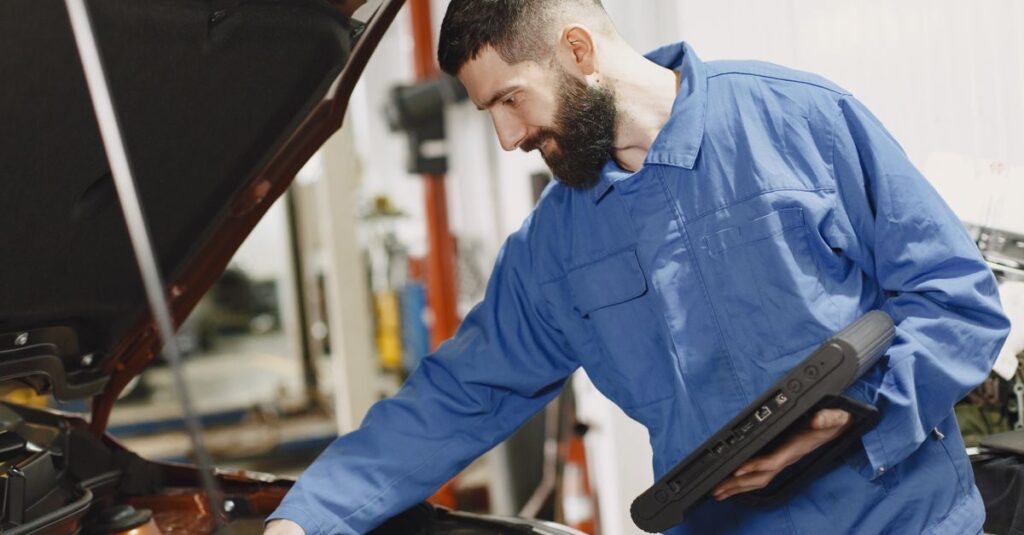
A technician will normally begin with a diagnostic scan to retrieve stored fault codes. Those codes can point towards the system that needs investigation, but they are not necessarily proof that a particular part has failed. Further inspection may be needed before anything is replaced, as explained in Ashtons Garage’s diagnostic guidance.
When contacting a garage or breakdown provider, describe when the light started and whether the car was shaking, losing power, overheating or making unusual noises. That information can help the technician assess whether the vehicle should be recovered rather than driven.
The simple rule
A flashing engine-management light means stop treating the journey as normal. Slow down, reach a safe place, avoid continuing under load and arrange professional help. A steady amber light may allow a short, careful trip if the car is behaving normally, but it still needs a prompt diagnosis and should never be ignored.