
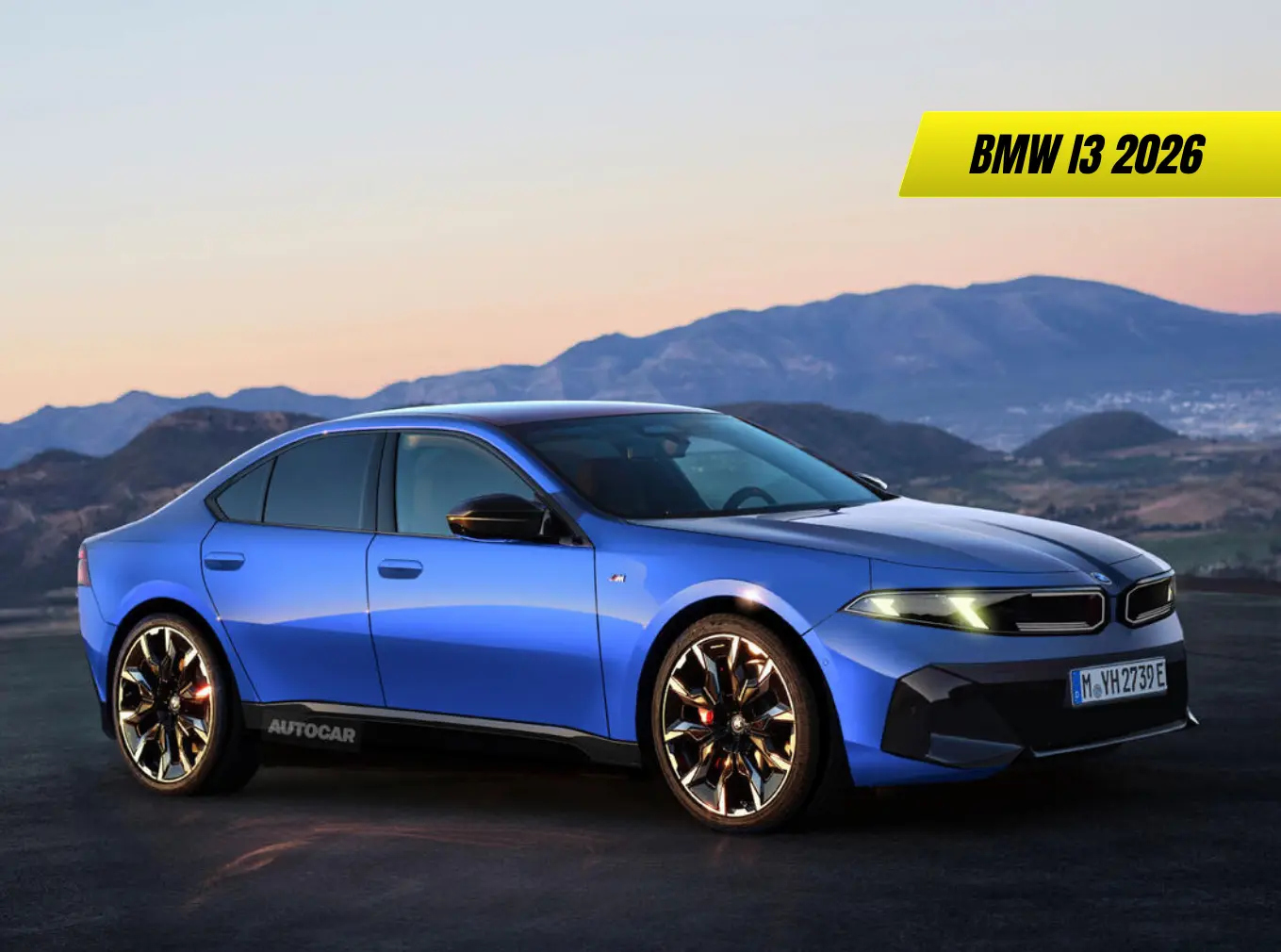
BMW has officially revealed the all-new i3 — the second Neue Klasse model and the electric successor to the 3 Series — with a class-leading 559-mile WLTP range, 400 kW DC charging capable of adding 249 miles in 10 minutes, and 469 hp from dual motors on an 800V platform.
The BMW i3 is back — and this time it is nothing like the compact urban runabout that bore the same name between 2013 and 2022. The new 2026 BMW i3 is the fully electric successor to the 3 Series saloon — BMW’s definitive sports saloon — built on the revolutionary Neue Klasse platform that underpins the brand’s entire electric future. It is the second Neue Klasse production car after the iX3, and in virtually every measurable dimension — range, charging speed, power, technology — it sets a new standard for the premium electric saloon class. UK deliveries are expected from autumn 2026, with pricing starting from approximately £47,185. For context on the wider BMW electric direction, our coverage of the BMW 7 Series facelift 2027 and the competitive landscape against the Mercedes-Benz EQEprovides essential background.
BMW i3 2026: Key Highlights
- 559 miles WLTP range — the longest range of any electric saloon currently on sale
- 400 kW DC rapid charging — adds 249 miles in 10 minutes at a compatible charger
- 800V architecture — sixth-generation BMW eDrive technology
- 469 hp (345 kW) and 645 Nm from dual electric motors — all-wheel drive as standard on launch spec
- 108.7 kWh usable battery — NMC cylindrical cell chemistry, sixth-generation
- 0–62 mph: approximately 4.5 seconds — confirmed under 5 seconds
- Length: 4,760 mm — slightly longer than the current 3 Series
- Built at BMW’s Munich factory — the home of the 3 Series
- UK on sale: autumn 2026 — pricing from approximately £47,185
- Rivals: Mercedes C-Class EV, Tesla Model 3, Polestar 2, Audi A4 e-tron
Release Date: Autumn 2026 in the UK
BMW has confirmed that production of the new i3 begins in August 2026 at the Munich factory, with UK deliveries following in autumn 2026. The launch specification is the i3 50 xDrive M Sport — a dual-motor, all-wheel-drive, fully equipped variant expected to be the primary volume model at launch. Additional powertrain options — including a rear-wheel-drive single-motor variant and the combustion-engined 3 Series that will share the same Neue Klasse platform — will follow in 2027.
Price: From Approximately £47,185 in the UK
BMW has not confirmed official UK pricing, but multiple sources indicate the i3 50 xDrive M Sport launch specification will start from approximately £47,185 — the same price as the current hybrid 3 Series 330e M Sport. This is a deliberately precise positioning decision by BMW: it signals that the electric i3 carries no price premium over the equivalent petrol-hybrid car, removing the financial barrier that has historically deterred 3 Series buyers from making the switch to electric.
| Model | Power | Range | DC Charging | UK Price (from) |
|---|---|---|---|---|
| BMW i3 50 xDrive M Sport | 469 hp | 559 miles | 400 kW | ~£47,185 |
| Tesla Model 3 Long Range AWD | 441 hp | 390 miles | 250 kW | £44,990 |
| Mercedes C-Class EV (est.) | ~300 hp | ~400 miles | 200 kW | ~£50,000 est. |
| Polestar 2 Long Range AWD | 476 hp | 396 miles | 205 kW | £52,900 |
| Audi A4 e-tron (est.) | ~300 hp | ~400 miles | 270 kW | ~£48,000 est. |
From my point of view, the £47,185 starting price combined with the 559-mile range, 400 kW charging and 469 hp makes the BMW i3 50 xDrive the most compelling single product announcement in the premium electric saloon segment since the Tesla Model S. The range and charging speed combination alone redefines what is possible in a sub-£50,000 electric car.
The Neue Klasse Platform: Why This Changes Everything
The BMW i3’s extraordinary performance credentials are entirely enabled by the Neue Klasse platform — the architecture that BMW has been developing for over five years and that will underpin every new BMW product from 2025 onwards.
Sixth-Generation Cylindrical Battery Cells
The most important technical breakthrough in the Neue Klasse is the sixth-generation cylindrical battery cell — a fundamentally new cell format that BMW developed in partnership with its battery suppliers. Key advantages over the previous generation:
- Energy density increased by 20% — more energy in the same physical space
- Charging speed increased by 30% — faster ion transfer within the cell enables the 400 kW peak charging rate
- Cell-to-pack integration — the cells are embedded directly into the vehicle’s structural floor, eliminating the conventional battery module casings and saving significant weight
- NMC chemistry — higher energy density than LFP chemistry, enabling the 108.7 kWh usable capacity in a package that fits within the i3’s saloon proportions
800V Architecture
The i3’s 800V electrical architecture is the enabler of the 400 kW DC charging capability. At 800V, the current required to deliver a given power level is halved compared to 400V systems — meaning thinner cables, less heat generation and dramatically faster charging without thermal management challenges.
The practical result: 249 miles of range added in 10 minutes at a compatible high-power charging point. In the UK, Gridserve Electric Highway and BP Pulse Ultra networks already support 400 kW charging — meaning the i3’s headline capability is immediately usable by UK buyers.
SuperBrain Vehicle Intelligence
The Neue Klasse platform introduces BMW’s SuperBrain — a centralised computing architecture that consolidates the functions previously distributed across dozens of separate ECUs into a small number of powerful central processors. For the i3, this means:
- Over-the-air software updates for all vehicle systems — not just infotainment but also safety, chassis and powertrain parameters
- Continuous improvement of the car throughout its ownership life
- Predictive energy management — the SuperBrain analyses route data, topography, traffic and weather to optimise battery usage on every journey
Performance: 469 hp, AWD and a Sports Saloon Character
The launch i3 50 xDrive produces 469 hp (345 kW) and 645 Nm — figures that place it firmly in M3 territory for power, though the i3’s character is tuned for sporting elegance rather than track aggression.
- 0–62 mph: approximately 4.5 seconds — estimated, not yet officially confirmed
- Top speed: approximately 155 mph (electronically limited)
- Torque delivery: instant from 0 rpm — the dual-motor AWD system delivers the characteristic EV surge that makes 469 hp feel considerably more dramatic than the equivalent combustion figure
BMW has confirmed that the iX3’s SuperBrain chassis systems have been retuned for a sportier driving character in the i3 — consistent with the 3 Series’ established position as the sports saloon benchmark. The i3’s lower centre of gravity (enabled by the floor-mounted battery) and the dual-motor torque vectoring capability are expected to give it handling characteristics that rival the current M340i despite the inevitable weight premium of the large battery pack.
Design: Neue Klasse Aesthetic for the Sports Saloon
The i3 adopts BMW’s Neue Klasse design language — first seen on the iX3 Vision concept and now refined for a production sports saloon:
- Closed front end — no traditional kidney grille apertures; instead a flat, illuminated panel that houses sensors and displays the BMW roundel
- Panoramic Vision — a pillar-to-pillar information projection system across the lower windshield
- Flush door handles — retractable units eliminating the traditional door handle protrusion
- Length: 4,760 mm — slightly longer than the current G20 3 Series (4,709 mm)
- Low roofline — a fastback-influenced silhouette that reduces drag without compromising rear headroom
- New BMW kidney graphic — illuminated on the closed front panel, maintaining brand recognition without requiring a conventional grille opening
The overall proportions are those of a classic three-box sports saloon — long bonnet, short overhangs, muscular rear haunches — interpreted through the clean-surface, graphic-focused Neue Klasse design philosophy.
BMW i3 Touring: The Electric Estate Variant
Alongside the saloon, BMW has confirmed that a 3 Series Touring variant on the Neue Klasse platform will follow — providing an electric estate car option for buyers who need the practicality of a load-lugging body without sacrificing the i3’s performance and range credentials.
The i3 Touring is expected to:
- Share the identical Neue Klasse platform and powertrain as the saloon
- Offer a boot capacity of approximately 500 litres — up from the saloon’s estimated 430 litres
- Arrive in the UK approximately 6–12 months after the saloon — late 2027
- Be priced at a premium of approximately £2,000–£3,000 over the equivalent saloon specification
For UK buyers, the i3 Touring will be the most important variant — the estate body style accounts for a significant proportion of premium saloon sales in Britain, and an electric estate with 559-mile range and 400 kW charging will be one of the most compelling long-distance family car propositions available at any price.
Charging in the UK: 400 kW — Is the Infrastructure Ready?
The i3’s 400 kW peak DC charging capability is the most headline-grabbing number in the car’s specification. But how usable is it on UK roads today?
Compatible UK charging networks (current):
- Gridserve Electric Highway: multiple 360 kW units at service areas — compatible with 800V vehicles, achieving near-maximum charge rates for the i3
- BP Pulse Ultra: 300 kW units at key motorway locations — delivering approximately 300 kW to 800V vehicles
- Osprey Charging: 350 kW units at selected locations
The reality for UK i3 owners in 2026: 350–360 kW will be the practical maximum at currently installed UK chargers — still adding approximately 220–230 miles in 10 minutes. As the Gridserve and BP Pulse networks continue to upgrade to 400 kW+ infrastructure throughout 2026–2027, the i3’s full capability will progressively become available. For guidance on UK speed camera and road rules relevant to fast motorway runs between chargers, our UK speed camera regulations 2025 guide is essential reading.
BMW i3 Saloon vs. Current 3 Series: The Full Transition
| Feature | BMW 330e M Sport | BMW i3 50 xDrive M Sport |
|---|---|---|
| Power | 292 hp | 469 hp |
| 0–62 mph | 5.8 sec | ~4.5 sec |
| Range | ~350 miles (petrol) | 559 miles (electric) |
| Charging | Petrol fill: 5 min | 249 miles in 10 min |
| CO2 | 26 g/km (PHEV) | 0 g/km |
| BiK rate | 5% | 3% |
| UK Price | ~£47,185 | ~£47,185 |
FAQ
When is the new BMW i3 on sale in the UK?
UK deliveries are expected from autumn 2026 — production begins at the Munich factory in August 2026.
How much will the BMW i3 2026 cost?
Expected to start from approximately £47,185 — the same price as the current BMW 330e M Sport.
What is the range of the new BMW i3?
Up to 559 miles WLTP — the longest range of any premium electric saloon on sale in the UK.
How fast does the BMW i3 charge?
Up to 400 kW DC — adding 249 miles of range in 10 minutes at a compatible ultra-rapid charger.
What platform is the new BMW i3 built on?
The Neue Klasse platform — BMW’s next-generation EV architecture featuring sixth-generation cylindrical battery cells and 800V architecture.
Is there a BMW i3 Touring estate?
Yes — a 3 Series Touring variant on the Neue Klasse platform is confirmed, expected in the UK approximately late 2027.
How does the BMW i3 compare to the Tesla Model 3?
The i3 offers 169 more miles of range (559 vs 390), significantly faster charging (400 kW vs 250 kW) and BMW’s traditional sports saloon driving character — at a slightly higher starting price.
Conclusion
The 2026 BMW i3 is the most important BMW since the M3 — a sports saloon that simultaneously represents the best of the brand’s traditional strengths (driver engagement, build quality, premium positioning) and the most technically advanced battery electric architecture currently in production anywhere in the world. At £47,185 with 559 miles of range and 400 kW charging, it makes the Tesla Model 3 feel underpowered, outranged and slowly charged by comparison. From my point of view, the i3 is the car that will finally convert committed 3 Series petrolheads to electric driving — and I would recommend placing an order the moment UK specifications are confirmed.





