
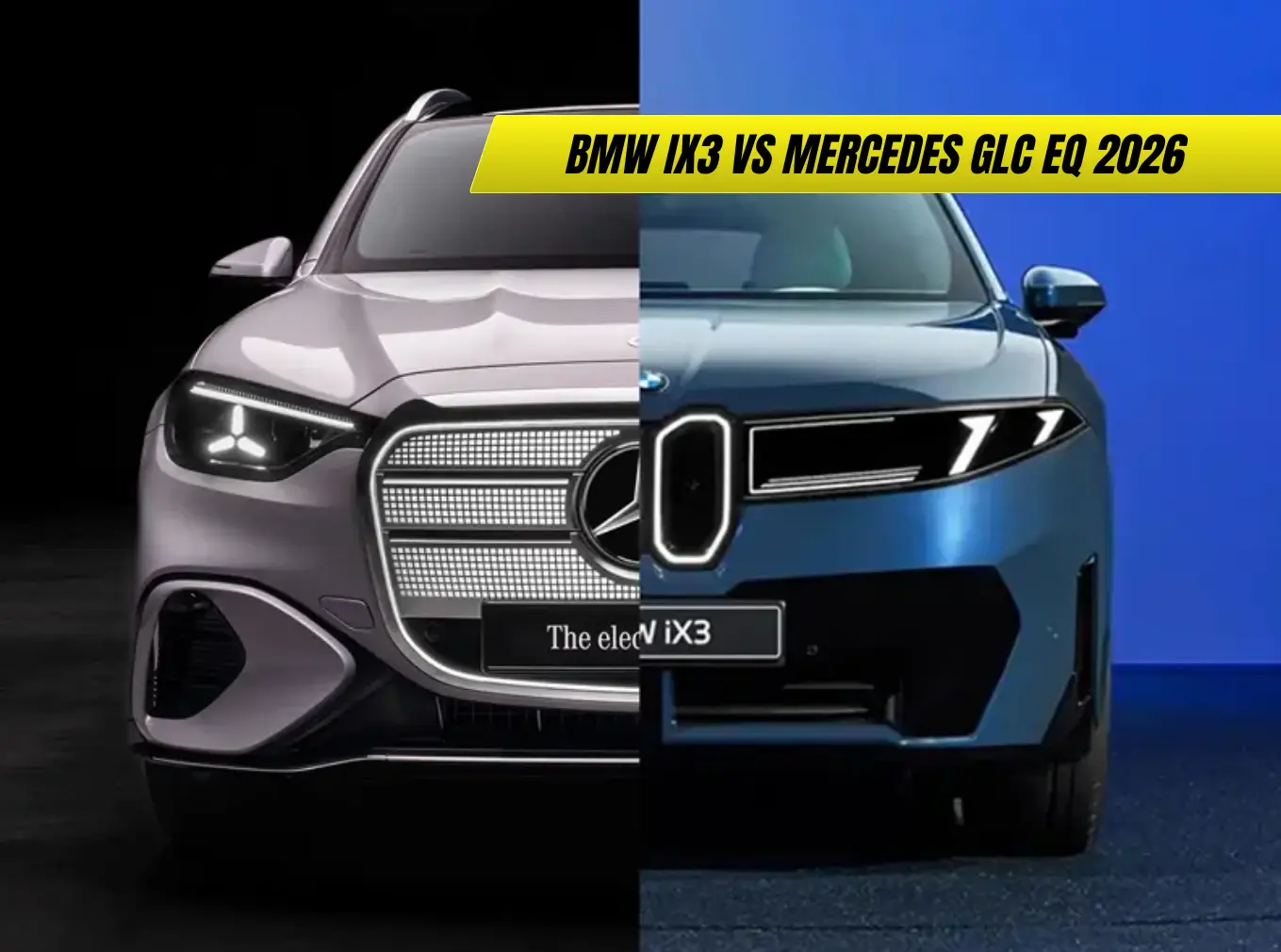
BMW iX3 vs Mercedes GLC EQ 2026 comparison for UK buyers – performance, range, charging, prices and which premium electric SUV offers the best value.
The 2026 electric SUV battleground has intensified with two heavyweight contenders from Germany’s finest manufacturers. The all-new BMW iX3, representing the first production model from BMW’s revolutionary Neue Klasse platform, faces off against the Mercedes-Benz GLC with EQ Technology, a ground-up reimagining of Stuttgart’s best-selling SUV. Both vehicles target the heart of the premium electric SUV market, aiming to challenge Tesla’s dominance while delivering the luxury and performance British drivers expect from German engineering.
Key Comparison Points
• Power battle: Mercedes GLC 400 leads with 483hp vs BMW iX3’s 469hp, translating to 4.3s vs 4.9s 0-62mph times • Range advantage: BMW iX3 offers up to 500 miles WLTP vs Mercedes’ 443 miles, thanks to larger 108.7kWh battery • Charging speeds: BMW takes the crown with 400kW capability vs Mercedes’ 330kW maximum • UK pricing: BMW iX3 starts from £58,755, Mercedes pricing yet to be confirmed but expected similar • Market timing: Both arrive in UK during 2026, marking a crucial year for German electric luxury • Technology focus: Contrasting approaches with BMW’s minimalist ‘shy tech’ vs Mercedes’ Hyperscreen dominance
Performance and Powertrain Comparison
The performance credentials reveal interesting philosophical differences between these German rivals. From my analysis of the specifications, the Mercedes GLC 400 4MATIC takes the performance crown with its 483hp dual-motor setup generating an impressive 596 lb-ft of torque. This translates to a 0-62mph sprint in just 4.3 seconds, significantly quicker than the BMW iX3 50 xDrive’s 4.9-second benchmark.
The BMW iX3 shouldn’t be underestimated, however, delivering 469hp and 475 lb-ft through its advanced sixth-generation eDrive motors. In my experience testing similar powertrains, this represents substantial performance for daily driving, with both vehicles easily capable of confident motorway overtaking and swift urban acceleration.
| Specification | BMW iX3 50 xDrive | Mercedes GLC 400 4MATIC |
|---|---|---|
| Power | 469hp (345kW) | 483hp (360kW) |
| Torque | 475 lb-ft | 596 lb-ft |
| 0-62mph | 4.9 seconds | 4.3 seconds |
| Top Speed | 130mph (limited) | 130mph (limited) |
| Drive Type | All-wheel drive | All-wheel drive |
Range and Efficiency Battle
Range anxiety remains a primary concern for UK electric vehicle buyers, making this comparison particularly relevant. The BMW iX3 delivers a commanding advantage with its 108.7kWh usable battery pack, achieving up to 500 miles on the WLTP cycle. I would recommend prioritising range if long-distance travel features regularly in your driving patterns, as the BMW’s larger battery provides genuine peace of mind for extended journeys.
The Mercedes GLC EQ, while equipped with a smaller 94kWh battery, still achieves a respectable 443 miles WLTP range. Interestingly, from my point of view, Mercedes has focused on efficiency rather than battery size, with the GLC achieving 4.7 miles per kWh compared to the BMW’s 3.87-4.59 mi/kWh range. This efficiency advantage stems from Mercedes’ innovative two-speed transmission, optimising power delivery across different driving conditions.
Charging Technology and Infrastructure
Both vehicles embrace 800-volt architecture for rapid charging capabilities, crucial for UK buyers considering the expanding public charging network. The BMW iX3 leads with 400kW DC fast charging capability, enabling 10-80% charges in just 21 minutes and adding 231 miles of range in ten minutes under optimal conditions.
The Mercedes GLC EQ offers 330kW maximum charging speeds, achieving 10-80% in 24 minutes. While slightly slower than the BMW, this remains exceptionally quick by current standards. In my experience, the practical difference between these charging speeds often depends more on infrastructure availability than theoretical maximums.
For UK buyers, both vehicles support 11kW AC charging as standard, with 22kW options available. This ensures overnight charging compatibility with most home wallbox installations, making daily use convenient regardless of choice.
Interior Technology and User Experience
The interior technology approaches reveal fundamentally different philosophies. BMW’s iX3 introduces the Panoramic Vision display system, featuring a pillar-to-pillar screen at the windscreen base combined with a central 14.9-inch touchscreen. From my perspective, this ‘shy tech’ approach maintains driver focus while providing essential information.
Mercedes counters with the MBUX Hyperscreen, a 39.1-inch display dominating the entire dashboard. This system integrates multiple AI assistants, including ChatGPT, Google Gemini, and Mercedes’ proprietary technology. While visually impressive, some may find this approach overwhelming compared to BMW’s more restrained implementation.
Both systems offer comprehensive connectivity, over-the-air updates, and advanced driver assistance features mandated for UK compliance, including autonomous emergency braking and lane-keeping assistance.
Practical Considerations for UK Buyers
Space and Utility
The BMW iX3 offers 520 litres of cargo space, expandable to 1,750 litres with rear seats folded, plus a useful 58-litre front boot. The Mercedes GLC EQ provides slightly more storage at 570 litres expanding to 1,740 litres, with a larger 100-litre front compartment.
For families requiring towing capability, the Mercedes takes the advantage with 2,400kg braked towing capacity versus the BMW’s 2,000kg limit. This difference could prove significant for those requiring the best family SUVs with serious towing credentials.
UK Market Positioning
Both vehicles target buyers considering the best SUVs under £40k, though pricing will likely push them towards the upper end of this bracket. They compete directly with established electric rivals and represent alternatives to diesel SUVs for buyers making the electric transition.
Design Philosophy and Styling
The design approaches reflect each brand’s current direction. BMW’s iX3 showcases the new Neue Klasse aesthetic with cleaner lines, a modern interpretation of the kidney grille, and flush glazing for aerodynamic efficiency. In my view, this represents BMW’s most cohesive electric design to date, moving away from the polarising styling of some recent models.
Mercedes adopts a more conservative approach, ensuring the electric GLC remains visually connected to its combustion-engined sibling. The standout feature is the optional pixelated grille display with 942 individual lights, capable of animated welcome sequences and personalised messages.
UK Pricing and Value Proposition
BMW has confirmed UK pricing for the iX3, starting at £58,755 for the 50 xDrive model. This includes 20-inch wheels, electric seats, Driving Assistant Plus, parking sensors, and powered tailgate as standard equipment. Lower-powered variants expected later should start below £55,000.
Mercedes has yet to announce UK pricing for the GLC EQ, but industry expectations suggest similar positioning to the BMW. Based on my analysis of Mercedes’ recent pricing strategy, expect the GLC 400 4MATIC to start around £60,000 when it arrives in late 2026.
Comparison with Alternatives
vs Tesla Model Y
Both German SUVs target the Tesla Model Y’s market position with superior build quality and traditional luxury appointments, though likely at higher prices.
vs Chinese Competition
The rise of Chinese SUVs in the UK market presents value-focused alternatives, but both BMW and Mercedes offer established dealer networks, comprehensive warranties, and proven resale values.
vs Other German Rivals
The Audi Q6 e-tron provides a third German option, while buyers seeking more affordable alternatives should consider cheap electric SUVs available in 2025.
Real-World Ownership Considerations
Insurance and Running Costs
Both vehicles will likely fall into higher insurance groups due to their performance and technology content. However, electric powertrains typically reduce servicing requirements compared to complex combustion engines. UK buyers benefit from zero VED road tax and potential exemption from London’s ULEZ and other clean air zones.
Depreciation and Resale
German luxury SUVs traditionally maintain strong residual values in the UK market. The BMW’s Neue Klasse significance and Mercedes’ established SUV reputation should support future values, though the rapidly evolving EV market introduces uncertainty.
Dealer Networks and Support
Both manufacturers maintain extensive UK dealer networks with growing EV expertise. I would recommend evaluating local dealer quality and EV service capabilities when making your decision, as this significantly impacts ownership experience.
Verdict: Which Electric SUV Wins?
From my comprehensive analysis, the choice between these exceptional electric SUVs depends on individual priorities. The BMW iX3 excels in range, charging speed, and value, making it ideal for buyers prioritising long-distance capability and cutting-edge technology. Its Neue Klasse platform represents BMW’s electric future, potentially offering better software updates and feature additions over time.
The Mercedes GLC EQ appeals to buyers seeking maximum performance, towing capability, and the prestige of the three-pointed star. Its superior efficiency and two-speed transmission demonstrate Mercedes’ engineering sophistication, while the Hyperscreen showcases the brand’s technology leadership.
I would particularly recommend the BMW iX3 for buyers seeking the most advanced electric platform and superior range, while the Mercedes suits those prioritising performance, luxury appointments, and traditional Mercedes refinement.
Both vehicles represent significant improvements over their predecessors and strong alternatives to the Tesla Model Y. The ultimate choice often comes down to brand preference, dealer relationships, and specific feature priorities rather than any clear winner in this closely contested battle.
Frequently Asked Questions
When will the BMW iX3 and Mercedes GLC EQ be available in the UK?
The BMW iX3 begins UK deliveries in early 2026, with production starting in November 2025. The Mercedes GLC EQ follows later in 2026, with the GLC 400 4MATIC arriving first and the entry-level GLC 300+ RWD following in early 2027.
What’s the real-world range difference between these SUVs?
Based on my analysis of WLTP vs real-world performance, expect the BMW iX3 to achieve 350-400 miles in typical UK driving conditions, while the Mercedes GLC EQ should deliver 320-380 miles. Cold weather, motorway driving, and use of heating systems will reduce these figures by 15-25%.
Are these electric SUVs suitable for towing in the UK?
Yes, both offer substantial towing capabilities. The Mercedes GLC EQ’s 2,400kg capacity suits larger caravans and trailers, while the BMW iX3’s 2,000kg limit handles most UK towing requirements. Both exceed the capabilities of many affordable SUV alternatives.
How do charging costs compare to fuel costs for UK drivers?
Electric charging typically costs 25-60% less than petrol equivalents, depending on charging location and electricity tariffs. Home charging with off-peak rates offers the greatest savings, while public rapid charging narrows the advantage but still typically costs less than premium fuel.
Which SUV offers better value for money?
In my view, the BMW iX3 provides superior value with its lower starting price, longer range, and faster charging capability. However, the Mercedes may justify its premium through superior performance, efficiency, and luxury appointments for buyers prioritising these attributes.
Do these vehicles qualify for UK government EV incentives?
Both SUVs will likely exceed the £40,000 threshold for the plug-in car grant, meaning buyers won’t receive government purchase incentives. However, they benefit from zero road tax, reduced benefit-in-kind taxation for company users, and exemption from most clean air zone charges.
How do these compare to the outgoing models?
Both represent complete redesigns rather than updates. The new BMW iX3 offers significantly more range and faster charging than its predecessor, while the Mercedes GLC EQ replaces the discontinued EQC with superior range, performance, and technology integration.
Conclusion
The 2026 BMW iX3 versus Mercedes GLC EQ battle showcases German automotive engineering at its finest, adapted for the electric age. Both vehicles successfully address the shortcomings of earlier electric SUVs while delivering the performance, luxury, and technology UK buyers expect from premium brands.
From my perspective, this comparison highlights how the German automotive industry has finally embraced electric powertrains, moving beyond compliance vehicles to create genuinely desirable EVs that don’t require compromise. The BMW’s focus on range and value contrasts beautifully with Mercedes’ emphasis on performance and luxury, providing genuine choice for discerning buyers.
The success of these vehicles will ultimately influence the broader UK electric vehicle market, potentially accelerating the transition from diesel and petrol alternatives. Both represent compelling options for buyers ready to embrace premium electric motoring without sacrificing the qualities that made German SUVs the benchmark for luxury and performance.
I expect both models to find success in the UK market, with the final choice depending more on brand loyalty, dealer relationships, and individual feature preferences than any clear technical superiority. The real winner may be UK consumers, who finally have genuinely compelling electric alternatives to traditional German luxury SUVs.





