
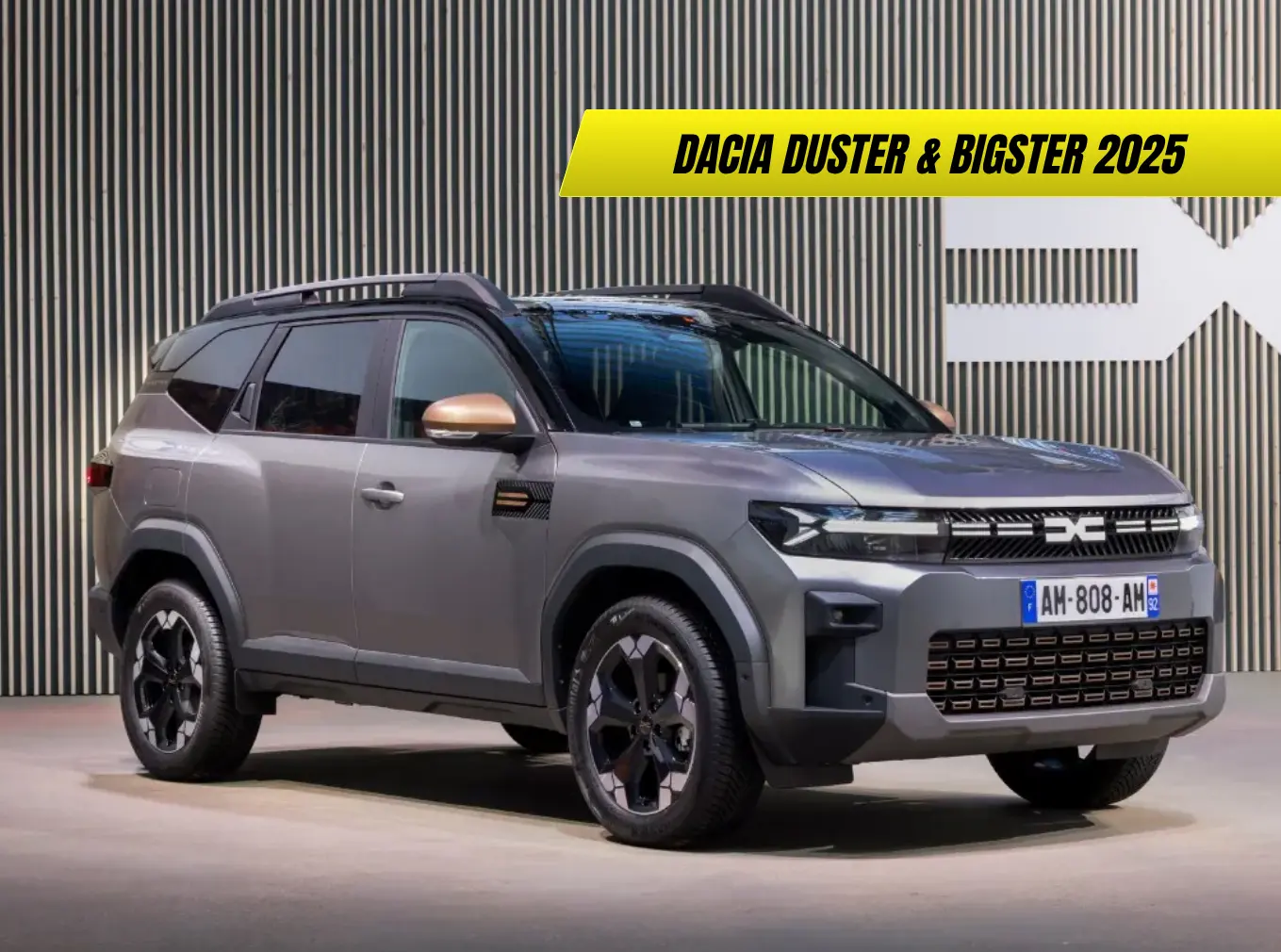
Dacia launches Bigster as brand’s largest SUV March 2026 measuring 4.57 meters with class-leading 667-702 liter cargo capacity depending on powertrain, offering four electrified engines (TCe 140 mild hybrid, Eco-G 140 bi-fuel LPG, Hybrid 155 full hybrid, Hybrid-G 150 4×4) starting €24,800 positioning as European market’s most affordable C-segment family SUV undercutting competitors €5,000-10,000 while maintaining Renault-proven mechanicals and comprehensive seven-year warranty coverage.
Romanian budget brand Dacia (Renault Group subsidiary) expands lineup upmarket through Bigster representing manufacturer’s first genuine C-segment SUV positioned above compact Duster (4.34m) and Jogger MPV (4.5m) targeting growing family buyers seeking maximum interior space and practicality within accessible sub-€30,000 pricing established manufacturers cannot profitably match without undermining mainstream brand positioning, as demonstrated by Volkswagen’s failed attempts marketing budget T-Cross variants eventually abandoned favor premium Tiguan focus leaving value segment undefended against Dacia’s relentless expansion capturing 4-6% European market share through ruthless cost optimization eliminating non-essential features (automatic tailgates, premium materials, advanced driver assistance) customers willing sacrifice accepting budget positioning. The 4.57-meter length and 2.70-meter wheelbase create generous interior volume delivering class-leading 24cm rear legroom plus exceptional 667-702 liter cargo capacity (depending on powertrain – mild hybrid offers maximum 702 liters, full hybrid reduced to 546-612 liters due to battery packaging) rivaling or exceeding larger premium SUVs costing €40,000-50,000 while Dacia maintains €24,800-31,300 accessible pricing through platform sharing (CMF-B architecture borrowed from Renault Austral, Nissan Qashqai), simplified trim structures (four levels versus typical seven-tier German hierarchies), and strategic equipment omissions reserving advanced technology for optional packages enabling sub-€25,000 entry price impossible achieving with comprehensive standard equipment. The four-powertrain strategy addresses diverse European market preferences spanning budget-conscious Eastern European buyers prioritizing LPG bi-fuel cost savings (Eco-G 140), efficiency-focused Western buyers demanding hybrid electrification (Hybrid 155 full hybrid), all-weather capability enthusiasts requiring traction (Hybrid-G 150 4×4), and value-oriented mainstream customers accepting conventional mild hybrid balancing performance and consumption (TCe 140), creating comprehensive range unmatched competitors typically offering maximum two-three powertrain choices within equivalent pricing though Dacia achieves portfolio breadth through Renault Group platform economics enabling engine proliferation impossible smaller independent manufacturers lacking multinational scale.
Technical Specifications: Comprehensive Powertrain Portfolio
Dacia offers four distinct electrified engines addressing varied customer priorities and regional market demands.
TCe 140 Mild Hybrid (Base Powertrain)
Engine Specifications
- Displacement: 1.2-liter turbocharged 3-cylinder
- Power output: 103 kW (140 hp) @ 5,500 rpm
- Torque: 260 Nm @ 1,600-3,600 rpm
- Configuration: Inline-3, direct injection, turbocharger
- Hybrid system: 48V belt-integrated starter generator + 48V battery
- Transmission: 6-speed manual standard (base) or 6-speed EDC dual-clutch automatic (optional)
- Drive: Front-wheel drive
Performance and Efficiency
- 0-100 km/h: ~10.5 seconds estimated
- Top speed: ~190 km/h
- Fuel consumption: 5.4-6.0 l/100km WLTP combined
- CO₂ emissions: 122-135 g/km
- Real-world consumption: 6.5-7.5 l/100km typical
Mild Hybrid Benefits
- Start-stop functionality with silent restart
- Regenerative braking energy recovery
- Modest electric assistance during acceleration (~10% consumption reduction)
- No external charging required (self-sufficient system)
Pricing
- Essential: €24,800
- Expression: €25,800
- Journey: €27,800
- Extreme: €27,800
Eco-G 140 Bi-Fuel LPG
Dual-Fuel Configuration
- Base engine: Same 1.2 TCe 140 turbocharged 3-cylinder
- Power output: 140 hp (identical to gasoline-only)
- Fuel system: Bi-fuel capable running gasoline or LPG
- Transmission: 6-speed manual (automatic unavailable for bi-fuel)
- Drive: Front-wheel drive
Fuel Capacity and Range
- Gasoline tank: 50 liters
- LPG tank: 49 liters (positioned spare wheel well)
- Combined range: 1,300+ km theoretical (exceptional touring capability)
- LPG consumption: ~7.5 l/100km (higher volume than gasoline due to lower energy density)
- Gasoline consumption: 5.4-6.0 l/100km
Operating Cost Advantage
- LPG price: ~€0.70-0.85 per liter (versus €1.60-1.85 gasoline)
- Annual savings: €600-900 for 15,000 km driving versus gasoline
- Payback period: ~2-3 years versus gasoline-only TCe 140
Pricing (Identical to TCe 140)
- Essential Eco-G: €24,800
- Expression Eco-G: €25,800
- Journey Eco-G: €27,800
- Extreme Eco-G: €27,800
LPG Market Considerations
- Strong infrastructure: Italy (~4,500 stations), Poland (~7,000 stations), France (~1,700 stations)
- Moderate availability: Spain (~700 stations), Netherlands (~500 stations)
- Limited infrastructure: Germany (~500 stations), UK (~1,400 declining), Scandinavia (minimal)
Hybrid 155 Full Hybrid
Advanced E-Tech System
Powertrain Configuration
- Gasoline engine: 1.8-liter naturally-aspirated 4-cylinder (94 kW / 127 hp)
- Primary electric motor: 36 kW (49 hp) integrated multi-mode transmission
- Secondary electric motor: 15 kW (20 hp) starter-generator
- Combined system output: 115 kW (155 hp)
- Battery: 1.2 kWh nickel-metal hydride (NiMH) positioned under rear seats
- Transmission: Multi-mode automatic (no traditional gearbox – innovative dog clutch system)
- Drive: Front-wheel drive
E-Tech Transmission Innovation
- Four electric modes + two engine modes creating efficient operation across speed ranges
- No CVT rubber-banding sensation
- Instant electric torque low speeds
- Seamless transitions between electric and combustion propulsion
Performance and Efficiency
- 0-100 km/h: ~10.0 seconds
- Top speed: ~170 km/h
- Fuel consumption: 4.6-4.8 l/100km WLTP combined (~61 mpg UK)
- CO₂ emissions: 105-109 g/km
- Real-world consumption: 5.2-5.8 l/100km typical (10-15% better than mild hybrid)
- Electric-only operation: Capable pure EV driving up to ~80 km/h for short distances (battery small capacity limits electric-only range to 1-2 km)
Pricing Premium
- Expression Hybrid 155: €29,300 (+€3,500 versus mild hybrid Expression)
- Journey Hybrid 155: €31,300 (+€3,500 versus mild hybrid Journey)
- Extreme Hybrid 155: €31,300 (+€3,500 versus mild hybrid Extreme)
Value Proposition
The €3,500 hybrid premium pays back through fuel savings:
- Annual driving 15,000 km: ~€450-600 fuel cost savings versus mild hybrid
- Payback period: 6-8 years (marginal for private buyers)
- Company car advantage: Lower CO₂ (105 vs 122 g/km) reduces BIK taxation significantly
Hybrid-G 150 4×4 (New 2026 Addition)
Innovative Bi-Fuel Hybrid with AWD
Powertrain Specifications
- Base: Hybrid 155 E-Tech full hybrid system
- Modification: LPG bi-fuel capability added to 1.8L gasoline engine
- Power output: 111 kW (150 hp) combined (slightly detuned versus Hybrid 155’s 155 hp)
- Drive: Four-wheel drive (unique to this variant)
- Transmission: E-Tech multi-mode automatic
Dual-Fuel Configuration
- Gasoline tank: 50 liters
- LPG tank: 40-45 liters estimated
- Battery: 1.2 kWh NiMH (same as Hybrid 155)
- Combined range: 1,200+ km (LPG + gasoline + electric regeneration)
Fuel Economy
- LPG consumption: ~5.5-6.0 l/100km
- Gasoline consumption: ~4.8 l/100km (when operating gasoline-only)
- Operating cost: Lowest in range due to cheap LPG fuel combined with hybrid efficiency
Pricing (New for 2026)
- Duster Hybrid-G 150 4×4: Starting €26,650 (launching December 2025)
- Bigster Hybrid-G 150 4×4: Pricing TBD, estimated €32,000-34,000
Target Market
- Eastern European buyers with excellent LPG infrastructure
- Towing enthusiasts requiring AWD traction
- Long-distance drivers benefiting from exceptional range
- Budget-conscious families wanting all-weather capability
Dimensions and Interior Space
The Bigster delivers class-leading spaciousness within accessible C-segment pricing.
Exterior Dimensions
| Measurement | Bigster | Duster (Comparison) | Difference |
|---|---|---|---|
| Length | 4,570 mm | 4,340 mm | +230 mm |
| Wheelbase | 2,700 mm | 2,657 mm | +43 mm |
| Width | 1,813 mm | 1,813 mm | Identical |
| Height | 1,690 mm | 1,660 mm | +30 mm |
| Ground clearance | 205 mm | 217 mm | -12 mm (Bigster lower) |
Design Proportions
- Generous 2.70m wheelbase creates spacious interior
- Extended rear overhang maximizes cargo capacity
- Upright stance maintaining SUV character
- Roof rails standard (visual element, modest load capacity)
Interior Volume and Practicality
Passenger Space (Class-Leading)
- Front headroom: 1,020 mm
- Rear headroom: 980 mm (best-in-class)
- Rear legroom: 240 mm knee clearance (class-leading, rivals premium D-segment SUVs)
- Seating capacity: 5 adults comfortably
- 60/40/20 split-folding rear seats: Central section converts to armrest with cupholders and smartphone storage
Cargo Capacity (Powertrain-Dependent)
| Configuration | Mild Hybrid 140 | Mild Hybrid-G 140 (LPG) | Hybrid 155 | Hybrid-G 150 4×4 |
|---|---|---|---|---|
| Seats up | 702 liters | 660 liters | 612 liters | 556 liters |
| Seats folded | 2,002 liters | 1,960 liters | 1,912 liters | 1,856 liters |
| Load length | 2,700 mm maximum | 2,700 mm | 2,700 mm | 2,700 mm |
Cargo Notes
- Mild hybrid offers maximum volume (no hybrid battery, smaller LPG tank than bi-fuel)
- Bi-fuel LPG reduces capacity ~40 liters (LPG tank positioned cargo floor)
- Full hybrid reduces capacity ~90-150 liters (NiMH battery under seats, elevated floor)
- All variants offer flat load floor with seats folded
- Adjustable floor height creating underfloor storage or flat loading surface
Practical Features
- YouClip system: Modular magnetic accessory rails throughout cabin enabling smartphone holders, tablets, cameras, lighting attachment
- 38.8 liters total interior storage compartments (door bins, center console, glove box)
- Electric tailgate: Optional (Journey/Extreme) or unavailable (Essential/Expression)
- Rear USB-C ports: 2x charging points for rear passengers
Equipment and Trim Levels
Dacia maintains simplified four-tier structure avoiding German-style complexity.
Essential (€24,800)
Base Equipment
- 17-inch alloy wheels
- LED daytime running lights (halogen headlights)
- Manual air conditioning
- Semi-digital instrument cluster (7-inch display + analog speedometer)
- 10-inch touchscreen infotainment
- Wireless Apple CarPlay / Android Auto
- Rear parking sensors
- Reversing camera
- YouClip modular storage system
- Cloth upholstery
- Manual tailgate
Safety (Standard All Trims)
- 6 airbags
- ABS with EBD
- Electronic stability control
- Lane departure warning
- Traffic sign recognition
- Automatic emergency braking
Expression (€25,800-29,300)
Additional Over Essential (+€1,000-1,500)
- Dual 10-inch displays (digital cluster + touchscreen)
- Automatic climate control (dual-zone)
- Front parking sensors (in addition to rear)
- Cruise control with speed limiter
- Rear privacy glass
- Electric and heated door mirrors
- Remote central locking with two keys
Journey (€27,800-31,300)
Additional Over Expression (+€2,000-2,500)
- 18-inch alloy wheels
- Full LED headlights (versus halogen Essential/Expression)
- Electric tailgate with hands-free opening
- Wireless smartphone charging pad
- Heated front seats
- Heated steering wheel (Winter Pack, €300-500 optional)
- Ambient interior lighting
- Premium cloth/microfiber upholstery
- Blind spot monitoring (€480-580 optional package)
Extreme (€27,800-31,300)
Outdoor/Rugged Specification (Same Price as Journey)
- 18-inch Extreme-specific alloy wheels (different design versus Journey)
- Black exterior trim accents (wheel arches, side skirts, mirrors)
- Roof rails (functional load capacity)
- Rubber floor mats and cargo liner
- Extreme badging interior and exterior
- Same technology as Journey trim
- Focuses rugged styling over luxury equipment
UK Market Positioning
British pricing converts favorable exchange rates creating exceptional value proposition.
UK Pricing (Converted from European Specifications)
| Trim | Powertrain | UK Price (Estimated) |
|---|---|---|
| Essential | TCe 140 mild hybrid | £24,995 |
| Expression | TCe 140 mild hybrid | £26,500 |
| Journey | TCe 140 mild hybrid | £28,500 |
| Expression | Hybrid 155 | £27,995 |
| Journey | Hybrid 155 | £30,500 |
| Extreme | Hybrid 155 | £30,500 |
UK Competitive Landscape
Direct Competitors
- Nissan Qashqai: £28,000-38,000 (established C-segment leader)
- Kia Sportage: £29,000-42,000 (comprehensive warranty, premium positioning)
- Hyundai Tucson: £32,000-45,000 (technology-rich, higher pricing)
- Mazda CX-5: £31,000-42,000 (driver-focused, upmarket materials)
- Volkswagen Tiguan: £35,000-50,000 (German premium, extensive options)
Bigster Value Advantage
- £3,000-10,000 cheaper than equivalent competitors
- Larger cargo capacity than most rivals
- Seven-year warranty versus typical 3-5 years
- Simple pricing avoiding complex option packages
UK Launch Timeline
- European launch: March 2026
- UK availability: April-May 2026 (right-hand-drive production begins)
- First deliveries: June 2026 onwards
Frequently Asked Questions
When can I buy the Dacia Bigster?
European sales commenced March 2026 with dealer availability across Italy, France, Germany, Spain immediately. UK right-hand-drive production begins April 2026 with first British deliveries June 2026. Contact Dacia dealers for reservation opportunities and specific market launch dates.
How much does the Bigster cost?
European pricing: €24,800-31,300 depending on powertrain and trim. UK pricing: £24,995-30,500 estimated. Base Essential TCe 140 mild hybrid starts €24,800/£24,995, top Hybrid 155 Journey/Extreme reaches €31,300/£30,500. Represents €5,000-10,000 savings versus equivalent competitors (Nissan Qashqai, Kia Sportage, VW Tiguan).
What’s the cargo capacity?
667-702 liters seats up depending on powertrain (mild hybrid maximum 702L, full hybrid reduced to 612L, bi-fuel 660L, AWD hybrid 556L). 1,856-2,002 liters seats folded creating flat load floor with 2.7-meter maximum length. Rivals or exceeds premium SUVs costing €40,000-50,000 despite Bigster’s €25,000-31,000 accessible pricing.
Should I choose mild hybrid, full hybrid, or bi-fuel LPG?
Choose TCe 140 mild hybrid if: budget-conscious (€24,800 entry), adequate 140 hp performance sufficient, mainly highway driving where hybrid gains minimal, prefer transmission choice (manual or automatic). Choose Hybrid 155if: maximum efficiency priority (4.6 l/100km vs 5.4 l/100km), company car driver benefiting lower CO₂ BIK taxation, urban driving maximizing hybrid benefits, willing pay €3,500 premium. Choose Eco-G 140 LPG if: access to LPG infrastructure (Italy, Poland, France), high annual mileage (15,000+ km maximizing fuel cost savings €600-900 annually), unlimited range priority (1,300+ km), manual transmission acceptable.
How does Bigster compare to Duster?
Bigster advantages: 230mm longer, 240mm more rear legroom, 667-702L cargo vs Duster’s 472-1,623L, more upscale interior materials, available full hybrid powertrain. Duster advantages: €5,000-7,000 cheaper (starts €19,990 vs Bigster’s €24,800), 12mm higher ground clearance (better off-road), more compact dimensions easier urban parking. Choose Duster for maximum value and off-road capability, Bigster for interior space and refinement.
Is seven-year warranty really free?
Yes, Dacia includes comprehensive seven-year/100,000-mile manufacturer warranty standard across range (whichever comes first). Covers mechanical failures, powertrain issues, electrical problems excluding normal wear items (tires, brakes, wipers). Industry-leading coverage versus typical 3-year European warranties creates substantial peace-of-mind advantage offsetting budget brand perception concerns.
Can the Bigster tow?
Towing capacity: 1,800 kg braked trailer (TCe 140, Eco-G 140, Hybrid-G 150 4×4 variants). Hybrid 155: Reduced to 1,450 kg (lighter-duty hybrid components). Adequate for caravans, boat trailers, horse boxes within reasonable limits though diesel alternatives offer 2,000-2,500 kg for heavy-duty towing. Consult specific variant specifications as capacities vary by powertrain and drive configuration.
Will Bigster hold its value?
Dacia depreciation historically worse than mainstream brands (Toyota, Mazda, Volkswagen) due to budget positioning and lower initial prices creating smaller absolute depreciation despite higher percentage losses. However, seven-year warranty transferable to subsequent owners potentially improves used values versus out-of-warranty premium alternatives requiring expensive repairs. Strong demand for affordable family SUVs may support values better than previous Dacia models as brand reputation improves and European acceptance grows.
Conclusion
The Dacia Bigster represents Romanian budget brand’s most ambitious European offensive targeting mainstream C-segment family SUV buyers through unbeatable €24,800-31,300 value proposition delivering class-leading interior space (667-702 liter cargo capacity, 240mm rear legroom), comprehensive electrified powertrain portfolio (mild hybrid, full hybrid, bi-fuel LPG, AWD hybrid), and industry-leading seven-year warranty coverage impossible established manufacturers profitably matching without cannibalizing mainstream brand positioning as demonstrated Volkswagen’s retreat from budget segments abandoning value customers to Dacia’s relentless expansion capturing 4-6% European market share through ruthless cost optimization and Renault Group platform economies enabling pricing undercuts €5,000-10,000 below equivalent Nissan Qashqai, Kia Sportage, Mazda CX-5, and Volkswagen Tiguan alternatives commanding premium solely through brand heritage rather than objective engineering superiority increasingly difficult justifying informed buyers prioritizing practicality over badges.
For European families, the Bigster delivers rational transportation solution maximizing interior volume, cargo capacity, and powertrain flexibility within accessible pricing budget-conscious households can afford without financial strain or extended loan commitments, while seven-year warranty coverage addresses traditional reliability concerns plaguing budget vehicles through comprehensive factory protection matching or exceeding premium alternatives typically offering merely 2-3 years creating genuine competitive advantage beyond simple purchase price considerations. The comprehensive powertrain strategy addressing regional market diversity (LPG infrastructure strong Eastern Europe, hybrid demand dominant Western Europe, AWD capability required Northern Europe winter conditions) demonstrates sophisticated product planning impossible achieving smaller manufacturers lacking Renault Group’s multinational scale and platform sharing economies enabling four distinct electrified powertrains within single model range matching or exceeding German premium manufacturers’ typical two-three engine choices despite Dacia operating one-third development budgets through component commonality, simplified specifications, and strategic feature omissions reserving advanced technology optional packages enabling sub-€25,000 entry pricing representing automotive industry’s most compelling value proposition current European market impossible replicating without comparable manufacturing scale, platform economics, and institutional cost discipline Renault Group developed through decades Eastern European budget vehicle production optimizing quality-cost balance Western manufacturers culturally incapable accepting without perceived brand damage.





