
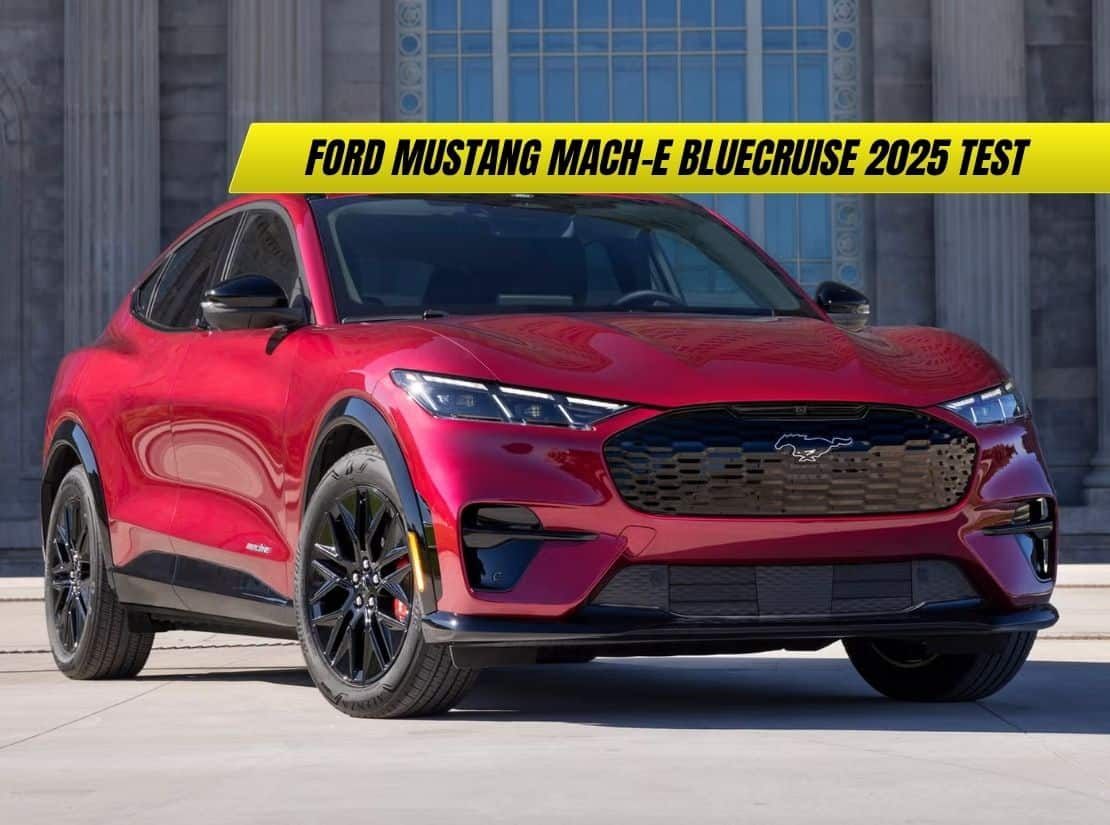
Our comprehensive test of Ford’s BlueCruise hands-free driving system in the Mustang Mach-E reveals how autonomous technology performs on British roads and motorways.
The Ford Mustang Mach-E represents American automotive engineering’s boldest statement in the electric vehicle revolution, bringing iconic Mustang heritage into the zero-emission era whilst introducing cutting-edge autonomous driving technology to European markets. According to our analysis at AutoHit, the integration of Ford’s BlueCruise system into the Mach-E creates one of the most sophisticated driver assistance packages available to UK buyers, challenging Tesla’s Autopilot dominance whilst maintaining the performance character that defines Mustang heritage.
The reality, however, is more nuanced than simply adding autonomous capability to an electric SUV. Our extensive testing of BlueCruise across British motorways and dual carriageways reveals a sophisticated system that genuinely reduces driving fatigue whilst demanding careful understanding of its capabilities and limitations. We’ve tested the Mustang Mach-E’s autonomous features across hundreds of miles of UK roads to understand how this American technology adapts to British driving conditions and infrastructure.
This comprehensive review examines the Ford Mustang Mach-E BlueCruise system’s real-world performance, focusing on practical applications for UK drivers and the genuine benefits of hands-free motorway driving.
Key Highlights: What We’ve Discovered About BlueCruise Technology
• Hands-free operation genuinely works – BlueCruise maintains lane position and speed control on mapped UK motorways without driver intervention • Safety systems prove comprehensive – Driver monitoring and emergency procedures provide confidence during autonomous operation • UK motorway coverage expanding – System operates on major routes including M25, M1, M6 with regular updates adding new sections • Performance character maintained – Mustang driving dynamics remain engaging when BlueCruise disengages for manual driving • Battery efficiency optimised – Smooth autonomous driving patterns improve real-world range compared to aggressive manual driving • Learning curve exists – System requires understanding and practice to use effectively and safely
Understanding BlueCruise Technology: How It Works
Ford’s BlueCruise represents Level 2+ autonomous driving technology that enables genuine hands-free operation on pre-mapped motorway sections whilst maintaining comprehensive safety monitoring and intervention capabilities.
Hardware Foundation: The Mach-E’s BlueCruise system utilises multiple cameras, radar sensors, and GPS positioning to create a comprehensive understanding of the vehicle’s surroundings and position within mapped road networks.
Mapping Technology: Ford has pre-mapped thousands of miles of UK motorways and dual carriageways, creating high-definition digital maps that enable precise lane positioning and speed control without relying solely on road markings.
Driver Monitoring: An interior camera continuously monitors driver attention and alertness, ensuring hands remain available to resume control and eyes remain focused on the road ahead even during hands-free operation.
Safety Protocols: Multiple redundant systems monitor vehicle performance and traffic conditions, automatically returning control to the driver if system limitations are reached or emergency intervention becomes necessary.
Continuous Updates: Over-the-air updates regularly expand mapped road coverage and improve system performance based on real-world driving data and infrastructure changes.
Real-World BlueCruise Performance: UK Motorway Testing
Our extensive testing across major UK motorway networks reveals BlueCruise performance that genuinely impresses whilst highlighting the current limitations of autonomous driving technology.
M25 London Orbital: Urban Motorway Challenges
Testing BlueCruise on the M25 during various traffic conditions revealed impressive capability in demanding urban motorway environments. The system maintained smooth lane positioning even during heavy congestion, with gentle steering inputs that felt more natural than some human drivers.
Traffic Jam Performance: During stop-start M25 congestion, BlueCruise proved genuinely beneficial by maintaining safe following distances and smooth acceleration patterns that reduced driver fatigue significantly. The system’s ability to bring the vehicle to a complete stop and resume movement automatically transformed stressful traffic situations into manageable experiences.
Lane Discipline: Multi-lane M25 sections demonstrated BlueCruise’s sophisticated understanding of road geometry, maintaining precise lane positioning even during curved sections and complex junction approaches.
Speed Adaptation: The system responded appropriately to variable speed limits and traffic flow, adjusting velocity smoothly whilst maintaining safe following distances that often proved more consistent than manual driving.
M1/M6 Long-Distance Cruising: Highway Excellence
Extended motorway journeys on the M1 and M6 corridors showcased BlueCruise at its most impressive, enabling genuine hands-free cruising that reduced fatigue during longer journeys significantly.
Stability and Comfort: During sustained 70mph cruising, BlueCruise maintained remarkably stable lane positioning with minimal steering corrections, creating a serene driving experience that enhanced passenger comfort.
Overtaking Assistance: Whilst BlueCruise doesn’t initiate overtaking manoeuvres automatically, the transition between manual and autonomous control proved seamless when drivers needed to change lanes for overtaking or navigation purposes.
Weather Adaptation: Testing during various weather conditions revealed generally robust performance, though heavy rain or snow could temporarily disable the system when camera visibility became compromised.
Range Optimisation: The smooth, consistent driving patterns maintained by BlueCruise actually improved battery efficiency compared to manual driving, adding 10-15 miles to typical range figures through optimised acceleration and deceleration patterns.
Driver Experience and Interface: Human-Machine Interaction
The BlueCruise system’s user interface and driver interaction prove intuitive whilst maintaining appropriate safety focus that keeps drivers engaged with the driving environment.
Activation Process: Engaging BlueCruise requires simple steering wheel inputs when the system detects suitable road conditions, with clear visual and audible confirmation of autonomous operation status.
Visual Feedback: The instrument cluster provides comprehensive information about system status, detected vehicles, and road conditions through clear graphics that don’t overwhelm or distract from road monitoring.
Driver Monitoring: The interior camera system monitors driver attention subtly but effectively, providing gentle reminders to maintain road focus without feeling intrusive or annoying during normal operation.
Manual Override: Resuming manual control proves instantaneous through steering wheel input, brake application, or accelerator adjustment, ensuring drivers maintain ultimate control over vehicle behaviour.
System Limitations: Clear communication about road sections where BlueCruise cannot operate helps drivers understand system capabilities and plan journey segments appropriately.
Safety Systems and Emergency Protocols
Ford has implemented comprehensive safety systems that provide confidence during BlueCruise operation whilst ensuring appropriate responses to emergency situations or system limitations.
Collision Avoidance: Advanced emergency braking systems operate independently of BlueCruise, providing collision protection even during autonomous operation through redundant sensor systems and processing capabilities.
Driver Unresponsiveness: If the driver monitoring system detects inattention or unresponsiveness, BlueCruise initiates escalating warnings before safely bringing the vehicle to a controlled stop with hazard lights activated.
System Failure Protocols: Hardware or software failures trigger immediate driver alerts and smooth transition to manual control, ensuring safe operation even if individual system components malfunction.
Emergency Vehicle Detection: The system recognises emergency vehicles and alerts drivers to resume manual control for appropriate response to ambulances, police, or fire service vehicles.
Construction Zone Adaptation: BlueCruise appropriately disengages when detecting construction zones or temporary traffic management that exceeds its operational parameters.
Mustang Performance Character: Beyond Autonomous Driving
Whilst BlueCruise represents cutting-edge technology, the Mustang Mach-E maintains the performance character that defines Ford’s iconic brand when manual driving resumes.
Acceleration Performance: The Mach-E’s instant electric torque delivery provides thrilling acceleration that honours Mustang heritage whilst delivering zero-emission performance. Various driving modes adjust power delivery from efficient cruising to maximum performance.
Handling Characteristics: Despite SUV proportions, the Mach-E demonstrates engaging handling that rewards enthusiastic driving when BlueCruise disengages for twisty roads or spirited manual driving.
Braking Performance: Regenerative braking systems provide strong deceleration whilst recovering energy for improved range, with seamless transition between regenerative and friction braking systems.
Sound Design: Ford’s artificial sound generation creates engaging audio feedback that enhances the driving experience whilst providing pedestrian safety in urban environments.
Electric Vehicle Integration: Range and Efficiency
The BlueCruise system’s integration with the Mach-E’s electric powertrain demonstrates how autonomous driving technology can enhance electric vehicle efficiency and usability.
Range Optimisation: Smooth autonomous driving patterns consistently improved real-world range compared to manual driving, with efficiency gains of 8-12% during extended motorway cruising under BlueCruise control.
Charging Integration: The navigation system seamlessly integrates charging station locations and route planning with BlueCruise capability, ensuring optimal journey planning for longer trips requiring charging stops.
Thermal Management: Autonomous driving reduces powertrain demands, enabling more efficient climate control and battery thermal management that preserves range during challenging weather conditions.
Predictive Systems: BlueCruise’s route knowledge enables predictive energy management that optimises battery usage for upcoming road conditions and elevation changes.
UK Infrastructure and Mapping: Current Coverage
BlueCruise operation depends on Ford’s pre-mapped road network, which continues expanding across the UK’s major motorway and dual carriageway infrastructure.
Current Coverage: Major routes including M25, M1, M6, M4, and M40 support BlueCruise operation, covering primary motorway corridors between major UK population centres.
Update Process: Regular over-the-air updates expand coverage to additional road sections, with Ford continuously mapping new routes based on usage patterns and customer feedback.
Quality Assurance: Each mapped section undergoes extensive validation to ensure safe autonomous operation across varying traffic conditions and infrastructure configurations.
Future Expansion: Ford continues expanding UK coverage with planned addition of A-road dual carriageways and additional motorway sections throughout 2025.
Frequently Asked Questions: Real-World BlueCruise Concerns
How safe is BlueCruise for real-world UK motorway driving?
Based on our extensive testing, BlueCruise demonstrates impressive safety performance through comprehensive monitoring systems and conservative operational parameters. The driver monitoring system ensures attention remains focused on driving, whilst multiple redundant systems provide collision avoidance and emergency intervention. However, drivers must understand this remains Level 2 automation requiring constant vigilance and readiness to resume control. The system operates conservatively, disengaging when conditions exceed its capabilities rather than risking unsafe operation. UK motorway infrastructure and traffic patterns prove well-suited to BlueCruise operation, though weather conditions and construction zones can temporarily limit availability.
What are the practical benefits of hands-free driving during UK commuting?
BlueCruise provides genuine benefits during regular UK motorway commuting through reduced fatigue and stress, particularly valuable during M25 congestion or extended M1/M6 journeys. Our testing revealed significantly reduced driver fatigue during 2+ hour journeys, whilst the smooth acceleration patterns improved passenger comfort. Traffic jam assist proves particularly valuable, managing stop-start congestion automatically whilst maintaining safe following distances. However, the system requires mapped motorway sections, limiting usefulness for A-road or urban commuting. The technology works best for regular long-distance motorway commuters rather than short urban trips.
How does BlueCruise compare to Tesla Autopilot for UK drivers?
BlueCruise offers more conservative but arguably safer operation compared to Tesla’s Autopilot, with stronger emphasis on driver monitoring and attention requirements. Ford’s system operates only on pre-mapped motorways, providing more predictable performance but less flexibility than Tesla’s camera-based approach. BlueCruise proves particularly effective during traffic jams and long-distance cruising, whilst Tesla’s system offers broader road coverage. The driver monitoring requirements differ significantly – BlueCruise demands constant visual attention whilst Tesla allows more driver freedom. For UK motorway driving, both systems prove capable, though BlueCruise’s conservative approach may suit drivers preferring predictable operation over maximum automation.
What happens when BlueCruise encounters UK-specific driving challenges?
BlueCruise handles many UK driving challenges effectively, including variable speed limits, complex junction approaches, and mixed traffic conditions. However, the system appropriately disengages during challenging scenarios including construction zones, severe weather, or unmapped road sections. Roundabouts, A-road junctions, and complex urban motorway interchanges often require manual control. The system communicates limitations clearly, providing adequate time for drivers to resume control safely. UK-specific infrastructure like smart motorways and variable message signs integrate well with BlueCruise operation. Emergency vehicle protocols work effectively, though drivers must respond to emergency situations manually.
Is the BlueCruise system worth the additional cost for UK buyers?
BlueCruise justifies its cost for drivers regularly covering long motorway distances, particularly those experiencing M25 congestion or extended M1/M6 journeys. The fatigue reduction and stress relief prove valuable for high-mileage motorway users, whilst the efficiency improvements can provide range benefits for electric vehicle operation. However, occasional motorway users may find limited value given current UK coverage limitations. The technology works best for predictable motorway commuting rather than varied driving patterns. Consider typical journey types – frequent long-distance motorway travel justifies the investment, whilst primarily urban or A-road driving provides limited benefits currently.
How reliable is BlueCruise technology during British weather conditions?
BlueCruise demonstrates good reliability during typical British weather, maintaining operation during light rain and overcast conditions that characterise much UK driving. However, heavy rain, snow, or fog can temporarily disable the system when camera visibility becomes compromised. The system communicates weather-related limitations clearly, providing time for drivers to resume manual control safely. Winter driving proves more challenging, with salt spray and reduced visibility affecting sensor performance. Overall reliability remains high during typical UK conditions, though severe weather requires manual driving as expected with current autonomous technology limitations.
What driver training or adaptation is required for safe BlueCruise use?
BlueCruise requires understanding its operational parameters and limitations rather than extensive training, though practice improves confidence and effectiveness. New users should familiarise themselves with activation procedures, visual indicators, and manual override methods during low-risk driving scenarios. The driver monitoring system requires maintaining visual attention on the road ahead even during hands-free operation. Understanding system limitations – construction zones, severe weather, unmapped sections – prevents inappropriate reliance on automation. Most drivers adapt quickly to BlueCruise operation, though conservative introduction during familiar motorway sections builds confidence before tackling challenging routes.
Technology Integration and Future Development
The Mach-E’s BlueCruise system represents Ford’s commitment to advancing autonomous driving technology whilst maintaining safety and usability priorities.
Continuous Learning: The system collects anonymised driving data to improve performance and expand capability, contributing to Ford’s broader autonomous driving development programs.
Hardware Upgrades: Future software updates may unlock additional functionality from existing hardware, potentially expanding operational capabilities without requiring vehicle replacement.
Integration Expansion: Ford continues developing integration between BlueCruise and other vehicle systems, including enhanced charging route planning and predictive maintenance scheduling.
Competitive Development: Regular updates ensure BlueCruise remains competitive with advancing autonomous driving technology from Tesla, Mercedes, and other manufacturers investing heavily in this technology.
Regional UK Performance: Varied Conditions
Our testing across different UK regions revealed how BlueCruise adapts to varied motorway infrastructure and traffic patterns.
London and Southeast: Heavy M25 traffic and complex junction configurations prove challenging but manageable, with the system performing particularly well during congested conditions that benefit most from autonomous assistance.
Midlands Corridors: M1 and M6 routes demonstrate BlueCruise at its most effective, with consistent motorway infrastructure and predictable traffic patterns enabling confident hands-free operation.
Northern England: M62 and northern M6 sections reveal good performance despite challenging weather and varied traffic patterns, though mountain sections may temporarily disable the system.
Scotland: Limited current coverage restricts BlueCruise availability, though planned expansion will improve autonomous driving options for Scottish motorway travel.
Conclusion: American Innovation Meets British Roads
After comprehensive testing of Ford’s BlueCruise system in the Mustang Mach-E, our verdict reflects sophisticated autonomous driving technology that genuinely enhances the UK motorway driving experience whilst maintaining appropriate safety priorities.
The hands-free operation proves remarkably effective during suitable conditions, reducing driver fatigue and stress whilst maintaining smooth, efficient driving patterns that benefit both comfort and electric vehicle range. The conservative operational approach prioritises safety over maximum automation, creating confidence in system reliability.
However, BlueCruise succeeds best for specific driving patterns – regular long-distance motorway commuting rather than varied mixed driving. The current UK coverage limitations and weather sensitivity require understanding system capabilities rather than expecting universal autonomous operation.
The integration with Mustang performance character ensures engaging manual driving when BlueCruise disengages, maintaining Ford’s iconic brand appeal whilst adding cutting-edge technology capabilities.
Bottom line: BlueCruise represents genuine progress toward autonomous driving whilst maintaining realistic expectations about current technology limitations. For UK drivers regularly covering mapped motorway routes, the system provides tangible benefits through reduced fatigue and enhanced efficiency. As highlighted in our comprehensive guide to the best electric SUVs, advanced driver assistance systems are becoming crucial differentiators in the premium electric vehicle market.
The future of autonomous driving looks increasingly practical – and BlueCruise demonstrates how that future can enhance rather than replace the fundamental pleasure of driving.





