
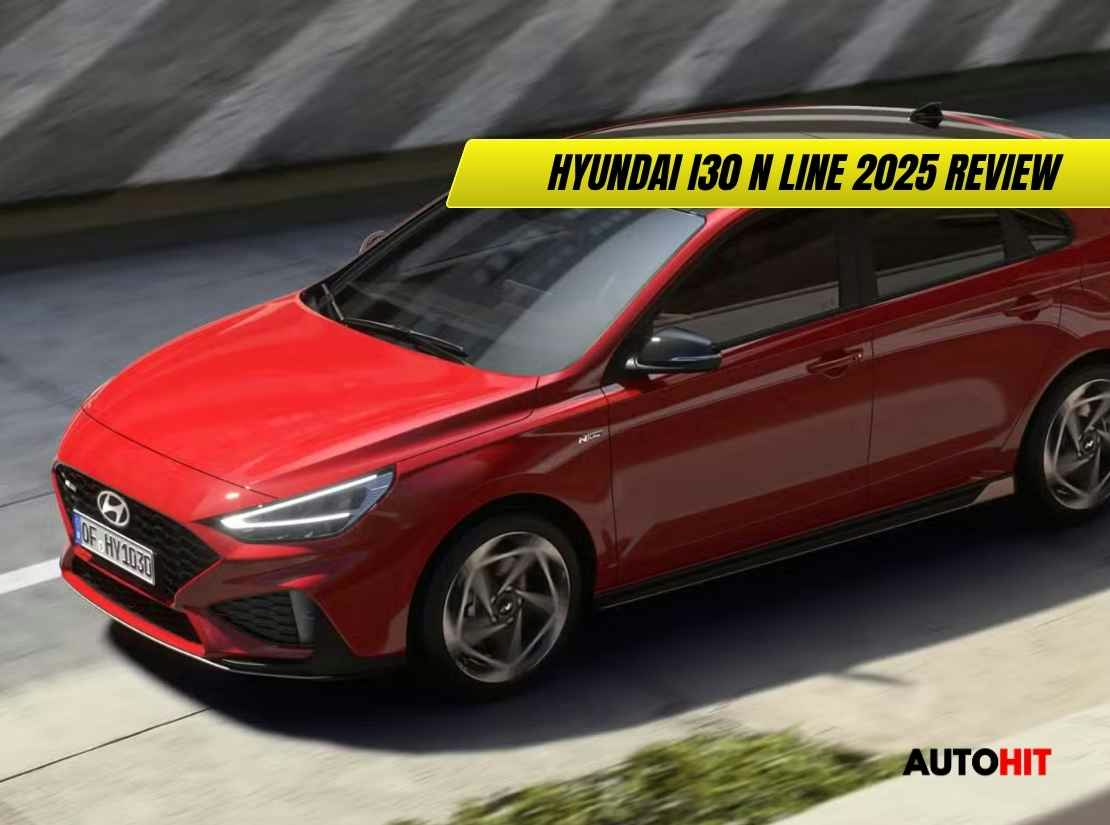
The refreshed Hyundai i30 N Line 2025 brings sharper styling, a dual 10.25-inch digital cabin, a 48V mild hybrid powertrain and a stiffened N Line chassis to one of Europe’s most popular compact hatchbacks — all from a starting price of €27,250, making it one of the strongest-value sport-influenced family cars on UK roads today.
Hyundai i30 N Line 2025: Key Highlights
- 100 hp 1.0-litre T-GDI mild hybrid with 48V electric assistance and 172 Nm of torque
- Dual 10.25-inch displays standard on N Line — instrument cluster and infotainment — with OTA map updates
- N Line-specific chassis tuning delivers a stiffer, more precise ride without reaching full N performance levels
- Boot capacity of 395 to 1,301 litres — above average for a five-door compact hatchback
- Full standard ADAS suite including forward collision avoidance, lane following assist and intelligent speed limit assist
- Continental pricing from €27,250 (base) and €31,600 (automatic with full specification)
Design and Exterior: Sharper, More Muscular, Distinctly N Line
The 2025 Hyundai i30 facelift is the most visually assertive update the model has received since its current generation launched. At 4.34 metres long, 1.80 metres wide and 1.46 metres tall, the i30 maintains its compact hatchback proportions while projecting a noticeably more dynamic character. The revised front fascia features a redesigned radiator grille, a refreshed lower bumper with more prominent air channel graphics, and new slim LED headlights with vertical daytime running light signatures — a detail that immediately distinguishes the updated car from its predecessor on the road.
The N Line specification amplifies these changes with exclusive additions: a sport-pattern front grille with dark metallic inserts in the side air intakes, N Line-specific side skirts, a rear bumper insert that visually widens the car’s stance and distinctive 18-inch alloy wheels in an N Line-exclusive design. The rear end is equally resolved — LED tail lights with a V-shaped light signature add a sporty graphic, and the rear bumper’s increased muscularity mirrors the front’s more aggressive expression. The overall result is a car that reads as genuinely sporting without resorting to unnecessary visual noise — a balance the i30 has historically managed well, and which the 2025 update maintains with confidence.
Interior and Technology: A Step Forward in Quality and Connectivity
The i30 N Line 2025 cabin represents a meaningful upgrade over the outgoing car. The dashboard has been finished in a new smooth-texture coating that is noticeably more pleasant to the touch than the material it replaces, and the centre tunnel is finished in gloss black — a detail that elevates the perceived quality of the cabin’s core interface area. Four seat upholstery options are available: standard fabric, fabric/leather combination, full leather and a suede-effect fabric with leather inserts — the last being the most distinctive and best suited to the N Line’s sporting character.
The twin 10.25-inch digital display system is standard on the N Line: the full-width instrument cluster provides clear, configurable driving data in a format that remains legible in direct sunlight, while the central infotainment screen manages media, navigation, vehicle settings and telephone functions through a well-organised menu structure. Notably, the system supports Over-the-Air map updates — a feature previously reserved for more expensive vehicles — meaning the navigation database remains current without manual intervention. Three USB-C charging ports are distributed between the front and rear cabins, a practical provision for families who travel with multiple devices.
The climate control system retains physical controls — a decision that, in our experience, remains one of the i30’s most practically valuable attributes in a segment increasingly dominated by all-screen interfaces that prioritise aesthetics over usability. The steering wheel is well-shaped and properly weighted, and the optional Highway Driving Assist 1.5 semi-autonomous system — operating at Level 2 — is among the more confident implementations available in this class.
Boot Space and Rear Passenger Comfort
The i30’s boot of 395 litres is above average for a compact five-door hatchback, and the expansion to 1,301 litres with the rear seats folded flat is class-competitive. The loading sill sits at approximately 74 cm from the ground — higher than ideal for loading heavy or bulky items — and a stepped load floor is present. The rear seat fold is a 60/40 split, enabling a combination of rear passenger and extended load use. Boot illumination and cargo hooks are standard.
Rear passenger space is genuine and accommodating for the segment. Knee room is adequate rather than generous for taller occupants, and headroom is slightly compromised by the gently sloping roofline — though adults up to approximately 180 cm will find the rear cabin comfortable for journeys of typical duration. The central rear position benefits from a relatively flat floor and a fold-down armrest with cupholders. Rear-seat USB-C charging is included, reflecting the car’s family-oriented brief despite its sporting identity.
Powertrain and Driving Experience: Efficient, Capable and Honest
The i30 N Line 2025 tested here uses the 1.0-litre three-cylinder T-GDI turbocharged direct injection petrol engine, producing 100 hp and 172 Nm of torque, integrated with a 48V mild hybrid system. The mild hybrid component provides electric torque assistance during acceleration and energy recuperation under braking, contributing directly to the declared consumption of 5.6 l/100 km and real-world figures of approximately 6.5 l/100 km over mixed driving. The 48V system does not enable pure electric driving but meaningfully reduces fuel consumption in urban and suburban conditions where the electric assistance is most active.
Drive modes include Eco, Normal and Sport. In Normal mode the i30 N Line is a pleasant, composed and responsive companion — the mild hybrid torque fill keeps the three-cylinder engine feeling more willing than its modest displacement suggests, and the dual-clutch DCT automatic gearbox delivers brisk, smooth upshifts in everyday driving. The N Line chassis tuning introduces a noticeably stiffer ride than the standard i30 — the suspension resists body roll more firmly through faster corners, and the steering weights up with a directness that rewards confident driving. This is not the i30 N, and it does not pretend to be — but it is demonstrably more engaging than the standard car, and the chassis communicates well enough to make a B-road a genuinely enjoyable experience.
The DCT’s behaviour in Eco mode is the powertrain’s principal compromise: the gearbox upshifts aggressively early in the rev range, and the combination of a light throttle mapping and early gear changes can make the car feel notably sluggish when prompt acceleration is needed. Switching to Normal or Sport mode resolves this immediately, and in our experience most drivers will leave the car in Normal for the vast majority of journeys. The top speed of 178 km/h is adequate for UK road use.
| Specification | Detail |
|---|---|
| Engine | 1.0-litre T-GDI, three-cylinder, 48V mild hybrid |
| Power | 100 hp / 172 Nm |
| Gearbox | DCT dual-clutch automatic |
| Drivetrain | Front-wheel drive |
| Top speed | 178 km/h |
| Declared consumption | 5.6 l/100 km |
| Real-world consumption | ~6.5 l/100 km |
| CO2 emissions | 126–128 g/km |
| Boot volume | 395–1,301 litres |
| Seats | 5 |
| Continental price (base) | €27,250 |
| Continental price (tested, auto) | €31,600 |
Safety: Comprehensive as Standard
The i30 N Line 2025 carries a strong standard safety specification. The full ADAS suite includes Forward Collision-Avoidance Assist with autonomous emergency braking, Lane Following Assist, Intelligent Speed Limit Assist, front and rear parking sensors with distance warning and Rear Occupant Alert — a system that reminds the driver to check the rear seats before leaving the vehicle, a feature of genuine value for families with young children. Optional additions include Junction Turning Assist, which monitors oncoming traffic during turns at intersections, and the Highway Driving Assist 1.5 Level 2 system for sustained semi-autonomous motorway driving.
For UK buyers, it is worth noting that all Hyundai models sold through the UK dealer network are covered by a 5-year unlimited mileage warranty — a strong ownership security provision that compares favourably with European-brand rivals. For current safety grouping data and independent assessment results, Thatcham Research provides the definitive UK reference.
Hyundai i30 N Line 2025 vs. Key Rivals
| Model | Power | Boot | Consumption | 0–100 km/h | Price (from) |
|---|---|---|---|---|---|
| Hyundai i30 N Line 1.0 T-GDI mHEV | 100 hp | 395–1,301 l | 5.6 l/100 km | N/A | €27,250 |
| Volkswagen Golf 1.0 eTSI | 110 hp | 381–1,237 l | 5.3 l/100 km | 10.9 sec | ~€31,000 |
| SEAT Leon 1.0 eTSI | 110 hp | 380–1,270 l | 5.4 l/100 km | 11.0 sec | ~€28,500 |
| Ford Focus ST-Line 1.0 EcoBoost mHEV | 125 hp | 341–1,354 l | 5.8 l/100 km | 10.1 sec | ~€29,500 |
| Renault Clio 6 | 143 hp | 391–1,108 l | 4.6 l/100 km | N/A | ~€26,000 |
The i30 N Line’s combination of a 1,301-litre maximum load capacity, a comprehensive standard ADAS suite and a 5-year unlimited mileage warranty positions it competitively against all segment rivals. The Volkswagen Golf remains the benchmark for refinement, but the i30 undercuts it meaningfully on price. For buyers interested in the wider small car segment, our review of the Renault Clio 6 2026 and the SEAT Ibiza 2026 offer useful comparisons at a slightly lower price point.
Is the Hyundai i30 N Line 2025 Available in the UK?
Yes. The Hyundai i30 is available through Hyundai’s UK dealer network and has been a strong seller in Britain for several model generations. UK pricing for the 2025 facelift starts from approximately £24,995 in standard trim, with the N Line automatic from approximately £28,495. The full UK powertrain range also includes a 1.5 T-GDI 160 hp option for buyers who require more performance without stepping up to the full i30 N. Full specifications, current offers and dealer information are available at hyundai.com/uk. Buyers interested in the performance flagship should also consult Hyundai’s i30 N, which occupies a distinct position in the compact hot hatch segment.
FAQ
Is the Hyundai i30 N Line 2025 worth buying in the UK?
Yes — in my experience, the i30 N Line represents one of the strongest value propositions in the compact hatchback segment. The combination of N Line chassis tuning, a dual 10.25-inch digital cabin, comprehensive standard safety technology and a 5-year unlimited mileage warranty at under £29,000 is difficult to match within the same budget.
What is the difference between the Hyundai i30 N Line and the i30 N?
The N Line is a styling and mild chassis upgrade applied to the standard i30 range, available with 100 hp and 160 hp engines. The i30 N is Hyundai’s full performance variant, producing 280 hp from a 2.0-litre turbocharged engine with a bespoke chassis, electronically controlled limited-slip differential and performance-focused tuning. The N Line is a daily driver with sporting aesthetics; the N is a genuine hot hatch.
What is the real-world fuel economy of the Hyundai i30 1.0 T-GDI mild hybrid?
Our road test returned approximately 6.5 l/100 km over a mixed urban, extra-urban and dual carriageway route — somewhat above the declared figure of 5.6 l/100 km, and consistent with the real-world performance of 48V mild hybrid systems at this power level. Urban-only driving with frequent regenerative events will improve on this figure.
Does the Hyundai i30 N Line have automatic transmission?
Yes. A DCT dual-clutch automatic gearbox is available alongside the six-speed manual. The automatic is standard specification on the tested N Line variant from €31,600. The manual transmission offers a marginally more driver-engaging experience and a small fuel economy advantage.
What is the boot size of the Hyundai i30?
The i30 offers 395 litres in standard five-seat configuration, expanding to 1,301 litres with the rear seats folded flat in a 60/40 split arrangement. The loading sill height of 74 cm is slightly above the class average and may require attention when loading heavy items.
Does the Hyundai i30 N Line have wireless Apple CarPlay?
The 2025 facelift supports both Apple CarPlay and Android Auto through the 10.25-inch central infotainment screen. Connectivity is via cable on base trims; wireless integration availability depends on specification — confirm with your Hyundai dealer at the point of order.
What warranty does Hyundai offer in the UK?
Hyundai UK provides a 5-year unlimited mileage manufacturer warranty on all new vehicles — one of the most generous standard warranties available in the UK compact car market and a meaningful ownership security advantage over many European rivals.
The Hyundai i30 N Line 2025 is a thoroughly accomplished compact hatchback that earns its place at the top of the segment through consistent, considered execution rather than headline-grabbing excess. The mild hybrid powertrain delivers genuinely competitive fuel economy, the N Line chassis provides a more engaging driving experience without sacrificing daily comfort, and the cabin’s dual-screen technology and comprehensive safety provision reflect a car that has been updated thoughtfully rather than simply restyled. From my point of view, for UK buyers seeking a practical, stylish and well-equipped family hatchback below £29,000, the i30 N Line automatic remains one of the most complete and keenly priced choices in its class.





