
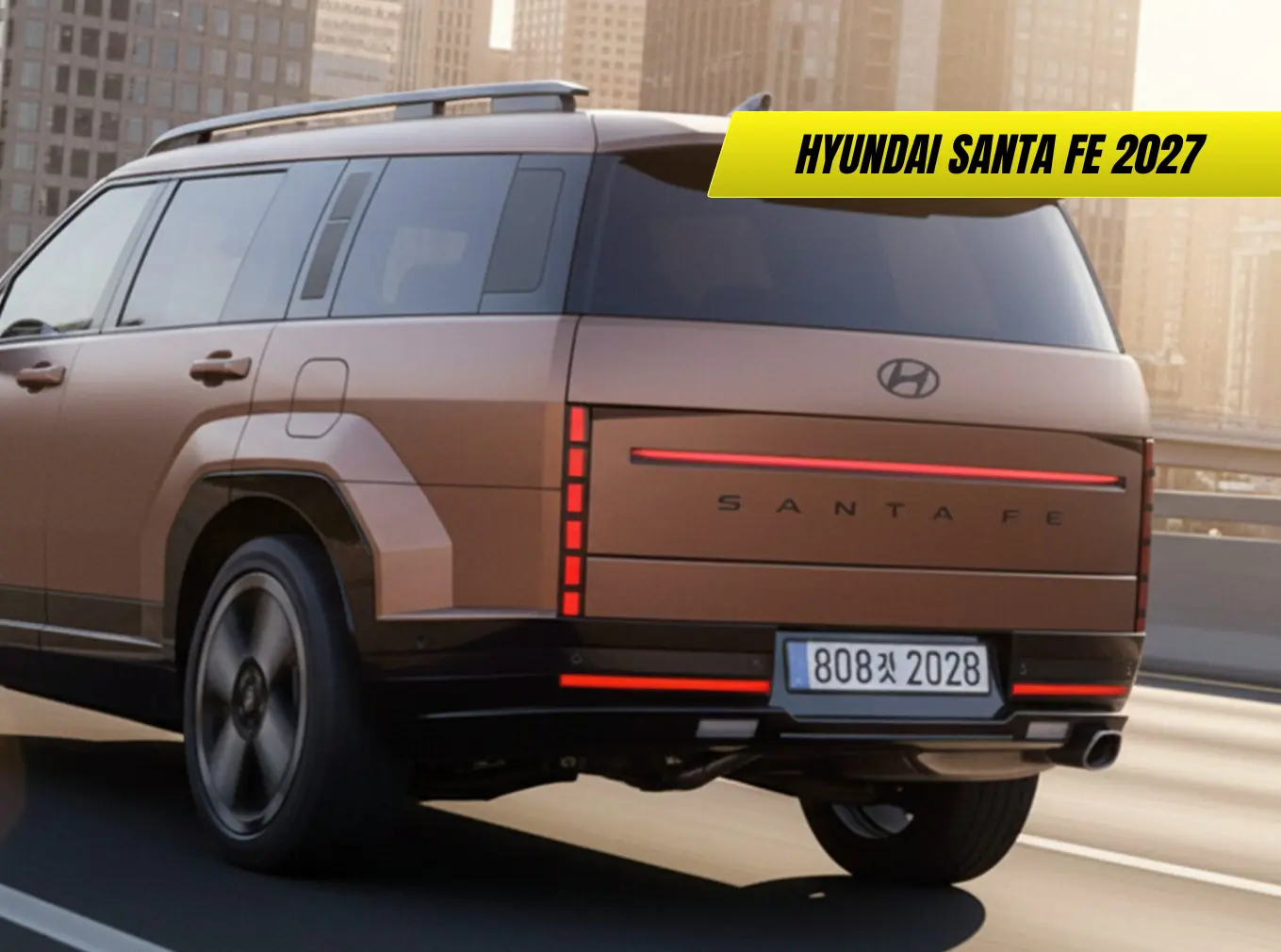
2027 Hyundai Santa Fe facelift gets redesigned rear lights, refined front end, and new automatic gearbox. UK launch late 2026 with hybrid and turbo petrol options from £45,000 estimated.
Hyundai prepares a comprehensive mid-cycle facelift for the Santa Fe arriving as a 2027 model year vehicle, addressing widespread criticism of the current generation’s polarizing boxy design through refined styling featuring vertical rear taillights replacing controversial horizontal H-shaped units, slimmer front headlights with repositioned LED daytime running lights, and more premium surfacing eliminating the rugged Land Rover-inspired aesthetic that alienated conservative buyers. Mechanical improvements include switching all 2.5-litre turbo petrol variants from problematic eight-speed dual-clutch transmission to conventional torque-converter automatic addressing years of customer complaints regarding jerky low-speed operation, whilst hybrid models continue using proven six-speed automatic. UK launch expected late 2026 or early 2027 with pricing estimated £45,000-60,000 depending on specification.
Hyundai Santa Fe 2027: Responding to Design Criticism
South Korean manufacturer Hyundai acknowledges the fifth-generation Santa Fe (MX5 chassis code, launched 2023) struggled meeting sales expectations despite spacious three-row accommodation and comprehensive powertrain lineup spanning hybrid, plug-in hybrid, and turbocharged petrol variants. The boxy, utilitarian styling drawing inspiration from previous-generation Land Rover Defender polarized opinion with automotive media praising bold differentiation whilst actual customers rejected unconventional appearance favouring conventional premium SUV aesthetics Mercedes GLE, BMW X5, and Audi Q7 exemplify.
Recent spy photographs captured heavily camouflaged prototypes testing European roads revealing substantial front and rear design modifications whilst maintaining current-generation body shell, confirming mid-cycle refresh rather than complete redesign minimizing development costs whilst addressing styling complaints threatening sales performance. Industry sources suggest Hyundai expedited the facelift timeline from typical four-year cycle to just three years (2024 launch, 2027 refresh) responding to weaker-than-anticipated market reception particularly Western markets where conservative styling preferences dominate premium segment.
The design evolution transitions Santa Fe from rugged utilitarian positioning toward refined premium aesthetic aligning with corporate siblings including Tucson and Palisade featuring elegant proportions, horizontal emphasis, and sophisticated lighting signatures characterizing modern Hyundai design language. This strategic pivot aims broadening appeal beyond adventure-oriented buyers toward mainstream families prioritizing sophistication over off-road capability though Santa Fe maintains standard all-wheel-drive and credible light off-road competence despite visual refinement.
What Changes for 2027 Facelift
Front Fascia Redesign
Spy photographs reveal completely new front-end design featuring:
- Slimmer headlight units positioned lower in bumper
- Vertical LED daytime running lights relocated to outer edges (versus current integrated position)
- Full-width LED light bar spanning upper grille creating horizontal emphasis
- Refined four-bar vertical grille slats replacing current chunky industrial appearance
- Cleaner bumper integration with smaller air intakes
- Eliminated rugged skid plate aesthetic favouring smooth premium surfacing
Rear Design Transformation
Most dramatic changes occur at the rear addressing widespread criticism of current H-shaped horizontal taillights creating busy, unconventional appearance:
- Vertical taillights flanking rear corners replacing horizontal units
- Slim horizontal LED strip connecting vertical lights creating subtle H-signature
- Repositioned number plate mounting (relocated from bumper to tailgate)
- Cleaner bumper design eliminating faux diffuser elements
- More elegant proportions emphasizing width over height
Similar rear design philosophy mirrors competitors including updated Nissan Qashqai and Kia Sorento featuring vertical light signatures creating sophisticated appearance.
Side Profile Refinements
Body sides receive subtle modifications maintaining current generation’s structure:
- Horizontal character line replacing vertical creases reducing visual bulk
- Revised wheel arch cladding (less pronounced black plastic)
- New alloy wheel designs (19-inch standard, 20-inch optional, 21-inch for Calligraphy trim)
- Modified door mirrors with integrated puddle lighting
- Flush door handles potentially introduced higher trims
Aerodynamic Improvements
Refined surfacing and optimized details target sub-0.30 drag coefficient (current model approximately 0.33 Cd) improving efficiency across powertrain lineup:
- Smoother A-pillar and windscreen integration
- Active grille shutters (expanded application across trim levels)
- Optimized underbody panels
- Aerodynamically-tuned wheel designs
- Reduced frontal area through slimmer lighting elements
Mechanical Upgrades: Transmission Replacement
Eight-Speed DCT Abandoned
Hyundai confirms eliminating problematic eight-speed wet dual-clutch transmission (DCT) from all 2.5-litre turbo Santa Fe models for 2026-2027 model year following years of customer complaints, warranty claims, and class-action lawsuit threats. The DCT exhibited characteristic issues including:
Common Complaints
- Jerky low-speed operation (parking manoeuvres, stop-and-go traffic)
- Clunky gear changes disrupting refinement
- Hesitation during acceleration from standstill
- Premature clutch wear requiring expensive replacements (£2,000-3,000)
- Software updates failing to resolve fundamental mechanical limitations
New Torque-Converter Automatic
Conventional eight-speed torque-converter automatic (likely Hyundai-developed unit or sourced from ZF) replaces DCT across turbocharged petrol lineup delivering improved refinement:
- Smoother low-speed operation eliminating DCT jerkiness
- More progressive gear changes enhancing comfort
- Proven reliability (millions of units operating globally)
- Reduced maintenance costs versus DCT clutch pack replacements
- Modest efficiency penalty (approximately 1-2 mpg versus DCT’s theoretical advantage)
The mechanical upgrade applies simultaneously to Santa Cruz pickup sharing Santa Fe’s platform and powertrain, addressing identical transmission complaints plaguing both models since respective launches.
Hybrid Powertrain Unchanged
Santa Fe Hybrid and Plug-in Hybrid variants continue utilizing 1.6-litre turbocharged four-cylinder engine paired with electric motor and six-speed automatic transmission avoiding DCT complications entirely. This proven powertrain delivers:
Hybrid Specifications (Current/Expected Carryover)
- Engine: 1.6-litre turbo four-cylinder (177 hp)
- Electric motor: 60 kW (80 hp)
- Combined output: 226 hp / 258 lb-ft torque
- Transmission: Six-speed automatic (smooth, refined operation)
- Fuel economy: 36 mpg combined (US figures, UK equivalent ~43 mpg)
- Battery: 1.49 kWh lithium-ion polymer
- EV-only range: Negligible (hybrid system optimizes efficiency, not pure electric driving)
Plug-in Hybrid Specifications (Expected Continuation)
- Engine: 1.6-litre turbo four-cylinder (177 hp)
- Electric motor: 66 kW (88 hp)
- Combined output: 268 hp
- Transmission: Six-speed automatic
- Battery: 13.8 kWh lithium-ion polymer
- EV-only range: 31 miles (50 km) WLTP
- Fuel economy: 80+ mpg equivalent (when charged regularly)
- Charging time: 2.5 hours (6.6 kW charger)
UK buyers favouring plug-in hybrid cars for company car tax benefits find Santa Fe PHEV compelling with just 8% BIK rate (2026/27 tax year) versus 37% for pure combustion equivalents.
Expected UK Specifications and Pricing
Trim Level Structure
Hyundai UK typically offers simplified three-tier structure versus America’s five-trim lineup:
| UK Trim | Expected Price | Key Equipment |
|---|---|---|
| Premium | £45,000-47,000 | 19″ alloys, LED lights, dual 12.3″ displays, heated seats, synthetic leather |
| Ultimate | £50,000-53,000 | 20″ alloys, ventilated seats, panoramic sunroof, Bose audio, highway driving assist |
| Calligraphy | £56,000-60,000 | 21″ alloys, Nappa leather, premium materials, full safety suite, luxury positioning |
Powertrain Pricing Differential
- Turbocharged 2.5-litre petrol: Base pricing (listed above)
- Hybrid: +£3,000-4,000 premium (better efficiency, lower running costs)
- Plug-in Hybrid: +£8,000-10,000 premium (31-mile EV range, 8% BIK taxation)
Powertrain Lineup (UK Market)
2.5-Litre Turbo Petrol (Volume Seller)
- Power: 277 hp (207 kW)
- Torque: 311 lb-ft (422 Nm)
- Transmission: Eight-speed torque-converter automatic (new)
- 0-62 mph: 7.8 seconds estimated
- Top speed: 130 mph limited
- Fuel economy: 28-30 mpg combined estimated
- CO₂ emissions: 210-220 g/km
1.6-Litre Turbo Hybrid (Efficiency Focus)
- Combined output: 226 hp
- Transmission: Six-speed automatic
- 0-62 mph: 8.7 seconds
- Top speed: 118 mph limited
- Fuel economy: 43-45 mpg combined
- CO₂ emissions: 140-150 g/km
1.6-Litre Turbo PHEV (Company Car Choice)
- Combined output: 268 hp
- EV range: 31 miles (50 km)
- 0-62 mph: 8.3 seconds
- Fuel economy: 80+ mpg equivalent (charged regularly)
- CO₂ emissions: 30-35 g/km
- BIK rate: 8% (2026/27 tax year)
All variants include all-wheel drive as standard equipment maintaining Hyundai’s positioning versus competitors offering front-wheel-drive base models.
Interior Technology and Features
Standard Equipment (Expected Premium Trim)
Current-generation Santa Fe’s interior likely carries over with minor material and colour updates:
Displays and Technology
- Dual 12.3-inch displays (digital instrument cluster + infotainment touchscreen)
- Wireless Apple CarPlay and Android Auto
- Bluelink connected services with smartphone app
- Over-the-air software updates
- 360-degree camera system with parking sensors
- Wireless smartphone charging (two devices simultaneously)
Comfort Features
- Tri-zone automatic climate control
- Heated front and second-row seats
- Synthetic leather upholstery (Premium), genuine Nappa leather (Calligraphy)
- Eight-way power-adjustable driver seat with lumbar support
- 60/40 split third-row seats (manual folding)
- Panoramic fixed glass roof with power sunshade
Safety Systems (Standard Across Range)
- Hyundai SmartSense suite including:
- Forward collision-avoidance assist with pedestrian/cyclist detection
- Blind-spot collision-avoidance assist
- Lane-keeping assist and lane-following assist
- Driver attention warning
- Rear cross-traffic collision-avoidance assist
- Highway driving assist (adaptive cruise control with lane centring)
Similar comprehensive safety equipment features across competitors including Toyota Corolla Cross and Mazda CX-60.
Calligraphy Luxury Features
Top-specification Calligraphy trim targets premium buyers typically considering German alternatives:
- Quilted Nappa leather upholstery with contrast stitching
- Ventilated front seats
- Heated steering wheel with genuine leather wrap
- 12-speaker Bose premium audio system
- Head-up display
- Dual wireless charging pads
- Ambient LED interior lighting (customisable colours)
- Calligraphy-specific exterior chrome trim
- 21-inch machined alloy wheels
Three-Row Seating
Santa Fe accommodates seven passengers (2+3+2 configuration) with second-row captain’s chairs optional reducing capacity to six whilst improving third-row access. Current generation’s spacious dimensions carry over:
- First-row headroom: 41.7 inches
- Second-row legroom: 42.1 inches (class-leading)
- Third-row legroom: 31.4 inches (adults suitable for short journeys)
- Cargo capacity: 571 litres behind third row, 2,050 litres with seats folded
UK Launch Timeline and Availability
Production and Delivery Schedule
Manufacturing Location
Hyundai produces Santa Fe at multiple global facilities with UK-market vehicles sourced from:
- Ulsan Plant, South Korea (right-hand-drive export production)
- Montgomery, Alabama, USA (left-hand-drive North American market)
Expected Timeline
- Official reveal: September-October 2026
- UK order books open: November 2026
- First customer deliveries: December 2026 / January 2027
- Full model range availability: Q1 2027
Pre-Facelift Run-Out Deals
Current 2024-2025 Santa Fe inventory likely receives substantial discounts (£3,000-5,000) during summer 2026 as dealers clear stock ahead of facelifted model arrival, creating value opportunities for buyers prioritising savings over latest styling.
Competitive Landscape: Premium Three-Row SUVs
Direct UK Market Rivals
| Model | Starting Price | Power | Fuel Economy | Seating |
|---|---|---|---|---|
| Hyundai Santa Fe Facelift | £45,000 est | 277 hp | 28 mpg | 7 seats |
| Kia Sorento | £44,995 | 261 hp | 34 mpg (HEV) | 7 seats |
| Mazda CX-80 | £48,000 | 249 hp | 36 mpg (PHEV) | 7 seats |
| Skoda Kodiaq | £37,000 | 204 hp | 35 mpg | 7 seats |
| Nissan X-Trail | £38,000 | 204 hp | 43 mpg (e-Power) | 7 seats |
| Land Rover Discovery Sport | £45,000 | 249 hp | 30 mpg | 7 seats |
Hyundai Advantages
- Comprehensive five-year unlimited mileage warranty (versus three years German brands)
- Competitive pricing versus premium alternatives
- Generous standard equipment reducing need for expensive options
- Modern technology and safety features
- Proven reliability (J.D. Power rankings consistently above-average)
Challenges
- Brand perception lacks German premium cachet
- Previous-generation transmission issues damaged reputation
- Polarizing styling alienated conservative buyers (facelift addresses)
- Moderate residual values versus Toyota/Mazda alternatives
Similar value propositions characterise other Korean offerings including Dacia Jogger targeting budget-conscious families.
Frequently Asked Questions
When will the Hyundai Santa Fe facelift arrive in the UK?
Official reveal expected September-October 2026 with UK order books opening November 2026. First customer deliveries anticipated December 2026 or January 2027 depending on production allocation and right-hand-drive manufacturing schedule. Full model range including all trim levels and powertrains available Q1 2027.
What’s changing on the 2027 Hyundai Santa Fe facelift?
Major design refresh includes vertical rear taillights replacing controversial H-shaped units, slimmer front headlights with repositioned LED daytime running lights, refined grille and bumpers creating premium appearance. Mechanical updates include new eight-speed torque-converter automatic transmission replacing problematic dual-clutch unit on turbocharged petrol variants, addressing years of customer complaints regarding jerky low-speed operation.
How much will the facelifted Santa Fe cost in the UK?
Estimated pricing £45,000-47,000 for entry Premium trim with 2.5-litre turbo petrol, £50,000-53,000 for mid-range Ultimate, and £56,000-60,000 for luxury Calligraphy specification. Hybrid variants add £3,000-4,000 premium whilst plug-in hybrid commands £8,000-10,000 additional cost justified through 31-mile EV range and 8% company car BIK taxation versus 37% combustion alternatives.
Is the transmission problem fixed on 2027 Santa Fe?
Yes, Hyundai replaces troublesome eight-speed dual-clutch transmission with conventional torque-converter automatic on all turbocharged petrol models for 2026-2027 model year. The new gearbox delivers smoother low-speed operation, more refined gear changes, and proven reliability eliminating previous DCT complaints. Hybrid models continue using existing six-speed automatic unaffected by DCT issues.
Should I wait for the Santa Fe facelift or buy current model?
Depends on priorities. Current 2024-2025 models likely receive substantial discounts (£3,000-5,000) during summer 2026 as dealers clear inventory, creating value for buyers accepting previous styling. However, facelifted 2027 model addresses major design criticism, fixes transmission problems, and offers refreshed appearance maintaining relevance longer. Company car drivers prioritising latest technology should wait, whilst private buyers prioritising savings could benefit from run-out deals.
How does Santa Fe compare to Kia Sorento?
Santa Fe and Sorento share fundamental platform though deliver different characters. Sorento offers more conservative styling, marginally lower pricing (£44,995 versus £45,000+ Santa Fe), and similar warranty coverage. Santa Fe counters with more distinctive appearance (post-facelift), potentially superior interior materials on Calligraphy trim, and comparable powertrains. Choose Sorento for mainstream appeal and dealer network, Santa Fe for differentiation and slightly more premium positioning.
What’s the fuel economy of 2027 Santa Fe?
Turbocharged 2.5-litre petrol: 28-30 mpg combined estimated. Hybrid: 43-45 mpg combined with 140-150 g/km CO₂. Plug-in Hybrid: 80+ mpg equivalent when charged regularly, 30-35 g/km CO₂, 31-mile pure electric range. Real-world economy varies significantly based on driving style, terrain, and climate control usage. PHEV delivers maximum efficiency for drivers with home charging completing daily commutes electrically.
Is the Santa Fe good for towing?
Yes, 2,500 kg braked towing capacity across turbocharged petrol and hybrid variants (PHEV may have reduced rating). Adequate for caravans, boat trailers, and horse boxes though diesel alternatives historically offered superior towing refinement and efficiency. Electric alternatives like Chinese SUVs typically offer similar capacity though battery range reduces dramatically when towing maximum loads.
Verdict: Necessary Refinement Broadening Appeal
The 2027 Hyundai Santa Fe facelift represents essential course correction addressing widespread criticism of the current generation’s polarizing boxy styling whilst resolving mechanical issues undermining customer confidence. The refined design language transitions Santa Fe from niche rugged aesthetic toward mainstream premium positioning competing directly against established rivals including Mazda CX-80, Kia Sorento, and Skoda Kodiaq through sophisticated appearance, comprehensive equipment, and competitive pricing.
Transmission replacement eliminates single biggest complaint plaguing current model, whilst design evolution should attract conservative buyers previously alienated by unconventional styling. However, compressed three-year facelift timeline (versus typical four-five years) suggests Hyundai acknowledges commercial urgency addressing weaker-than-anticipated sales performance threatening important product line profitability.
For UK families requiring three-row accommodation within £45,000-60,000 budget, the facelifted Santa Fe delivers compelling proposition balancing space, technology, warranty coverage, and running costs. Company car drivers benefit from 8% BIK plug-in hybrid taxation creating substantial savings versus combustion alternatives, whilst five-year unlimited mileage warranty provides peace of mind unmatched by German premium rivals charging premium pricing without equivalent coverage.
The Santa Fe succeeds in offering credible mainstream alternative to premium three-row SUVs though lacks brand cachet justifying equivalent pricing to German rivals. Buyers prioritising substance over badge prestige find excellent value whilst those seeking maximum residual values and established dealer networks may prefer Toyota, Mazda, or premium European alternatives accepting higher initial costs.





