
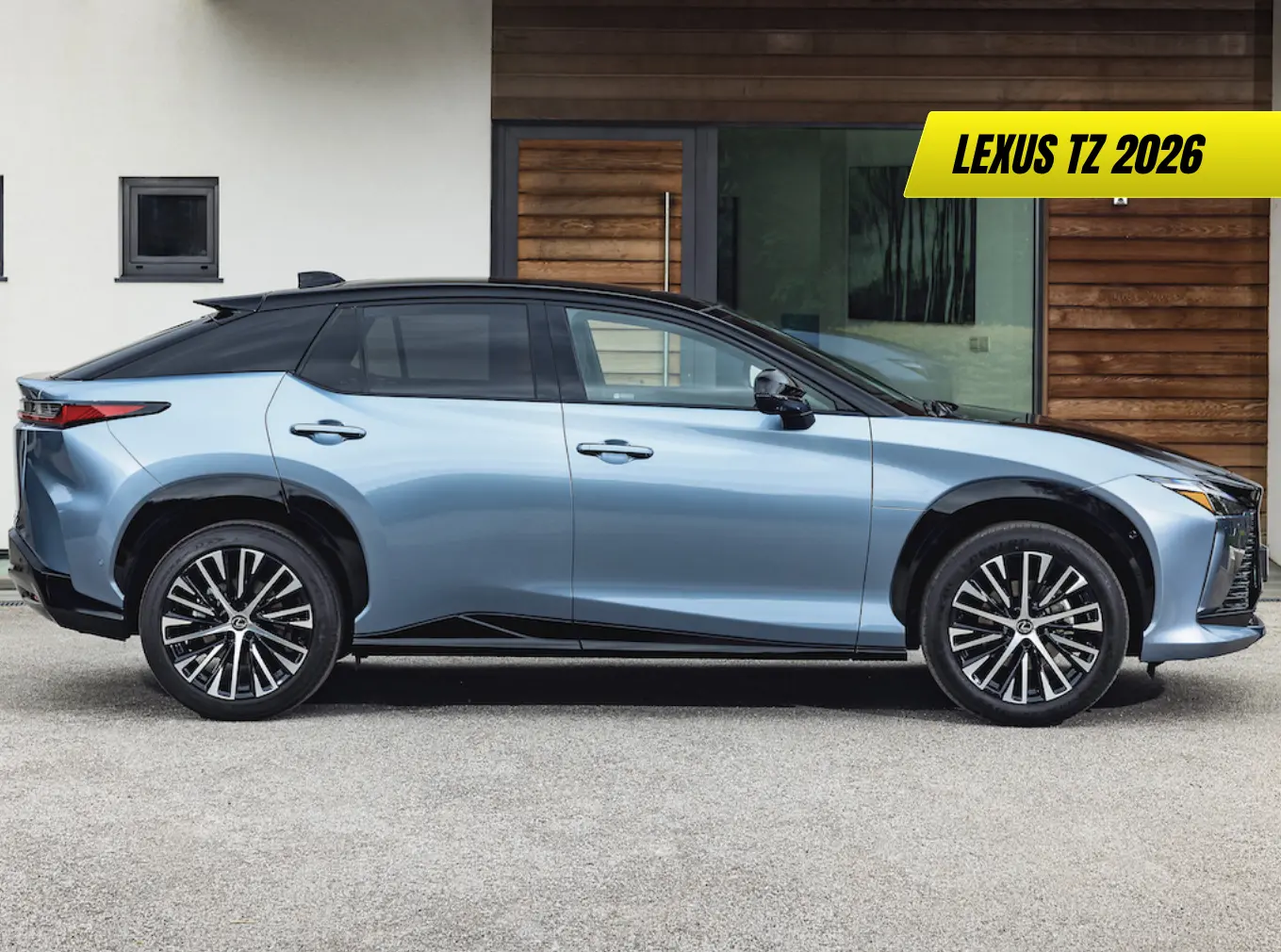
Lexus has entered the full-size electric SUV arena with its most ambitious model yet — a premium, seven-seat EV that shares bones with the Toyota Highlander but promises a decisively more luxurious experience.
The Lexus TZ is a new three-row electric SUV debuting in May 2026, offering up to 338 hp, a 95.8 kWh battery, and up to 320 miles of claimed range, positioned above the Toyota Highlander EV on the TNGA-K platform.
Key Points
- Debuts 7 May 2026
- Based on TNGA-K platform, stretched to 5,050 mm length
- Available as TZ450e (221 hp) and TZ550e (338 hp)
- Battery options of 77 kWh and 95.8 kWh
- Top-spec range: up to 320 miles (515 km)
- Seating for up to seven passengers across three rows
- Shares 14-inch infotainment with Toyota Highlander EV, but with premium Lexus treatment
Lexus’s Biggest EV Yet
The Lexus TZ represents the brand’s most direct challenge yet to large premium electric SUVs from European and Korean rivals. At 5,050 mm long with a 3,050 mm wheelbase, it is a genuinely full-size vehicle — longer than the Kia EV9 and comparable to the BMW iX or Volvo EX90. The three-row layout accommodates up to seven passengers, with the emphasis on premium-grade materials and Lexus’s signature Tazuna cockpit philosophy: a driver-focused interior that minimises distraction while maintaining full connectivity.
The cabin shares the 14-inch infotainment screen with its Toyota Highlander EV sibling but surrounds it with elevated materials, a revised instrument layout, and Lexus’s characteristic attention to tactile quality. Expect premium leather, open-pore wood or premium composite trim options, and the kind of noise suppression that sets Lexus apart from mass-market rivals.
Powertrains: TZ450e vs TZ550e
Two powertrain grades are expected at launch:
- TZ450e: Single or dual-motor with 221 hp, 77 kWh battery, estimated range ~250 miles
- TZ550e: Dual-motor AWD with 338 hp, 95.8 kWh battery, up to 320 miles (515 km)
The TZ550e’s 338 hp output matches the Kia EV9 GT’s headline figure and should deliver 0–62 mph in approximately 5.5–6.0 seconds — brisk rather than thrilling, but appropriate for a vehicle prioritising refinement over performance. Charging speeds have not been officially confirmed, but the platform should support at least 150 kW DC rapid charging, allowing a 10–80% top-up in under 30 minutes.
| Variant | Power | Battery | Est. Range |
|---|---|---|---|
| TZ450e | 221 hp | 77 kWh | ~250 miles |
| TZ550e | 338 hp | 95.8 kWh | 320 miles |
UK Availability and Competition
Lexus has a strong and loyal UK following, and large electric SUVs in this class are a growing segment. The TZ’s most direct UK rivals will be the Kia EV9, Hyundai Ioniq 9, BMW iX, and Volvo EX90. Pricing in the US is expected to start in the low-to-mid $50,000s, which translates to a UK entry price of approximately £45,000–£50,000 — positioning it competitively against the EV9 (from £55,000) and below the BMW iX.
UK right-hand drive availability has not been officially confirmed at the time of writing, but given Lexus’s UK commitment and RHD manufacturing in Japan, it seems highly likely. From my point of view, the TZ represents exactly the kind of product Lexus needs to reinvigorate its brand among younger luxury SUV buyers — buyers who are increasingly choosing Korean or German electric alternatives over Japanese premium marques.
For broader context on the large electric SUV segment and how to compare options, our guide to 20 best SUVs to buy in 2025 under £40k provides a useful benchmark, as does our diesel SUVs comparison for those not yet committed to full electrification.
Is the Lexus TZ the same as the Toyota Highlander EV?
They share the TNGA-K platform and some interior components, but the Lexus TZ has distinct exterior styling, premium interior materials, and a higher specification throughout.
When does the Lexus TZ go on sale?
An official debut took place on 7 May 2026. Sales timing for Europe and the UK has not yet been confirmed by Lexus.
How many seats does the Lexus TZ have?
The TZ is a three-row SUV expected to seat up to seven passengers, with the possibility of a six-seat configuration with captain’s chairs in the second row.
How does the Lexus TZ compare to the Kia EV9?
The TZ550e matches the EV9 on power (338 hp) and exceeds it slightly on claimed range. The Lexus is expected to prioritise refinement and material quality; the EV9 currently leads on charging speed and technology features.
Will the Lexus TZ qualify for UK benefit-in-kind tax advantages?
As a battery-electric vehicle, the TZ will attract the current 2% BIK rate applicable to zero-emission company cars in the UK — a significant incentive for business drivers at this price point.
In my experience, Lexus produces some of the most refined and dependable vehicles on sale, and the TZ appears to apply that philosophy to the full-size electric SUV segment with genuine conviction. If UK pricing is competitive, this could be a landmark model for the brand.





