
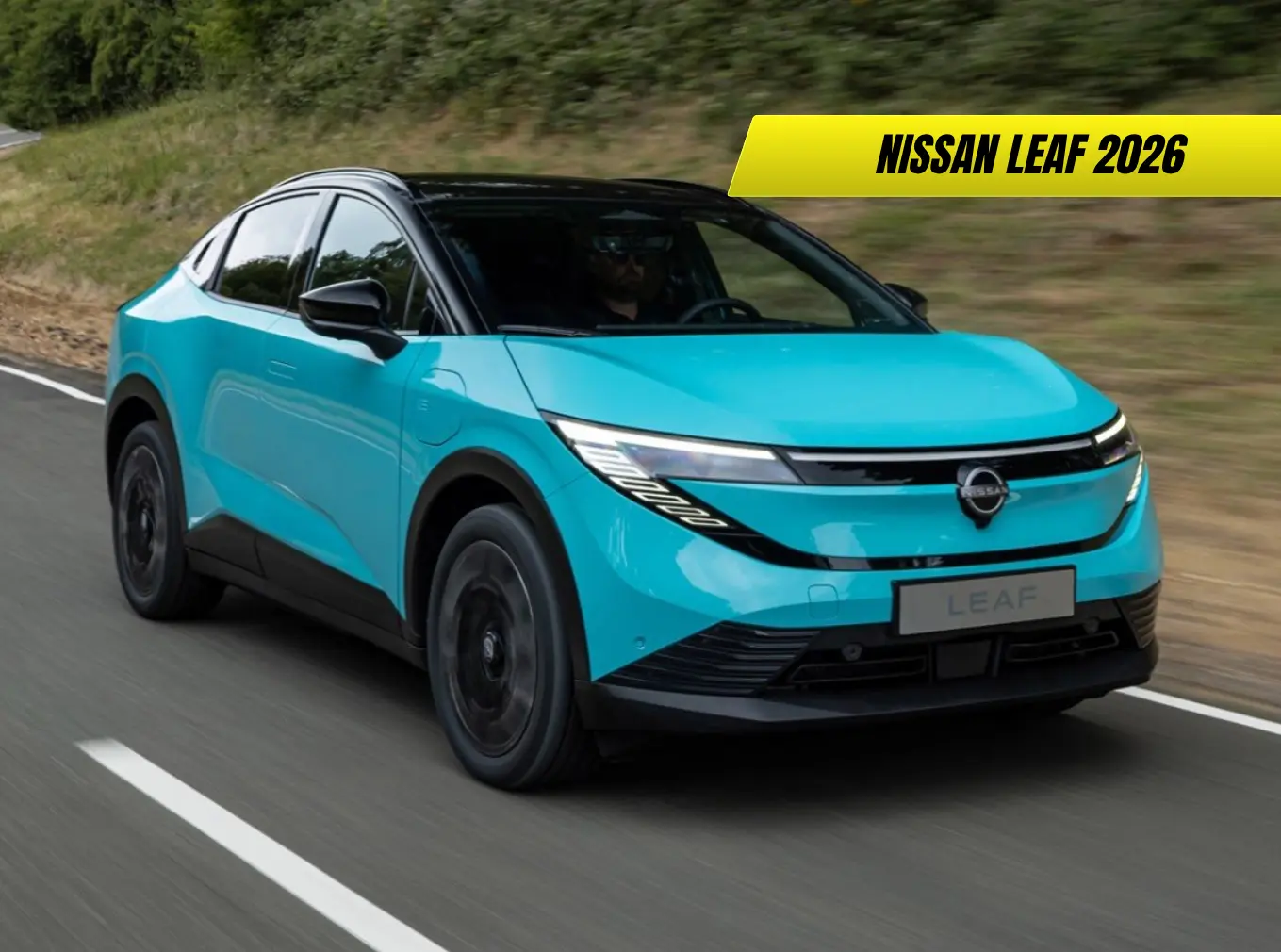
The third-generation Leaf moves upmarket with SUV-inspired styling, longer range and a clearer family focus.
The Nissan Leaf 2026 represents a clean-sheet rethink of one of the world’s most important electric cars. After pioneering the mass-market EV segment, the Leaf evolves into a more spacious, more efficient and more premiumvehicle, positioned closer to compact electric SUVs than traditional hatchbacks. For UK buyers, this shift brings meaningful gains in range, comfort and everyday usability—while keeping the Leaf’s reputation for reliability intact.
Key Points
- All-new third-generation Nissan Leaf
- SUV-inspired design replaces hatchback profile
- Larger battery options and longer WLTP range
- New interior technology and driver assistance
- Front-wheel drive with refined electric motors
- UK launch expected in 2026
- Prices likely to rise, but with stronger value proposition
Introduction
When the original Leaf arrived, it defined what an affordable electric car could be. However, buyer expectations have moved on. Range anxiety, charging speed and interior quality now matter as much as price. The 2026 Leaf responds by repositioning itself as a family-friendly electric crossover, aligning more closely with vehicles like the Renault Scenic E-Tech and Volkswagen ID.4.
From my point of view, this strategic shift is overdue—and necessary—for the Leaf to remain competitive in the UK market.
Release Date and UK Availability
Expected Timeline
| Stage | Timing |
|---|---|
| Global reveal | Late 2025 |
| UK pricing announced | Early 2026 |
| Orders open | Q1–Q2 2026 |
| First UK deliveries | Mid–late 2026 |
Right-hand-drive production is confirmed, with the UK remaining a priority European market.
Price and Trim Levels
Estimated UK Pricing
| Version | Estimated Price |
|---|---|
| Entry EV | £34,000–£36,000 |
| Mid-range | £37,000–£40,000 |
| Long-range / high-spec | £41,000–£45,000 |
Although more expensive than earlier Leafs, the new model offers substantially more range, space and technology.
Exterior Design
The Leaf’s styling changes dramatically for 2026.
Design Highlights
- Taller, crossover-like stance
- Shorter bonnet with cab-forward proportions
- Aerodynamically optimised body
- Slim LED lighting front and rear
- Flush door handles on higher trims
- Larger alloy wheels (18–19 inches)
The new shape improves efficiency while appealing to buyers who prefer SUV aesthetics.
Interior and Technology
Inside, the Leaf finally delivers a modern EV cabin.
Cabin Highlights
- Dual-screen digital cockpit
- Larger central touchscreen
- Wireless Apple CarPlay and Android Auto
- Improved material quality
- Simplified dashboard layout
- Enhanced sound insulation
From my point of view, the interior leap forward is just as important as the range increase.
Battery, Range and Charging
Expected Battery Options
| Battery | Estimated WLTP Range |
|---|---|
| ~60 kWh | ~300 miles |
| ~87 kWh | ~370–390 miles |
Charging
- DC rapid charging up to ~150 kW
- 10–80% in approximately 30 minutes
- AC charging up to 11 kW
This finally brings the Leaf in line with modern long-range EV expectations in the UK.
Performance and Driving Experience
The Leaf remains focused on smooth, accessible performance.
Driving Characteristics
- Single electric motor, front-wheel drive
- Power outputs around 215–230 hp
- Instant torque for urban driving
- Comfortable suspension tuning
- Stable motorway behaviour
From my point of view, Nissan’s emphasis on refinement rather than outright sportiness suits the Leaf’s target audience perfectly.
Practicality and Space
The move to a crossover layout significantly improves usability.
Practical Highlights
- Higher seating position
- Easier access for passengers
- Boot capacity around 470–500 litres
- Flat load floor with seats folded
- Improved rear legroom
This makes the Leaf far more suitable as a primary family car than previous generations.
Safety and Driver Assistance
The 2026 Leaf introduces Nissan’s latest safety suite.
- ProPILOT Assist with lane centring
- Adaptive cruise control
- Traffic-sign recognition
- Blind-spot monitoring
- Autonomous emergency braking
- 360-degree camera on higher trims
All systems meet current UK safety and approval standards.
Dimensions (Estimated)
| Measurement | Value |
|---|---|
| Length | ~4.45 m |
| Width | ~1.85 m |
| Height | ~1.62 m |
| Wheelbase | ~2.75 m |
Rivals
| Model | Key Strength |
|---|---|
| Nissan Leaf 2026 | Balance of range & comfort |
| Renault Scenic E-Tech | Space & efficiency |
| Volkswagen ID.4 | Brand breadth |
| Hyundai Kona Electric | Technology |
| Tesla Model Y | Charging network |
FAQ
Is the Nissan Leaf 2026 still a hatchback?
No, it adopts a more SUV-like crossover shape.
Does it offer more range than before?
Yes, significantly more, especially in long-range form.
Is it suitable for motorway driving?
Yes, with improved refinement and longer range.
Is it ULEZ-compliant?
Yes, it is fully electric.
Will it be more expensive than the current Leaf?
Yes, but with substantial upgrades in return.
Conclusion
The Nissan Leaf 2026 reinvents a pioneering nameplate for a far more demanding EV market. By embracing crossover proportions, extending range and upgrading interior quality, Nissan transforms the Leaf into a credible family electric car rather than a niche urban EV. From my point of view, this evolution finally gives the Leaf the tools it needs to compete head-to-head with Europe’s best electric SUVs—and restores its relevance for UK buyers looking beyond their first EV.





