
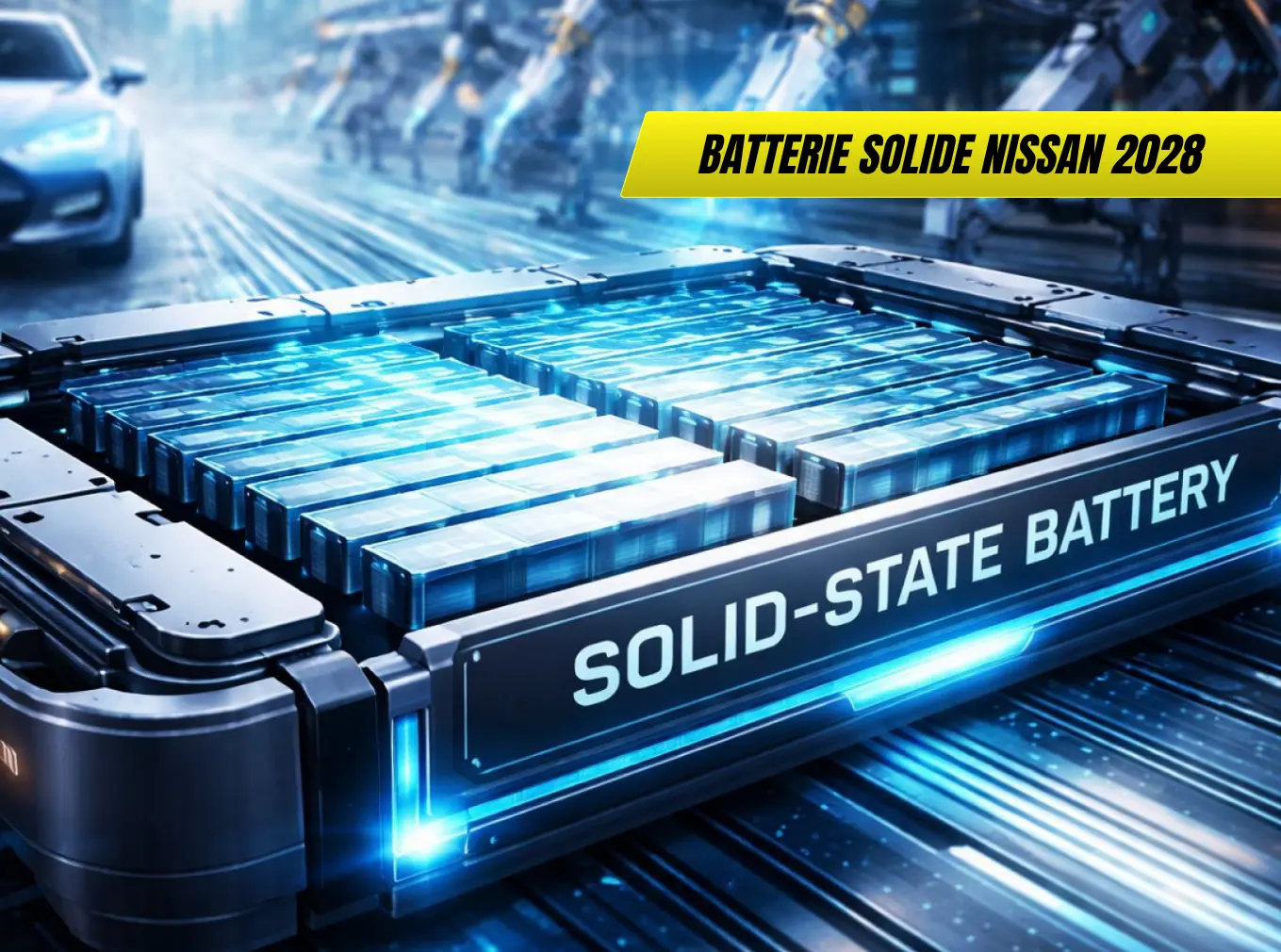
Nissan has confirmed that its first electric vehicle powered by all-solid-state batteries is on track for a 2028 launch — a breakthrough technology that promises to more than double driving range to over 620 miles WLTP, cut charging time by up to 50% and dramatically improve battery safety and longevity.
A technical briefing in April 2026 confirmed that Nissan has successfully stacked 23 battery cell layers into a single solid-state prototype pack, meeting required charge and discharge targets ahead of its 2028 production milestone.
- First solid-state battery EV confirmed on track for 2028 production
- 23 battery cell layers successfully stacked in prototype form as of April 2026
- Expected WLTP range exceeding 620 miles (1,000 km) — more than double current lithium-ion
- Charging time cut by up to 50% — potentially full charge in under 30 minutes
- Battery cost target of $75 per kWh — well below current average of $115 per kWh
- Partnership with US firm LiCAP Technologies using Activated Dry Electrode production process
The Breakthrough That Changes Everything
All-solid-state batteries (ASSBs) are widely regarded as the single most transformative technology in the roadmap for electric vehicles. Unlike conventional lithium-ion batteries, which use a liquid electrolyte to conduct ions between electrodes, solid-state batteries use a solid electrolyte — a material change that unlocks a cascade of performance, safety and cost improvements.
Nissan has been developing this technology at its Yokohama plant in Japan, where a pilot production line opened in January 2025. The April 2026 technical briefing confirmed that the prototype pack — with 23 stacked cell layers — has achieved the charge and discharge performance targets required for real vehicle use, representing a major milestone on the path to commercial production.
Range: More Than Double Current EVs
The most headline-grabbing implication of solid-state batteries is range. Reports suggest Nissan’s ASSB technology can double driving range compared with current lithium-ion equivalents. For context, the current Nissan Ariya’s long-range battery offers approximately 389 miles WLTP — a solid-state equivalent of that car would theoretically offer well over 620 miles on the WLTP cycle.
Energy density is the key driver: solid-state batteries offer up to 450 Wh/kg — approximately 80% higher than the best current lithium-ion cells — meaning the same vehicle can carry either far more energy in the same space, or the same energy in a significantly smaller and lighter pack.
Charging: Up to 50% Faster
Solid-state batteries also address the other major practical concern for EV buyers: charging time. The absence of a liquid electrolyte enables faster ion transfer between electrodes, reducing the time required for a full charge. Nissan’s technology is expected to cut charging time by up to 50% — meaning a car that currently requires 45 minutes for a 10–80% charge could do the same in approximately 22–25 minutes.
This improvement arrives just as the UK’s ultra-rapid charging network is reaching meaningful coverage density, with 350 kW chargers increasingly available at motorway services. The combination of faster charging capability in the car and higher-powered infrastructure on UK roads is well-timed.
Cost and Safety Advantages
The partnership with US-based LiCAP Technologies and its Activated Dry Electrode process is central to Nissan’s cost strategy. By eliminating the drying and solvent recovery steps required in conventional battery manufacturing, the process reduces production costs significantly. Nissan targets a battery cost of $75 per kWh — compared with the current global average of approximately $115 per kWh — a reduction that would make electric vehicles meaningfully more affordable at the retail level.
Safety is also fundamentally improved: without a flammable liquid electrolyte, solid-state batteries are far less susceptible to thermal runaway — the chain reaction responsible for the fire risk in damaged lithium-ion packs. This improvement is particularly relevant for UK buyers following recall notices related to battery and electrical systems in current EV and hybrid models.
| Technology | Lithium-Ion (current) | Nissan Solid-State (2028) |
|---|---|---|
| Energy density | ~250 Wh/kg | up to 450 Wh/kg |
| Expected range | ~389 miles (Ariya LR) | 620+ miles |
| Charge time (10–80%) | ~40–45 min | ~22–25 min |
| Battery cost | ~$115 per kWh | target $75 per kWh |
| Fire risk | Moderate (liquid electrolyte) | Low (solid electrolyte) |
| Cycle life | 2,000–3,000 cycles | up to 10,000 cycles |
What Vehicle Will Use It First?
Nissan has not yet confirmed which specific model will be the first to use solid-state batteries. Given the technology’s premium implications — higher range, higher performance, premium cost at launch — it is likely to debut in a flagship model rather than an entry-level EV. The rumoured return of the Nissan GT-R as an electric performance car, and the potential revival of the Nissan Silvia, are both plausible candidates.
FAQ
When will Nissan’s first solid-state battery EV go on sale?
2028, based on the current confirmed production roadmap.
What range will it offer?
Over 620 miles WLTP — more than double the range of Nissan’s current lithium-ion EVs.
How fast will it charge?
Charging time is expected to be cut by up to 50%, potentially enabling a full charge in under 30 minutes.
Is the technology confirmed as production-ready?
The April 2026 technical briefing confirmed that the 23-layer prototype has met charge and discharge performance targets. Full production readiness is the goal for 2028.
Which Nissan model will use it first?
Not yet confirmed. A flagship performance or premium model is the most likely candidate.
Will it be more expensive than current EVs?
At launch, yes — but Nissan’s $75/kWh cost target suggests prices could rapidly approach current EV levels within a few years of launch.
Is Nissan the only manufacturer pursuing solid-state batteries?
No — Toyota, Volkswagen and several others are also in development. Nissan is among the furthest advanced in terms of pilot production infrastructure.
Conclusion
Nissan’s solid-state battery programme is one of the most significant technological developments in the automotive industry today. The combination of doubled range, halved charging time, improved safety and lower long-term cost has the potential to resolve every major remaining objection to electric vehicle adoption. From my point of view, 2028 cannot come soon enough — and Nissan’s confirmation that the prototype has met its performance targets is the most encouraging signal yet that this technology will deliver on its extraordinary promise.





