
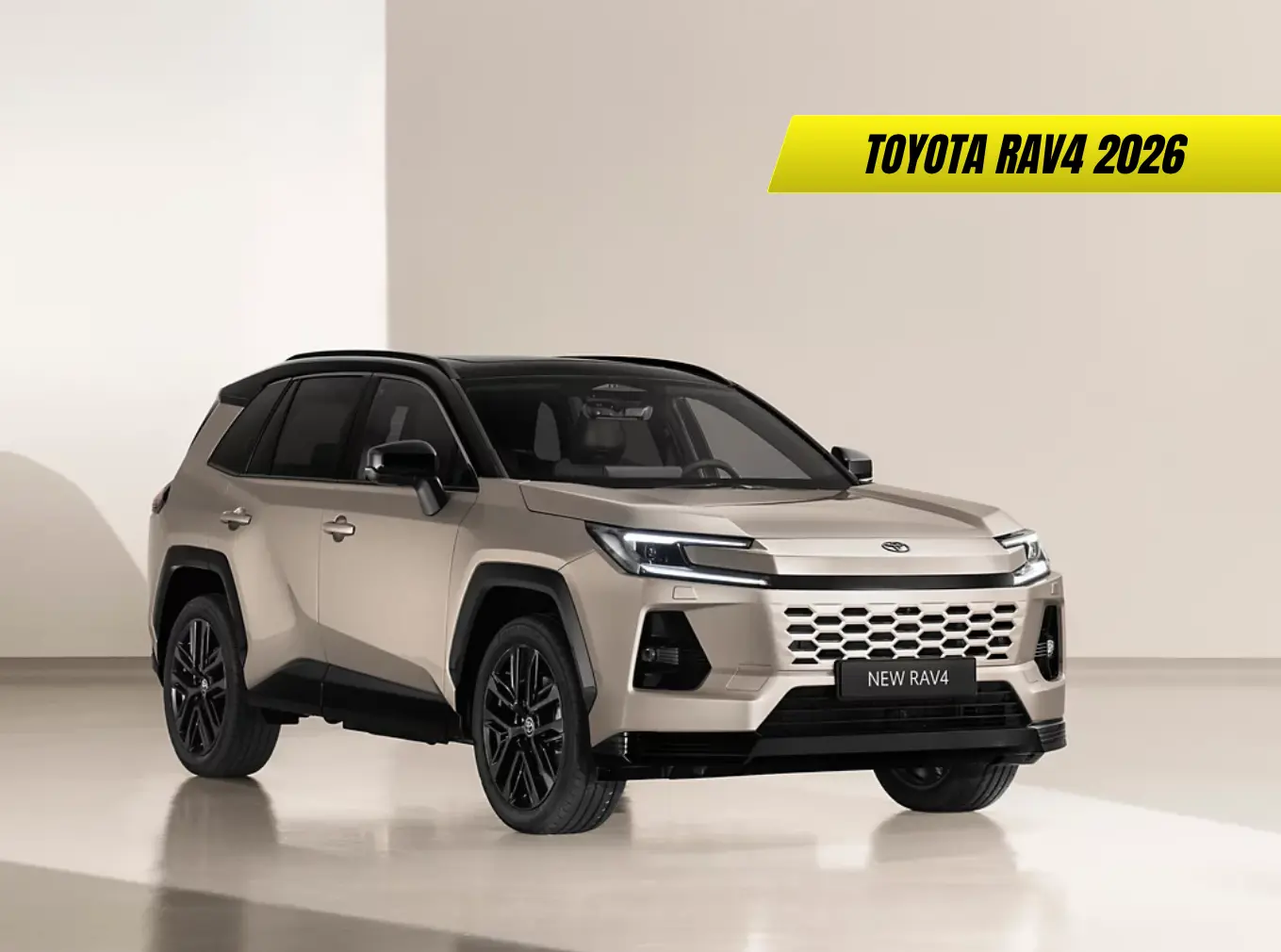
The sixth-generation Toyota RAV4 2026 arrives with a redesigned exterior, a completely new interior, a refined 185 hp full hybrid powertrain and real-world fuel consumption of just 5 l/100 km — making it one of the most compelling and accomplished family SUVs available in the UK market today.
Toyota RAV4 2026: Key Highlights at a Glance
- 185 hp full hybrid (FWD) combining a 2.5-litre 143 hp petrol engine with a 136 hp synchronous electric motor
- Available in four powertrain configurations: Full Hybrid FWD 185 hp, Full Hybrid AWD 194 hp, PHEV FWD 272 hp and PHEV AWD 309 hp
- Real-world consumption confirmed at 5 l/100 km — matching the declared WLTP range of 4.9–5.2 l/100 km
- Completely redesigned interior with a 12.9-inch Toyota Arene infotainment screen and a lowered 12.3-inch digital instrument cluster
- Boot capacity of 514 litres (446 litres on PHEV variants) with a flat load floor
- Continental pricing from €45,200 (full hybrid FWD) and €53,700 (PHEV); UK pricing to be confirmed
Design and Exterior: Stronger, More Assertive and Immediately Modern
The sixth-generation RAV4 retains the model’s established dimensions — 4.60 metres long(4.65 metres in AWD specification), 1.86 metres wide and 1.70 metres tall, with a 2.69-metre wheelbase — but presents an entirely new visual character. The front end adopts what Toyota describes as the “hammerhead” concept: a sculpted bonnet with pronounced raised ridges, flanked by slimmer LED headlights whose graphic is more angular and assertive than the outgoing car’s. The effect is of a face with considerably more personality than before — robust and purposeful without the excessive chrome excess that can undermine the design of competitors in this segment.
The body profile has been sharpened, with updated wheel arch geometry that emphasises the car’s ground clearance and off-road capability — available in bicolour finish on upper trims. 18 to 20-inch alloy wheels depending on specification complete an exterior that has grown from the previous generation’s solid but somewhat anonymous appearance into something genuinely distinctive. At the rear, new horizontal LED light clusters carry a revised RAV4 model logo at centre — a contemporary touch that updates the car’s identity without abandoning the visual continuity that has made it a globally recognisable nameplate over three decades.
Interior: Completely Redesigned and Significantly Improved
The interior of the sixth-generation RAV4 is the most dramatic step forward the model has taken since its first generation. The dashboard has been restructured entirely around a horizontal architecture, with a 12.3-inch digital instrument cluster repositioned 4 cm lower than in the outgoing car — a deliberate engineering decision that meaningfully improves the driver’s forward visibility through the steering wheel rather than above it. The 12.9-inch central infotainment screen runs the new Toyota Arene software platform, delivering a sharper, more responsive interface with an updated graphic design that reflects contemporary premium standards.
Materials quality has been notably upgraded: the majority of dashboard surfaces are soft-touch, finished in black with colour-matched accents, and the perforated synthetic leather seat upholstery is pleasant and well-finished. Some areas of the lower dashboard and door cards retain harder plastics — an honest acknowledgement that the RAV4’s pricing positions it as a premium mainstream vehicle rather than a pure luxury product. The redesigned steering wheel incorporates a revised button layout for more intuitive use, and the heated grip area now extends around the full circumference of the rim — a detail that will be appreciated on cold British winter mornings. 45W USB-C fast charging ports are standard, alongside a wireless charging pad, and a well-designed arrangement of storage cubicles accommodates everything from bottles to smartphones efficiently.
Rear Space and Boot: Consistently a Class Benchmark
The RAV4 has historically led its segment in rear passenger space and boot capacity, and the sixth generation maintains that advantage. The rear cabin provides generous knee room and headroom for adults up to 185 cm, and the central rear console carries dedicated air vents and USB charging — a provision that competing models at this price do not universally match. The seat cushions have been reshaped for improved thigh support on longer journeys.
The 514-litre boot in the full hybrid variant is accessed through a wide, low-silled aperture — the flat load floor and regular shape make loading bulky items straightforward. The powered tailgate (standard on upper trims) adds practical daily convenience, and fold-down rear seats create a fully flat, extended load area. PHEV variants trade 68 litres of boot space to accommodate the larger battery pack, yielding 446 litres — still competitive by segment standards. A rear-mounted spare wheel is not available on the sixth generation, with a tyre inflation kit occupying the under-floor compartment.
Powertrain and Driving Experience: Smooth, Efficient and Reassuringly Capable
The primary powertrain in the UK-bound RAV4 is the 2.5-litre full hybrid producing 185 hp in FWD configuration, pairing a 143 hp naturally aspirated petrol engine with a 136 hp synchronous permanent magnet electric motor through a CVT automatic gearbox. The driving character is orientated firmly towards comfort and refinement: suspension tuning absorbs road imperfections and broken surfaces with genuine composure, insonorisation at speeds above 100 km/h is effective, and the hybrid system transitions between electric and petrol modes transparently in all but the most demanding acceleration events.
In our first-drive test on the roads around Malaga — covering 42 km of varied terrain including a fast-flowing section — the car returned exactly 5 l/100 km: precisely in the middle of Toyota’s declared range of 4.9–5.2 l/100 km. This correlation between official and real-world figures is a defining characteristic of Toyota’s full hybrid system, which has been refined over multiple generations to deliver genuine on-road efficiency rather than optimistic laboratory numbers. The CVT gearbox is the powertrain’s principal compromise: under hard acceleration, the transmission holds engine revs in a manner that feels somewhat disconnected and strained — the car accelerates, but the sensation is effortful rather than fluid. In everyday moderate driving, this characteristic is largely absent.
The 309 hp PHEV AWD variant — driven briefly over an off-road section during the Malaga test — is a substantially different experience. The additional power is immediately tangible, the all-wheel drive system provides exceptional traction confidence on loose surfaces, and the electric motor’s instant torque transforms the car’s responses off-road. For UK buyers who regularly tow or need genuine all-weather, all-surface capability, the PHEV AWD justifies its premium over the FWD hybrid convincingly.
The sixth generation also introduces the latest iteration of Toyota Safety Sense: the advanced driver assistance suite now includes a more precise blind-spot monitor, a new After Collision Brake system — which automatically brings the car to a standstill following a collision if the driver is unable to do so — and an enhanced Panoramic View Monitor with three-dimensional perspective. This builds on an already comprehensive safety record that has underpinned the RAV4’s strong Euro NCAP ratings across previous generations.
| Specification | HEV FWD | HEV AWD | PHEV FWD | PHEV AWD |
|---|---|---|---|---|
| Power | 185 hp | 194 hp | 272 hp | 309 hp |
| Drivetrain | FWD | AWD | FWD | AWD |
| 0–100 km/h | 8.0 sec | TBC | TBC | TBC |
| Top speed | 180 km/h | TBC | TBC | TBC |
| Consumption (WLTP) | 4.9–5.2 l/100 km | TBC | TBC | TBC |
| Boot volume | 514 l | 514 l | 446 l | 446 l |
| Price (continental, from) | €45,200 | TBC | €53,700 | TBC |
Trim Levels and Equipment
The sixth-generation RAV4 is available in four trim levels in continental Europe: RAV4, Icon, Premium and GR Sport. The tested Icon trim — priced at €48,700 in Italy — represents the volume specification, adding comfort and technology upgrades over the entry grade. The GR Sport trim introduces a sportier exterior with dedicated design elements and a firmer chassis tune, without altering the powertrain. UK-specific trim naming and equipment levels will be confirmed closer to launch — Toyota UK typically tailors its trim structure for British market preferences and fleet buyer expectations.
For UK company car drivers, the RAV4’s PHEV variants are of particular interest. With CO2 emissions well below 50 g/km in plug-in hybrid specification, they attract significantly reduced Benefit-in-Kind taxation — a meaningful financial advantage over the self-charging hybrid variants for those who can charge at work or at home. For a comprehensive guide to the best PHEV options across the UK market, our best plug-in hybrid cars UK 2025 guide is the definitive resource.
Toyota RAV4 2026 vs. Key Rivals
| Model | Power | Boot | Consumption | 0–100 km/h | Price (from) |
|---|---|---|---|---|---|
| Toyota RAV4 HEV FWD 2026 | 185 hp | 514 l | 5.0 l/100 km | 8.0 sec | €45,200 |
| Hyundai Tucson Hybrid | 230 hp | 540 l | 5.5 l/100 km | 8.5 sec | ~€42,000 |
| Ford Kuga PHEV | 225 hp | 411 l | 1.5 l/100 km* | 9.3 sec | ~€46,000 |
| Volkswagen Tiguan eHybrid | 272 hp | 652 l | 1.2 l/100 km* | 7.2 sec | ~€50,000 |
| Nissan Qashqai e-Power | 190 hp | 479 l | 5.5 l/100 km | 7.9 sec | ~€38,000 |
*PHEV figures with full battery. The RAV4’s 514-litre boot leads the hybrid-specific entries in this comparison, and its real-world consumption figure of 5.0 l/100 km is among the most honest in the segment. For those interested in Toyota’s wider range, our coverage of the Toyota Corolla Cross 2025 and the Toyota Aygo X 2026 Hybrid provides useful context at different size and price points.
Is the Toyota RAV4 2026 Available in the UK?
The sixth-generation Toyota RAV4 2026 arrives at Toyota dealerships across continental Europe from the weekend of 18–19 April 2026, with the exception of the PHEV FWD variant which follows in September. UK market availability is expected to follow shortly after the European launch. Toyota UK pricing has not been officially confirmed at the time of writing, but based on the continental price structure and the previous generation’s UK pricing, the RAV4 2026 is expected to start from approximately £42,000–£44,000 in entry hybrid specification. The full range, configurator and dealer information will be available at toyota.co.uk once UK pricing is confirmed.
Finance options in continental markets start from €229 per month and leasing from €559 per month — indicating competitive ownership costs that Toyota UK will likely replicate with local market-specific offers. For UK drivers comparing the RAV4 2026 against the full spectrum of the large SUV market, our guide to the 20 best SUVs to buy in 2025 under £40k provides a comprehensive overview of the alternatives.
FAQ
When does the Toyota RAV4 2026 go on sale in the UK?
The European launch is scheduled for the weekend of 18–19 April 2026. UK market availability is expected to follow within weeks of the continental launch. Visit toyota.co.uk for confirmed UK on-sale dates and pricing once announced.
What is the real-world fuel economy of the Toyota RAV4 2026 hybrid?
In our first drive test of 42 km over mixed terrain including a fast road section, the RAV4 2026 full hybrid FWD returned exactly 5 l/100 km — precisely within Toyota’s declared range of 4.9–5.2 l/100 km. This is one of the strongest real-world to WLTP correlations in the compact hybrid SUV segment.
How many seats does the Toyota RAV4 2026 have?
The RAV4 2026 is a five-seat vehicle across all variants. There is no seven-seat option. Buyers requiring seven seats in the Toyota hybrid SUV range should consider the Toyota Highlander or wait for confirmed availability of a larger variant.
What is the boot size of the Toyota RAV4 2026?
The full hybrid variants offer 514 litres of boot space. PHEV variants — which carry a larger battery pack — offer 446 litres. Both figures are competitive for the class, and both variants feature a flat load floor and wide loading aperture.
What powertrains are available on the Toyota RAV4 2026?
Four configurations are available: Full Hybrid FWD 185 hp, Full Hybrid AWD 194 hp, PHEV FWD 272 hp and PHEV AWD 309 hp. All use a CVT automatic gearbox. No petrol-only or diesel variants are offered in the sixth generation — a definitive statement of Toyota’s hybrid-first strategy.
Does the Toyota RAV4 2026 have Apple CarPlay?
Yes. The 12.9-inch central infotainment screen running the Toyota Arene software platform supports both Apple CarPlay and Android Auto as standard across all trim levels.
What safety systems does the Toyota RAV4 2026 have?
The sixth generation carries the latest Toyota Safety Sense suite, including autonomous emergency braking, adaptive cruise control, lane-keeping assist, blind-spot monitoring (improved precision over the fifth generation), the new After Collision Brake system and an enhanced Panoramic View Monitor with three-dimensional perspective — the most comprehensive Toyota safety package to date.
The Toyota RAV4 2026 is a genuinely significant update to the world’s best-selling compact hybrid SUV. By addressing the interior’s previous weaknesses with a completely redesigned cabin, upgrading the infotainment to a 12.9-inch Arene-based system and refining the hybrid powertrain to deliver real-world consumption that consistently matches official figures, Toyota has reinforced the RAV4’s position at the top of its segment with quiet but decisive authority. From my point of view, the full hybrid FWD in Icon trim represents the sweet spot in the range for most UK buyers — efficient, refined, well-equipped and backed by Toyota’s unmatched hybrid reliability record. For those who need all-weather capability and maximum performance, the PHEV AWD 309 hp is one of the most compelling all-round SUVs available at any price. The RAV4 2026 is not a car that shouts — it simply delivers, every time.





