
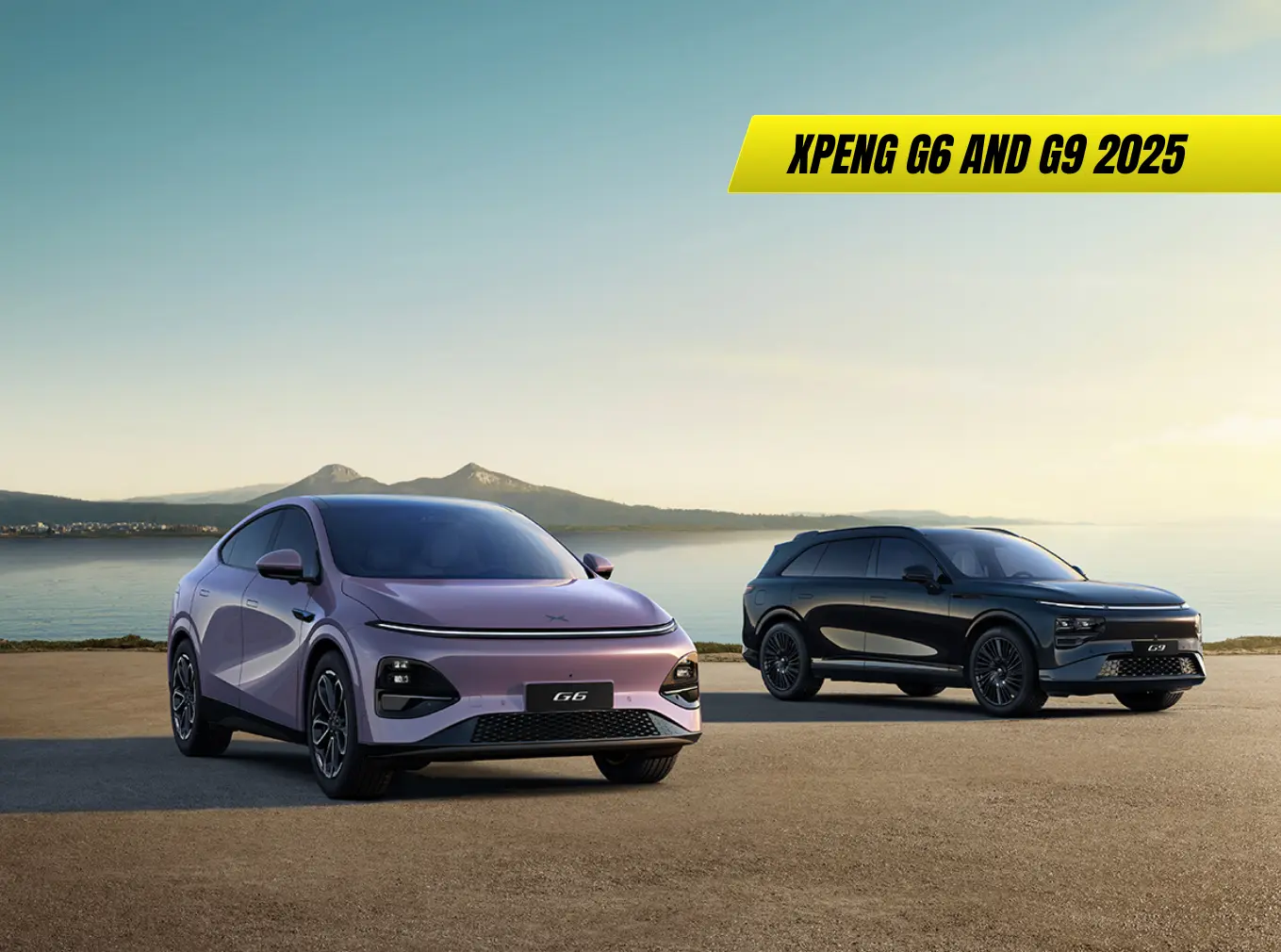
XPeng G6 and G9 2025 facelifted models revealed with updated styling, enhanced tech and improved specs. Full UK guide to Chinese electric SUVs and British market availability.
Chinese electric vehicle manufacturer XPeng has revealed comprehensively updated versions of its G6 and G9 electric SUVs for 2025, introducing refined styling, enhanced technology features, and improved specifications across both model ranges. These mid-cycle updates demonstrate XPeng’s commitment to rapid product evolution—a characteristic increasingly common among Chinese EV manufacturers who iterate their vehicles far more frequently than traditional European or Japanese brands typically manage. The refreshed models incorporate lessons learned from initial launches, addressing owner feedback whilst maintaining the competitive pricing and advanced technology that initially attracted attention. However, for UK buyers, these impressive updates remain frustratingly theoretical—XPeng currently maintains no official British presence, leaving these compelling electric SUVs unavailable through legitimate channels despite their apparent competitiveness against established alternatives dominating UK showrooms.
Key Points:
- XPeng G6 and G9 receive 2025 mid-cycle updates with styling refinements and technology enhancements
- G6 is mid-size electric SUV (4.75m length) competing theoretically with Tesla Model Y and BYD Atto 3
- G9 is larger premium electric SUV (4.89m length) rivalling BMW iX and Mercedes EQE SUV segment
- UK availability remains unconfirmed—XPeng has not announced British market entry plans or timeline
- Expected UK pricing if launched: G6 from £38,000-£46,000, G9 from £56,000-£72,000
- Both models feature XPILOT advanced driver assistance, long-range batteries (up to 400+ miles WLTP), and rapid charging
- Chinese electric vehicle competition intensifies globally, but UK penetration limited to established brands like BYD and MG
XPeng’s Market Position and European Strategy
Understanding XPeng’s broader strategic context helps UK buyers comprehend why these compelling vehicles remain unavailable in Britain despite clear technical competitiveness. Founded in 2014, XPeng represents China’s new generation of electric vehicle manufacturers—companies emerging without legacy combustion engine businesses, enabling exclusive focus on electric and intelligent vehicle technology from inception.
XPeng has positioned itself as a technology-forward premium brand, emphasising advanced autonomous driving systems, over-the-air software updates, and connected vehicle features. The company’s XPILOT technology rivals Tesla’s Autopilot in sophistication, and in certain specific capabilities surpasses it—particularly in urban environments where XPeng’s lidar sensors and advanced mapping provide advantages. This technological emphasis differentiates XPeng from value-focused Chinese competitors like MG, positioning it closer to premium territory occupied by Tesla and emerging European electric brands.
However, XPeng faces substantial challenges in Western markets. Brand recognition remains minimal outside China and select European early-adopter markets. Dealer networks are non-existent or embryonic across most of Europe. Consumer concerns about Chinese vehicle data security persist amongst some buyers and government bodies. For UK buyers specifically, XPeng exists only as an intriguing alternative visible through automotive media coverage yet entirely unavailable through official purchasing channels.
XPeng’s European expansion has focused primarily on Norway, Sweden, the Netherlands, and Denmark—markets demonstrating strong EV adoption, progressive regulatory environments, and consumer bases more willing to experiment with unfamiliar brands. The UK, despite being Europe’s second-largest automotive market, has not featured prominently in XPeng’s announced expansion plans, suggesting the company has determined that British market entry challenges outweigh potential benefits at this stage.
From my point of view, XPeng exemplifies the broader challenge facing Chinese automotive brands attempting UK penetration: producing increasingly competitive products whilst lacking the brand heritage, dealer infrastructure, and consumer trust that established manufacturers enjoy through decades of British presence. Our comprehensive guide to Chinese SUVs in the UK for 2025 explores which Chinese brands have successfully established UK operations and which remain aspirational for British buyers.
XPeng G6 2025 Facelift: Mid-Size Electric SUV Updates
The XPeng G6 occupies the crucial mid-size electric SUV segment where it would theoretically compete against the Tesla Model Y, BYD Atto 3, Volkswagen ID.4, and Hyundai Ioniq 5 if British market entry materialised. Measuring approximately 4.75 metres length, the G6 offers spacious five-seat accommodation with generous boot capacity estimated around 570 litres—expanding to approximately 1,500 litres with rear seats folded.
The 2025 facelift introduces several refinements:
Exterior styling updates: The front fascia receives revised lighting signatures with updated LED elements creating more distinctive appearance, whilst the rear features modified tail lamp graphics and subtle bumper detailing. These changes maintain XPeng’s design language whilst modernising the appearance—typical mid-cycle refresh approach avoiding alienating existing owners whilst freshening appeal for new buyers. Additional body colours join the palette, providing broader choice for style-conscious buyers.
Interior enhancements: Updated infotainment software with improved user interface responds to owner feedback about usability and responsiveness. Enhanced voice recognition better understands natural language commands, reducing reliance on touchscreen interaction whilst driving. Material quality improvements include upgraded upholstery options and refined trim finishes, addressing early criticism about interior presentation not matching the vehicle’s technological sophistication or premium pricing aspirations.
Technology additions: The updated XPILOT autonomous driving suite incorporates refined algorithms improving performance in challenging conditions including heavy rain and complex urban environments. Over-the-air update capability has expanded, enabling remote software improvements addressing issues and adding features without requiring dealer visits. Additional driver assistance functions include enhanced parking assistance and improved traffic sign recognition specifically calibrated for European road signage.
Battery and charging improvements: Whilst fundamental battery capacities remain similar (66 kWh and 87.5 kWh options), updated battery management systems improve efficiency and potentially extend range slightly. Charging calibration refinements enable faster charging curve optimisation, reducing 10-80% charging times by several minutes through better thermal management and power delivery algorithms.
Expected specifications for the facelifted G6:
- Battery options: 66 kWh and 87.5 kWh lithium-iron-phosphate (LFP) or nickel-manganese-cobalt (NMC) chemistries
- Range: Approximately 300 miles (66 kWh) to 390 miles (87.5 kWh) on WLTP cycle—modest improvements over previous specifications
- Power outputs: Single-motor RWD versions with 272 bhp, dual-motor AWD variants with 469 bhp
- Acceleration: 0-62 mph in 5.9 seconds (RWD) or 3.9 seconds (AWD)
- Charging: Up to 280 kW DC rapid charging capability, enabling 10-80% in approximately 18-20 minutes
- Top speed: Electronically limited to 125 mph
For UK buyers comparing electric SUV options currently available, our detailed guide to the best electric cars in 2025provides comprehensive analysis across segments and manufacturers actually selling vehicles through British dealer networks.
ModelLengthBattery OptionsWLTP RangePowerUK AvailabilityUK PriceXPeng G6 (2025)4.75m66 / 87.5 kWh300-390 miles272-469 bhpNot availableN/ATesla Model Y4.75m60 / 75 kWh283-331 miles299-534 bhpAvailableFrom £44,990BYD Atto 34.45m60.5 kWh260 miles201 bhpAvailableFrom £36,490Hyundai Ioniq 54.64m58 / 77.4 kWh238-315 miles170-325 bhpAvailableFrom £41,850Volkswagen ID.44.58m52 / 77 kWh213-321 miles174-286 bhpAvailableFrom £39,950
XPeng G9 2025 Facelift: Premium Electric SUV Enhancements
The XPeng G9 represents the brand’s premium flagship, competing in the luxury electric SUV segment against the BMW iX, Mercedes EQE SUV, Audi Q8 e-tron, and Tesla Model X. At approximately 4.89 metres length, the G9 provides substantially more interior space than the G6, with particular emphasis on rear-seat comfort and premium materials throughout the cabin.
The 2025 facelift brings more comprehensive updates than its smaller sibling:
Styling evolution: More extensive exterior revisions include redesigned front grille area with updated lighting elements incorporating new LED signatures, revised side body sculpting adding visual drama, and modified rear-end detailing with new three-dimensional tail lamp graphics. The changes maintain family resemblance to the G6 whilst establishing clearer visual distinction justifying the G9’s premium positioning and substantially higher pricing.
Interior upgrades: Significant enhancements focus on rear-seat luxury, recognising that G9 buyers at this price point often employ chauffeurs or prioritise passenger comfort equally with driver experience. Updated rear-seat entertainment systems feature larger screens, improved audio quality, and enhanced connectivity. Executive seating packages add massage functions, enhanced climate control with individual zone management, and upgraded materials including Nappa leather options. The front cabin receives similar attention with improved material quality, refined ergonomics, and enhanced ambient lighting creating more sophisticated atmosphere.
Advanced technology integration: The G9’s comprehensive sensor suite receives calibration improvements enhancing XPILOT performance, particularly in complex scenarios involving pedestrians, cyclists, and unusual road configurations. Lidar sensor integration (standard on higher specifications) provides three-dimensional environmental mapping enabling more sophisticated autonomous driving capabilities—though UK regulatory restrictions would limit actual functionality even if the vehicle achieved British market availability.
Air suspension refinement: Updated adaptive air suspension calibration improves ride quality whilst maintaining dynamic capability when desired. Multiple driving modes enable personality adjustment from comfort-prioritised settings ideal for motorway cruising to sportier configurations tightening responses for more engaging driving on challenging roads. Ride height adjustment facilitates easier entry/exit whilst providing ground clearance when necessary.
Battery and performance updates: The G9’s large-capacity batteries (93.1 kWh and 98 kWh options) receive similar management system improvements as the G6, optimising efficiency and potentially extending range slightly. Performance variants may receive enhanced power delivery calibration extracting additional responsiveness from the dual-motor AWD powertrain.
Expected G9 specifications after 2025 updates:
- Battery options: 93.1 kWh and 98 kWh high-capacity packs using advanced cell chemistry
- Range: Approximately 345 miles (93.1 kWh) to 420 miles (98 kWh) on WLTP cycle
- Power outputs: Dual-motor AWD standard with outputs ranging 408-551 bhp depending on specification
- Acceleration: 0-62 mph in 4.1 seconds (standard) or 3.1 seconds (Performance variant)
- Charging: Up to 300 kW DC rapid charging capability, 10-80% in under 20 minutes with compatible infrastructure
- Air suspension: Standard on higher trims providing adaptive damping and ride height adjustment
The G9’s updated specifications would position it competitively against established premium electric SUVs if UK availability materialised, though whether British buyers would embrace Chinese badges at £56,000-£72,000 price points remains highly questionable given established alternatives from prestigious German manufacturers.
XPILOT Autonomous Driving Technology Enhancements
XPeng’s XPILOT advanced driver assistance system represents genuine competitive differentiator, incorporating hardware and software sophistication rivalling Tesla’s Autopilot whilst in specific scenarios potentially exceeding it. The 2025 updates bring refined algorithms, improved sensor fusion, and enhanced capabilities addressing limitations identified through real-world deployment across XPeng’s existing markets.
XPILOT enhancements in 2025 models include:
Improved environmental perception: Better object classification distinguishes between different vehicle types, pedestrians, cyclists, and stationary objects with greater accuracy. This enables more appropriate responses to complex scenarios—maintaining larger buffers around vulnerable road users, anticipating cyclist movements more accurately, and distinguishing between harmless roadside objects and actual obstacles requiring avoidance.
Enhanced urban navigation: City driving presents autonomous systems’ greatest challenges through dense traffic, frequent intersections, pedestrians crossing unpredictably, and ambiguous road markings. The updated XPILOT demonstrates improved urban capability through better understanding of complex intersection rules, more confident roundabout navigation, and smoother integration into dense traffic flow.
Weather performance: Early autonomous systems struggled in adverse weather where sensors face degradation—cameras blinded by rain or glare, radar confused by heavy precipitation, lidar compromised by fog. The 2025 updates incorporate better sensor fusion algorithms intelligently weighting inputs from different sensors based on current conditions, maintaining functionality across broader environmental ranges.
Learning and adaptation: Over-the-air updates enable continuous improvement as XPeng’s fleet accumulates additional real-world data. The system learns from challenging scenarios encountered by any vehicle, distributing improvements across the entire fleet. This collective learning approach enables rapid capability development impossible with traditional vehicles requiring physical dealer visits for updates.
However, critical UK limitations apply. British regulations currently prohibit hands-off driving except specific circumstances with type-approved systems meeting stringent requirements. XPeng’s XPILOT would operate as advanced Level 2 autonomy in the UK, requiring constant driver supervision despite sophisticated capabilities. Drivers must keep hands on the steering wheel, maintain attention on the road, and remain ready to intervene immediately—essentially using XPILOT as very advanced cruise control rather than genuine autonomy.
Understanding UK driving regulations applies equally regardless of vehicle technology sophistication. Resources covering UK driving licence points explain penalty systems affecting all British drivers, whilst guides addressing UK speed camera regulations cover evolving enforcement approaches increasingly incorporating intelligent speed assistance technologies.
UK Market Entry Challenges and Barriers
The fundamental question facing UK buyers interested in XPeng vehicles involves understanding why these compelling electric SUVs remain unavailable despite apparent competitive specifications and reasonable pricing. Multiple interconnected factors create substantial barriers preventing XPeng’s British market entry, each representing significant investment and risk requiring careful consideration.
Regulatory compliance and certification: UK vehicle type-approval requires extensive testing and certification demonstrating compliance with British safety, emissions (even for electric vehicles), and construction standards. Post-Brexit, UK regulations have diverged slightly from EU standards, necessitating separate approval processes adding costs and complexity. For XPeng to sell vehicles legally in Britain, every model requires individual type-approval—a process costing hundreds of thousands of pounds per vehicle and requiring months of testing and documentation.
Right-hand-drive conversion: Britain’s right-hand-drive requirement adds substantial engineering and manufacturing costs. Converting vehicles involves far more than simply moving the steering wheel—entire dashboard structures, pedal assemblies, HVAC systems, and electrical architectures require redesign and retooling. For manufacturers projecting modest UK sales volumes, these conversion costs may not achieve viable return on investment, particularly when resources could instead focus on larger left-hand-drive markets.
Dealer network establishment: British buyers purchasing £40,000-£70,000 vehicles expect convenient local dealer access for sales, servicing, and warranty work. Building UK dealer networks from zero requires enormous capital investment in property, equipment, staff training, and parts inventory. XPeng would need to either establish company-owned facilities (extremely expensive) or recruit independent dealers willing to invest in representing an unknown Chinese brand (extremely difficult given dealer reluctance without proven demand).
Parts and service infrastructure: Beyond dealer showrooms, XPeng requires comprehensive parts distribution networks ensuring rapid availability of replacement components across Britain. Service technicians need training on XPeng-specific systems, diagnostic equipment requires deployment, and warranty administration systems need establishment. This infrastructure represents multi-million pound investment before selling a single vehicle.
Brand building and marketing: UK consumers demonstrate strong preference for familiar brands with established reputations. Introducing an unknown Chinese brand requires substantial marketing investment building awareness and credibility. XPeng would compete against manufacturers with decades of British presence and advertising spend measured in tens of millions of pounds annually—a daunting challenge for new entrants with limited budgets.
Political and security considerations: Ongoing UK government scrutiny of Chinese technology products, particularly those incorporating extensive connectivity and data collection, creates regulatory uncertainty. Whilst no specific automotive restrictions currently exist, broader concerns about data security and critical infrastructure dependencies make some manufacturers cautious about UK investment given potential future restrictions.
From my perspective, these combined challenges explain XPeng’s apparent reluctance to prioritise UK market entry despite the country being Europe’s second-largest automotive market. The required investment runs into hundreds of millions of pounds, the timeline extends across multiple years, and success remains uncertain given established competition and consumer scepticism about unfamiliar brands. For UK buyers seeking Chinese electric SUVs available now, brands like BYD and MG have made these investments and established functioning British operations, eliminating uncertainty surrounding aspirational imports.
Theoretical UK Pricing and Competitive Positioning
Should XPeng eventually enter the UK market, pricing strategy would prove crucial to success. The brand cannot simply match established competitors—it must offer compelling value overcoming inherent disadvantages of brand unfamiliarity, limited dealer infrastructure, and uncertain residual values affecting total cost of ownership.
For the XPeng G6, I anticipate UK pricing would need to start around £38,000-£42,000 for base specifications with the smaller 66 kWh battery, extending to £44,000-£46,000 for long-range or dual-motor AWD variants. This positions it competitively against the BYD Atto 3 (from £36,490) whilst significantly undercutting the Tesla Model Y (from £44,990) and Hyundai Ioniq 5 (from £41,850). The pricing must balance offering clear value whilst maintaining premium positioning reflecting the advanced technology and sophisticated specifications.
For the premium XPeng G9, UK pricing becomes substantially more challenging. Premium segment buyers prioritise brand prestige, dealer experience, and residual value certainty alongside product quality. I estimate UK pricing would require starting around £56,000-£60,000 for base specifications, potentially reaching £68,000-£72,000 for fully-loaded Performance variants with maximum battery capacity and all available technology. This significantly undercuts the BMW iX (from £77,000), Mercedes EQE SUV (from £80,000), and Audi Q8 e-tron (from £69,000), but whether UK buyers choose unfamiliar Chinese brands over established German luxury badges remains highly questionable regardless of specification advantages or cost savings.
For UK buyers exploring actually-available alternatives across various price points, our guide to SUVs under £40,000covers excellent options in British showrooms today, whilst our comprehensive mid-size SUV comparison explores the segment where the G6 would theoretically compete.
SegmentXPeng ModelExpected UK PriceKey UK CompetitorsCompetitor PricingMid-size electric SUVG6 (2025)£38,000-£46,000 (est.)Tesla Model Y, BYD Atto 3, Hyundai Ioniq 5£36,490-£44,990Premium electric SUVG9 (2025)£56,000-£72,000 (est.)BMW iX, Mercedes EQE SUV, Audi Q8 e-tron£69,000-£80,000
Available UK Alternatives Worth Considering Now
Given XPeng’s absence from the UK market with no confirmed entry timeline, British buyers seeking mid-size or premium electric SUVs must focus on actually-available alternatives. Several excellent options exist across various price points, each with established UK dealer support and proven ownership experiences.
Mid-size electric SUV alternatives to the G6:
Tesla Model Y (from £44,990): Dominant market position with extensive Supercharger network access, proven technology, and strong performance. Build quality concerns persist for some buyers, and polarising styling doesn’t appeal universally. However, the Model Y’s combination of range, performance, technology, and charging infrastructure creates compelling package despite premium pricing.
BYD Atto 3 (from £36,490): Exceptional value proposition with 260-mile range, comprehensive equipment, and Chinese engineering proving increasingly sophisticated. More conservative styling than cutting-edge alternatives, and brand prestige lags established manufacturers. However, aggressive pricing and MG-style approach of offering generous specifications creates strong value argument.
Hyundai Ioniq 5 (from £41,850): Distinctive retro-modern styling, 800V fast-charging architecture enabling very rapid charging, and Hyundai’s excellent 5-year warranty. Slightly less practical packaging than conventional SUV shapes, and higher pricing than some alternatives. Nonetheless, the Ioniq 5’s combination of style, technology, and brand credibility creates appealing package.
Volkswagen ID.4 (from £39,950): Established brand trust, solid build quality reflecting Volkswagen Group standards, and good dealer network across UK. Less exciting than newer alternatives, and range falls short of best competitors. However, conservative buyers valuing familiarity and perceived quality over cutting-edge technology may prefer the ID.4’s reassuring conventionality.
Kia EV6 (from £42,995): Shares platform with Ioniq 5 but offers different styling and Kia’s industry-leading 7-year warranty. Similar rapid charging capabilities and strong specifications. Slightly sportier positioning than Hyundai alternative appeals to specific demographics.
Premium electric SUV alternatives to the G9:
BMW iX (from £77,000): Established premium credentials, excellent interior quality, comprehensive UK dealer network, and sophisticated technology integration. Very high pricing and controversial exterior styling divisive amongst buyers. However, BMW badge prestige and ownership experience justify premium for target demographic.
Mercedes EQE SUV (from £80,000): Luxury brand prestige, advanced technology including MBUX infotainment, comprehensive equipment. Extremely expensive and somewhat conservative design. Mercedes ownership experience and dealer network provide reassurance for buyers prioritising established luxury brands.
Audi Q8 e-tron (from £69,000): Quattro all-wheel-drive heritage, sophisticated interior, and Audi’s reputation for build quality. High pricing and relatively conventional design. Strong residual values and established dealer support appeal to conservative premium buyers.
Tesla Model X (from £89,990): Maximum performance, extensive range, Supercharger network access. Falcon-wing doors prove impractical for UK parking constraints, and extreme pricing limits appeal. However, Tesla’s technology leadership and charging infrastructure create advantages despite cost.
Polestar 3 (from £69,900): Scandinavian design excellence, Volvo engineering heritage, competitive specifications. Relatively new model with limited long-term reliability data, and Polestar’s developing dealer network less established than traditional premium brands.
Our guide to best electric cars available in 2025 provides comprehensive comparisons helping UK buyers identify optimal choices from actually-available alternatives rather than unavailable aspirational options.
Should UK Buyers Wait for XPeng?
This question demands pragmatic assessment of probabilities and alternatives. I strongly recommend UK buyers do not delay electric SUV purchases whilst waiting for XPeng’s uncertain market entry for multiple compelling reasons:
No confirmed timeline: XPeng has not announced UK market entry plans, timelines, or even expressed definitive commitment to the British market. Waiting indefinitely for uncertain products makes little practical sense when excellent alternatives exist immediately.
Substantial barriers remain: Right-hand-drive conversion, regulatory approval, dealer network establishment, and parts infrastructure development require multi-year timelines and enormous investment even if XPeng committed to UK entry tomorrow. Early adopters would face limited service options and potentially extended waits for repairs.
Residual value uncertainty: Unknown brands suffer weak residual values until market establishes appropriate pricing through actual transactions. The first UK XPeng buyers would likely face significant depreciation as the used market determines values—a financial risk avoided by purchasing established alternatives with known residual performance.
Excellent alternatives available: The UK electric SUV market offers numerous compelling choices across all price points, sizes, and specifications. Delaying purchase for uncertain products when better-established alternatives exist today seems illogical unless XPeng offers genuinely irreplaceable features—which it doesn’t, despite impressive specifications.
Changing market dynamics: The electric vehicle market evolves rapidly. Battery technology advances, new competitors emerge, and pricing shifts as manufacturing scales and Chinese competition intensifies. The XPeng models looking competitive today may face substantially stronger alternatives by the time UK availability potentially materialises.
If you’re strongly attracted to XPeng’s specifications and technology, I recommend following the brand’s European expansion developments closely whilst purchasing currently-available alternatives meeting immediate needs. Perhaps consider short-term leasing arrangements positioning you to transition to XPeng if and when UK availability materialises, without committing to long-term ownership of alternatives.
For buyers requiring vehicles immediately, focus on proven options actually available in UK showrooms with established dealer support and known ownership experiences. The theoretical advantages of unavailable vehicles provide no practical benefit versus real vehicles you can drive today.
Are XPeng vehicles currently available to purchase in the UK?
No, XPeng does not currently sell vehicles in the United Kingdom through official channels. The company has focused European expansion on Norway, Sweden, the Netherlands, and Denmark. No official UK launch timeline has been announced, and establishing British presence would require substantial investment in dealer networks, right-hand-drive conversion, and regulatory approval—commitments XPeng has not yet made for the UK market.
How do the 2025 XPeng updates improve on previous models?
The 2025 facelifts bring refined exterior styling with updated lighting signatures, enhanced interior materials and technology interfaces, improved XPILOT autonomous driving calibration, better battery management systems potentially extending range slightly, and various quality improvements addressing owner feedback. These updates represent typical mid-cycle refresh enhancements maintaining competitiveness without fundamental redesigns.
What is the real-world range for XPeng G6 and G9 on UK roads?
Based on WLTP specifications, the G6 should deliver approximately 300-390 miles depending on battery option, with real-world UK driving typically yielding 10-15% less—suggesting practical range around 255-340 miles. The larger G9 should achieve 345-420 miles WLTP, translating to real-world range around 295-365 miles. Winter driving with heating significantly reduces these figures, potentially to 220-300 miles (G6) and 250-320 miles (G9) in coldest conditions.
Can I import a XPeng vehicle from Europe to the UK?
Technically possible but strongly inadvisable. European-specification XPeng vehicles are left-hand-drive, making them impractical and potentially dangerous for UK use. Additionally, imported vehicles would lack UK type-approval, creating DVLA registration difficulties or impossibility. You would have no manufacturer warranty, no access to UK service networks, face significant depreciation if attempting resale, and potentially encounter insurance difficulties.
How does XPeng’s XPILOT compare with Tesla’s Autopilot?
XPeng’s XPILOT incorporates similar or potentially superior hardware to Tesla Autopilot, including lidar sensors on premium G9 models which Tesla lacks. In Chinese markets where both systems operate, XPILOT demonstrates competitive or superior capabilities in specific scenarios, particularly complex urban environments where lidar provides advantages. However, UK regulatory restrictions would limit both systems to Level 2 autonomous driving requiring constant driver supervision, reducing practical differences in British use.
What Chinese electric SUVs can I actually buy in the UK now?
UK-available Chinese electric SUVs include the BYD Atto 3 (from £36,490), MG ZS EV (from £28,495), MG4 (from £26,995), and MG Marvel R. These vehicles offer proven UK dealer support, established ownership communities, known specifications, and eliminate uncertainty surrounding brands like XPeng that haven’t confirmed UK availability. Our comprehensive guide to Chinese SUVs in the UK explores these options thoroughly.
Will XPeng announce UK market entry in 2025?
Unknown—XPeng has not provided public statements regarding UK market plans or timelines. Given the substantial investment required for right-hand-drive conversion, dealer network establishment, regulatory approval, and marketing, any potential UK entry would likely be announced well in advance allowing preparation time. Monitor XPeng’s official communications and UK automotive media for any announcements, but do not delay vehicle purchases based on speculation about uncertain future availability.
Conclusion: Impressive But Inaccessible
The 2025 XPeng G6 and G9 facelifts demonstrate Chinese electric vehicle manufacturers’ rapid product development capabilities, introducing meaningful improvements addressing owner feedback whilst maintaining competitive specifications and advanced technology. Both updated models represent genuinely impressive electric SUVs that would compete strongly in their respective segments if UK availability materialised—the G6 challenging the Tesla Model Y and established mid-size alternatives, the G9 bringing premium features and technology to the luxury electric segment at potentially compelling pricing.
However, for UK buyers, these observations remain frustratingly academic. XPeng’s absence from the British market means these vehicles exist only as aspirational alternatives visible through automotive media coverage but entirely unavailable through legitimate purchasing channels. No confirmed UK launch timeline, no right-hand-drive availability, no dealer network, and no established ownership experience makes recommending these vehicles to British buyers impossible regardless of their objective specifications and apparent competitiveness.
From my point of view, XPeng exemplifies the broader phenomenon of impressive Chinese electric vehicles that UK buyers simply cannot purchase despite clear technical merit. Whilst this situation may change—XPeng could announce UK entry at any time—the practical advice for British buyers remains unchanged: focus on excellent electric SUVs actually available in UK showrooms with established dealer support, proven ownership experiences, and known residual values. The BYD Atto 3, Tesla Model Y, Hyundai Ioniq 5, and numerous other alternatives offer compelling combinations of specifications, pricing, and crucially, immediate availability with proper UK support infrastructure. Sometimes the vehicle you can buy today with full manufacturer backing beats the theoretically superior vehicle you might potentially be able to buy someday through uncertain channels—especially when that someday remains entirely unconfirmed and those channels entirely non-existent.





