
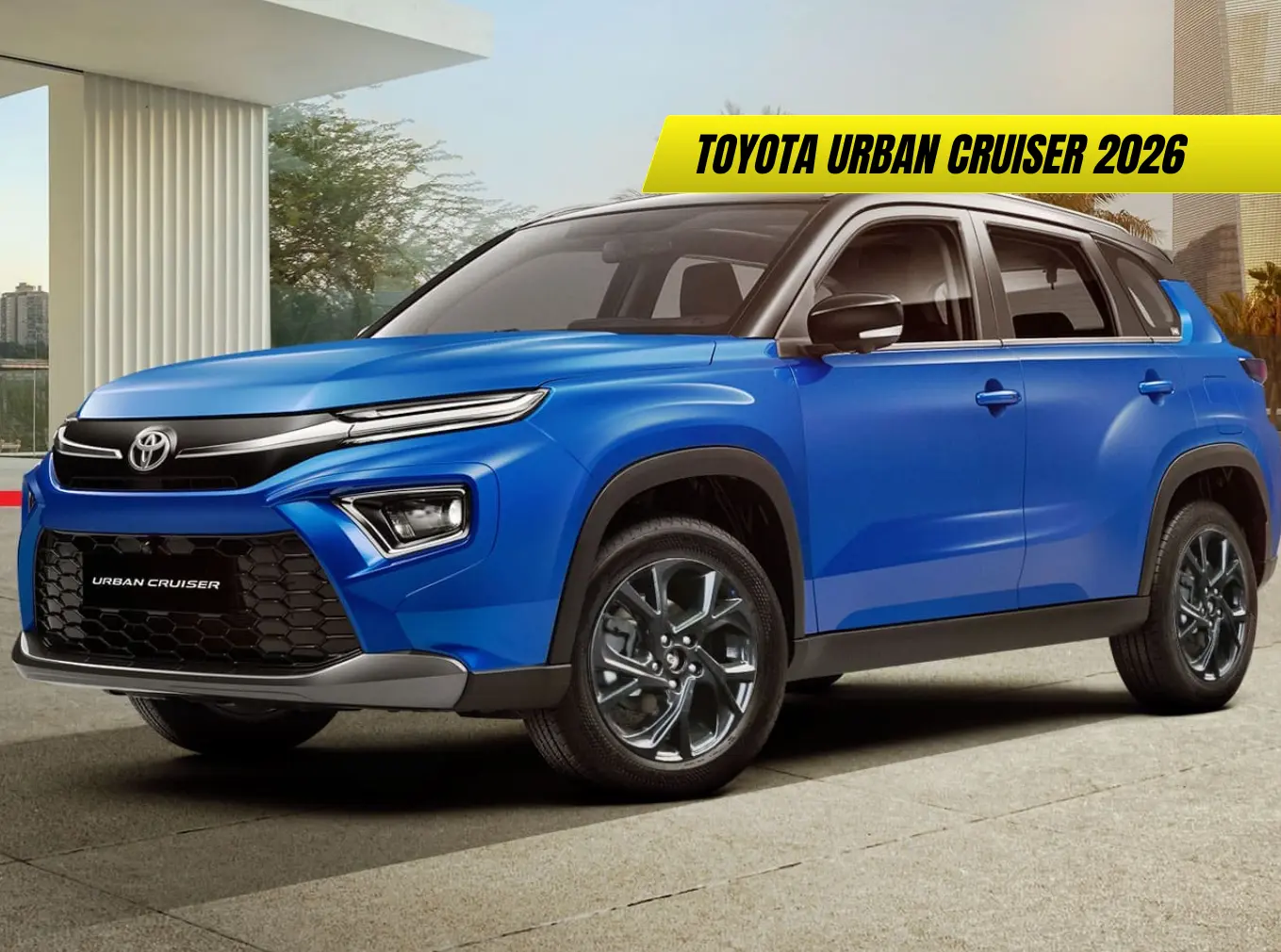
Toyota Urban Cruiser 2026 electric SUV – UK release date uncertain, expected £28k-£32k price, 250-300 mile range. Complete guide with alternatives for British buyers.
The compact electric SUV segment is heating up, and Toyota’s Urban Cruiser name is making a comeback—but with a crucial twist. After retiring the petrol-powered Urban Cruiser in recent years, Toyota is preparing to resurrect the nameplate for an all-electric city SUV built on the same platform as Suzuki’s eVX concept. However, as French automotive sources suggest, the launch timeline and market availability remain uncertain, particularly for European markets. For UK buyers eager for an affordable electric Toyota SUV, this creates both anticipation and questions about when—or if—the Urban Cruiser EV will arrive on British roads.
Key Points:
- Toyota Urban Cruiser 2026 is an electric compact SUV sharing its platform with Suzuki’s eVX concept
- Expected to measure around 4.3 metres in length, positioning it below the bZ4X in Toyota’s electric range
- UK availability remains unconfirmed, with Continental European launch also uncertain for 2026
- Anticipated range of approximately 250-300 miles on the WLTP cycle with battery options likely between 48-60 kWh
- Pricing could start from around £28,000-£32,000 if it reaches the UK market, competing directly with MG ZS EV and Hyundai Kona Electric
- Alternative UK options include the Toyota bZ4X and upcoming smaller electric models in Toyota’s expanding EV lineup
Understanding the Electric Compact SUV Landscape in the UK
Before diving into the Urban Cruiser specifically, it’s worth understanding where this vehicle would sit within the broader UK electric vehicle market. The compact electric SUV segment has become fiercely competitive, with manufacturers from Europe, Asia, and increasingly China vying for British buyers’ attention. If you’re considering electric vehicles more broadly, our comprehensive guide to the best electric cars in 2025 provides detailed comparisons across all segments and price points.
The appeal of compact electric SUVs in the UK is straightforward: they offer the elevated driving position and perceived practicality that British buyers have embraced, whilst maintaining dimensions suited to urban environments and residential parking. Unlike larger SUVs that can feel cumbersome on narrow British roads and in multi-storey car parks, compact models around 4.3 metres length strike a balance between space and manoeuvrability.
What Is the Toyota Urban Cruiser 2026?
The Toyota Urban Cruiser nameplate previously adorned a rebadged Suzuki Vitara sold between 2009-2016, but this 2026 iteration represents something entirely different. Built as part of Toyota and Suzuki’s collaborative partnership, the new Urban Cruiser will be a purpose-built electric vehicle sharing its fundamental architecture with Suzuki’s eVX electric SUV concept unveiled at the 2023 Auto Expo in India.
This collaboration makes strategic sense for both manufacturers. Toyota gains access to a compact electric platform suited for urban markets, whilst Suzuki benefits from Toyota’s advanced electric powertrain technology and global manufacturing scale. The Urban Cruiser is expected to measure approximately 4.3 metres in length, making it considerably smaller than Toyota’s current electric SUV offering, the bZ4X, which stretches to 4.69 metres.
From my point of view, this positioning could prove particularly attractive for UK city dwellers seeking an electric vehicle with Toyota’s reputation for reliability but in a more manoeuvrable package. However, the uncertainty surrounding UK availability remains the elephant in the room—Toyota has not officially confirmed whether British buyers will have access to this model.
UK Availability: Will the Urban Cruiser Come to Britain?
Here’s where prospective UK buyers need to manage expectations carefully. According to French automotive sources, the Toyota Urban Cruiser’s launch in France—and by extension, other European markets—appears uncertain for 2026. Toyota has not included the Urban Cruiser in official UK product announcements, and the company’s European electric strategy currently centres on the bZ4X and forthcoming smaller electric models.
The reality is that Toyota may prioritise other markets for the Urban Cruiser launch. India and select Asian markets seem to be the primary focus, where compact SUVs dominate sales charts and where the collaborative Suzuki relationship holds particular strength. European regulations, charging infrastructure expectations, and competitive pressure from established players like the MG ZS EV may influence Toyota’s decision to delay or potentially skip UK introduction entirely.
Understanding UK regulatory requirements becomes crucial here. British drivers must navigate specific compliance standards including MOT requirements—though new vehicles are exempt for the first three years—and UK driving licence points systems that apply equally to electric and conventional vehicles. Any vehicle sold in the UK must meet these standards, which may factor into Toyota’s decision-making process.
Expected Specifications and Performance
Whilst official specifications remain under wraps, we can make educated projections based on the Suzuki eVX concept specifications and Toyota’s existing electric vehicle technology. The Urban Cruiser is anticipated to offer battery capacity options between 48 kHh and 60 kWh, delivering an estimated WLTP range of 250-300 miles depending on specification.
Power output will likely fall in the 150-180 bhp range for front-wheel-drive variants, with the possibility of a dual-motor all-wheel-drive option delivering around 220-240 bhp. Given the platform’s dimensions and intended urban focus, expect acceleration figures of approximately 7-8 seconds for 0-60 mph—adequate rather than exhilarating, but perfectly suited for city and suburban driving.
Charging capabilities should include DC rapid charging support up to 100-150 kW, enabling 10-80% charges in roughly 30-35 minutes at compatible public chargers. For UK owners, this would make the Urban Cruiser practical for occasional longer journeys whilst primarily serving as an urban runabout charged overnight on a home wallbox.
In my experience with compact electric SUVs, this specification balance represents the sweet spot for British buyers who need practical urban transport with sufficient range for weekend trips—assuming, of course, that Toyota decides to actually sell it here.
Pricing Expectations for the UK Market
If the Urban Cruiser reaches UK showrooms, pricing strategy will prove crucial for its success. Based on component costs, platform economics, and competitive positioning, I anticipate a starting price around £28,000-£32,000 for the base model, with higher-specification variants potentially reaching £35,000-£38,000.
This pricing would position the Urban Cruiser directly against established competitors in the UK electric compact SUV segment. The MG ZS EV currently starts from around £28,495, whilst the Hyundai Kona Electric begins at approximately £33,450. The Vauxhall Mokka Electric sits around £31,995, and the Peugeot e-2008 starts from about £34,600.
For buyers on tighter budgets, it’s worth exploring our guide to the cheapest cars in 2025, which covers affordable options including petrol, hybrid, and electric models for first-time buyers. Whilst the Urban Cruiser wouldn’t qualify as a true budget option, it would sit at the more accessible end of the electric SUV spectrum.
ModelStarting Price (est.)Battery CapacityWLTP RangePower OutputToyota Urban Cruiser (projected)£28,000-£32,00048-60 kWh250-300 miles150-180 bhpMG ZS EV£28,49550.3 kWh273 miles177 bhpHyundai Kona Electric£33,45048.6 kWh234 miles156 bhpVauxhall Mokka Electric£31,99550 kWh209 miles136 bhp
Design and Interior Features
Whilst official images remain limited, the Urban Cruiser is expected to blend Toyota’s latest design language with practical urban-focused dimensions. Expect a relatively upright profile maximising interior space within the compact footprint, with design cues potentially borrowing from both the bZ4X and Toyota’s conventional SUV lineup.
Inside, the Urban Cruiser should feature Toyota’s latest infotainment system with smartphone connectivity including Apple CarPlay and Android Auto as standard. A digital instrument cluster paired with a central touchscreen (likely 10-12 inches) will provide vehicle information and connectivity features. Sustainable materials and practical storage solutions should feature prominently, acknowledging the urban-focused buyer demographic.
Boot capacity will necessarily be modest given the overall dimensions—expect around 350-400 litres with rear seats in place, expanding to approximately 1,000 litres with seats folded. This compares reasonably with the MG ZS EV’s 380 litres and Hyundai Kona Electric’s 332 litres, making it adequate for weekly shopping and occasional larger loads, though perhaps not ideal for those requiring substantial cargo capacity regularly.
From my point of view, the interior will need to feel considerably more premium than the previous Urban Cruiser (which was essentially a rebadged budget SUV) to justify positioning alongside established Toyota models and compete with increasingly sophisticated Chinese alternatives. Speaking of which, our detailed guide to Chinese SUVs in the UK for 2025 demonstrates just how competitive this segment has become, with manufacturers like BYD and MG offering feature-rich interiors at aggressive price points.
Safety and Technology Features
Toyota’s commitment to safety equipment should ensure the Urban Cruiser arrives with comprehensive active and passive safety systems as standard. Toyota Safety Sense—the manufacturer’s suite of driver assistance technologies—will almost certainly be included across the range, incorporating:
- Pre-collision system with pedestrian and cyclist detection
- Adaptive cruise control with stop-and-go functionality
- Lane departure alert with steering assist
- Automatic high beam headlights
- Road sign assist
Additional technologies likely to feature include blind-spot monitoring, rear cross-traffic alert, and a 360-degree camera system on higher specifications. Given current UK safety expectations and the forthcoming UK speed camera regulations for 2025, intelligent speed assistance and connected safety features should also be present.
Battery warranty will probably follow Toyota’s standard approach of 8 years or 100,000 miles, with state-of-health guarantees of 70% capacity retention. This matches industry norms and provides reassurance for UK buyers concerned about long-term battery degradation—a particular consideration in Britain’s variable climate conditions.
Modern vehicles also feature comprehensive warning light systems to alert drivers to potential issues. Understanding dashboard indicators like the spanner warning light becomes essential for maintaining any vehicle properly, whether electric or conventional.
UK Alternatives to Consider Now
Given the uncertainty surrounding the Urban Cruiser’s UK availability, British buyers seeking a compact electric SUV should seriously consider confirmed alternatives currently available. Several excellent options exist in this segment, each with their own strengths:
MG ZS EV: The current segment value leader, offering genuine 273-mile range, spacious interior, and competitive pricing from £28,495. Chinese ownership has enabled MG to price aggressively whilst including generous equipment levels. However, brand prestige and residual values lag behind established manufacturers.
Hyundai Kona Electric: Recently redesigned, the Kona Electric delivers distinctive styling, excellent infotainment technology, and Hyundai’s industry-leading 5-year unlimited mileage warranty. The 234-mile range suits most UK driving patterns, though smaller battery capacity than some rivals.
Vauxhall Mokka Electric: British brand heritage combined with Stellantis electric technology creates a compelling package. Bold exterior design and competitive pricing make it attractive, though the 209-mile range falls short of some alternatives and may prove limiting for longer journeys.
For those willing to consider slightly larger alternatives, our comprehensive guide to mid-size SUVs in the UK for 2025 provides detailed comparisons of vehicles offering more space and range, albeit at higher price points. Alternatively, if you’re specifically shopping in the £40,000 bracket, our article on 20 best SUVs to buy in 2025 under £40k covers both electric and conventional options comprehensively.
If you’re specifically interested in Toyota’s current electric offerings available in the UK, the bZ4X represents the brand’s committed electric SUV option, starting from around £42,000 with substantially more space and range than the Urban Cruiser would offer.
Running Costs and UK Considerations
Should the Urban Cruiser reach UK shores, running costs would likely prove considerably lower than equivalent petrol SUVs. With no VED (road tax) currently payable on pure electric vehicles registered before April 2025, and reduced company car tax rates of just 2% BIK for 2025/26, the financial incentives remain attractive for both private buyers and fleet operators.
Electricity costs for charging at home on an average UK domestic tariff would work out at approximately 7-9p per mile, compared with 15-20p per mile for equivalent petrol models. However, this assumes primarily home charging—public rapid charging costs have risen substantially, with some networks now charging 65-85p per kWh, which significantly erodes the cost advantage.
For those who regularly travel on motorways and major routes, understanding UK toll roads and charges becomes important for accurate journey cost calculations. Whilst toll roads remain relatively uncommon in Britain compared to Continental Europe, they do exist on certain routes and can add to overall running costs.
UK insurance costs for compact electric SUVs typically fall in groups 20-25, broadly similar to equivalent petrol models. The Toyota brand reputation for reliability should help secure competitive premiums, though electric vehicle repair costs can be higher than conventional vehicles, which insurers factor into their calculations.
For UK tax purposes, electric vehicles registered from April 2025 onwards will pay standard VED from the second year onwards (first year remains exempt), currently £190 annually. This represents a significant change from the previous total exemption and should be factored into long-term ownership calculations.
Comparison with Plug-in Hybrid Alternatives
Some UK buyers considering the Urban Cruiser might also evaluate plug-in hybrid alternatives, which offer electric-only capability for shorter journeys whilst retaining petrol engines for longer trips without range anxiety. Our detailed guide to plug-in hybrid cars for UK drivers explores this technology comprehensively.
Toyota’s own RAV4 PHEV has proven extremely popular with UK buyers, offering approximately 50 miles of electric range combined with a 2.5-litre petrol engine for total flexibility. However, the RAV4 PHEV sits in a larger, more expensive category than the anticipated Urban Cruiser positioning.
For those interested in Toyota’s full hybrid technology without plug-in capability, options like the Corolla Hybrid and RAV4 Hybrid deliver excellent fuel economy without requiring charging infrastructure. Our article covering the best hybrid cars for 2025 provides comprehensive coverage of these alternatives and explains how different hybrid systems work.
In my experience, pure electric vehicles like the Urban Cruiser make most sense for buyers with regular access to home charging who rarely exceed 200 miles in a single journey. For those regularly covering longer distances or lacking home charging facilities, plug-in hybrids or conventional hybrids may prove more practical despite higher running costs.
Should You Wait for the Urban Cruiser?
This brings us to the crucial question facing potential UK buyers: should you delay purchasing an electric SUV in hope that the Urban Cruiser becomes available? Based on current information, I would not recommend waiting indefinitely for a model with no confirmed UK launch date.
The reality is that Toyota has not officially announced UK availability for the Urban Cruiser, and automotive manufacturers often adjust regional product strategies based on market conditions, regulatory requirements, and competitive pressures. Waiting for an uncertain model means potentially missing out on currently available vehicles that genuinely suit your needs and benefit from established dealer networks, demonstrated reliability, and known residual values.
If you’re specifically committed to Toyota ownership, consider the bZ4X if your budget extends to the £42,000+ starting price. For more affordable options, Toyota’s hybrid lineup remains excellent—the Toyota RAV4 continues to be one of Britain’s most popular SUVs for good reason, whilst the Toyota Corolla Cross offers compact SUV dimensions with proven hybrid technology.
For buyers firmly decided on an affordable compact electric SUV immediately, the MG ZS EV or Hyundai Kona Electric represent proven, available options with established dealer support and demonstrated real-world performance on UK roads.
What is the expected UK release date for the Toyota Urban Cruiser 2026?
Toyota has not officially confirmed a UK release date for the Urban Cruiser 2026. French automotive sources suggest even the Continental European launch remains uncertain for 2026, with Toyota potentially prioritising Asian markets initially. UK buyers should not expect confirmed availability announcements until at least late 2025 or early 2026, if at all.
How much will the Toyota Urban Cruiser cost in the UK?
If the Urban Cruiser reaches UK showrooms, estimated pricing would likely start around £28,000-£32,000 for base models, with higher specifications potentially reaching £35,000-£38,000. This would position it competitively against the MG ZS EV (from £28,495) and Hyundai Kona Electric (from £33,450), though official UK pricing has not been announced.
What range will the Urban Cruiser offer on UK roads?
Based on anticipated battery specifications between 48-60 kWh, the Urban Cruiser should deliver approximately 250-300 miles of WLTP range depending on specification and driving conditions. Real-world UK driving, particularly in winter conditions with heating use, would likely reduce this to around 200-250 miles—adequate for most daily driving and occasional longer journeys.
Is the Urban Cruiser suitable for UK motorway driving?
With expected power outputs of 150-180 bhp and a platform designed primarily for urban use, the Urban Cruiser should cope adequately with UK motorway driving, though it may not feel as refined at sustained 70 mph cruising as larger electric SUVs. Range consumption will increase significantly at motorway speeds, potentially reducing the practical range to around 180-220 miles on longer trips.
Can I charge the Urban Cruiser at home in the UK?
Yes, the Urban Cruiser would be fully compatible with UK home charging infrastructure. Using a 7 kW home wallbox connected to an off-peak electricity tariff, you could expect a full charge overnight (0-100%) in approximately 7-9 hours depending on battery size. This represents the most cost-effective charging method for UK owners with off-street parking.
What are the best UK alternatives to the Toyota Urban Cruiser?
Currently available UK alternatives include the MG ZS EV (from £28,495, 273-mile range), Hyundai Kona Electric (from £33,450, 234-mile range), Vauxhall Mokka Electric (from £31,995, 209-mile range), and Peugeot e-2008 (from £34,600, 213-mile range). Each offers confirmed availability, established dealer networks, and proven real-world performance on British roads.
Will the Urban Cruiser qualify for any UK government incentives?
The UK government’s Plug-in Car Grant ended in June 2022, so no purchase grants apply. However, electric vehicles continue to benefit from reduced company car tax (2% BIK for 2025/26) and were exempt from VED until April 2025. Vehicles registered from April 2025 onwards pay standard VED from the second year (first year exempt), currently £190 annually. These incentives apply equally to all pure electric vehicles sold in the UK.
Conclusion: Promise Meets Uncertainty
The Toyota Urban Cruiser 2026 represents an intriguing proposition—a compact electric SUV blending Toyota’s reliability reputation with Suzuki’s platform expertise, targeting the increasingly popular affordable electric segment. The specifications appear competitive, and the anticipated pricing could position it attractively against established rivals in the UK market.
However, the fundamental issue remains: we simply don’t know if UK buyers will have the opportunity to purchase this vehicle. Toyota’s silence on UK availability, combined with reports of uncertain European launches, suggests this may be a model designed primarily for other markets where the collaborative Suzuki relationship carries greater strategic importance.
From my point of view, the Urban Cruiser highlights both the exciting expansion of electric vehicle choices and the frustrating reality that not all promising models reach every market. For UK buyers eager for an affordable electric Toyota SUV, the pragmatic approach involves focusing on confirmed, available alternatives rather than waiting indefinitely for a model that may never arrive. The current compact electric SUV segment offers several excellent options with proven UK dealer support and demonstrable real-world performance—sometimes the car you can buy today beats the one you might be able to buy tomorrow, regardless of how appealing it appears on paper.





