
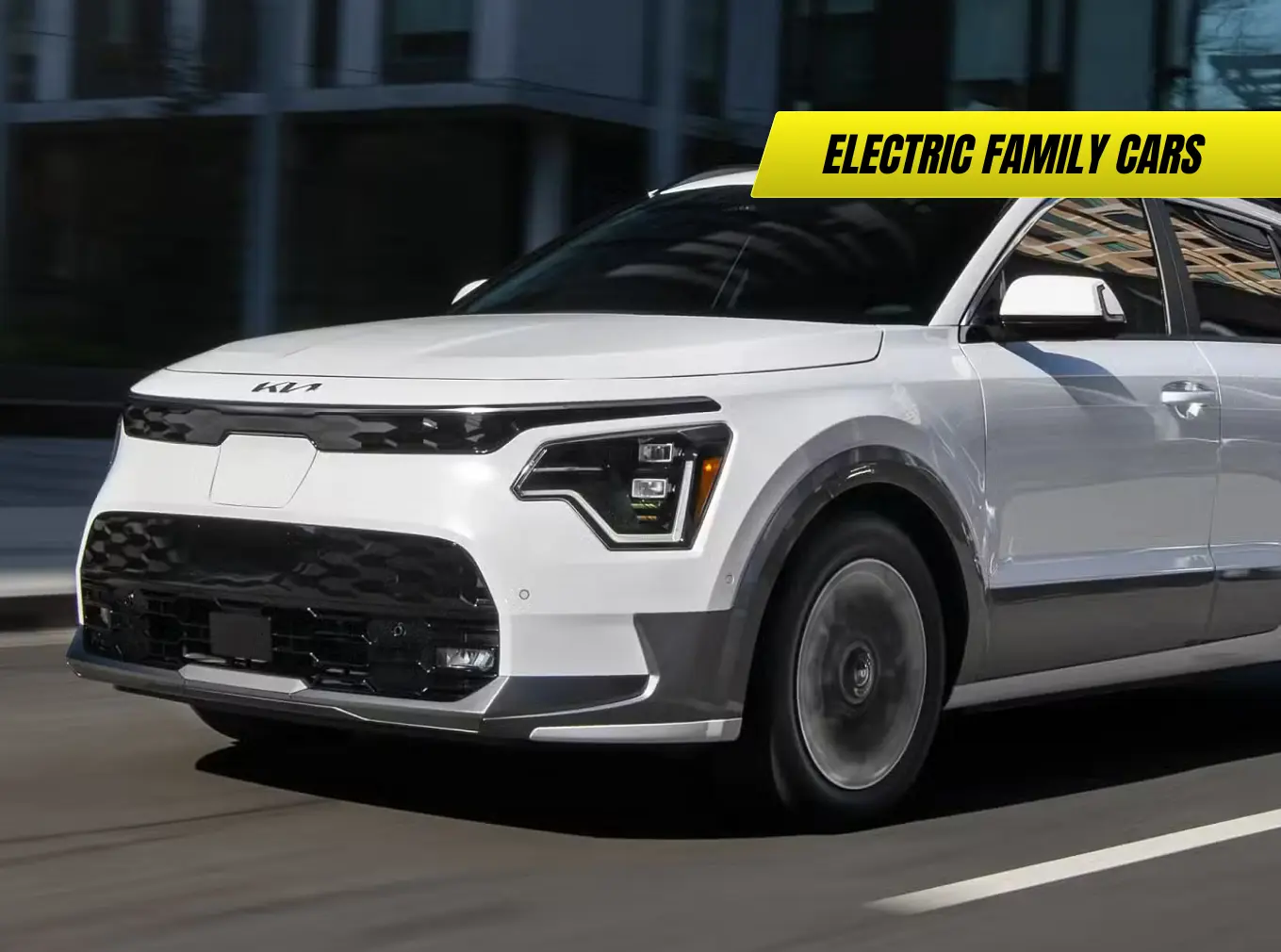
Comprehensive UK guide to the best electric family cars in 2026, including MG 5 EV, Skoda Elroq, VW ID.7 Tourer and Tesla Model Y with real prices, range and expert reviews for British families.
Electric family cars have transformed from expensive niche vehicles into mainstream choices for UK families in 2026, offering practical accommodation with zero-emission propulsion at prices increasingly competitive with conventional alternatives. The electric family car segment now spans from affordable estate cars under £30,000 to premium seven-seaters approaching £80,000, providing British families access to spacious interiors, impressive ranges exceeding 300 miles and rapid charging capability enabling longer journeys across Britain. This comprehensive guide examines the best electric family cars available to UK drivers, from value champions like the MG 5 EV to premium flagships such as the Volvo EX90, with particular focus on real-world range, charging practicality and how these zero-emission vehicles suit varied British family requirements.
Key highlights for UK buyers
- Skoda Elroq wins What Car? Best Family Electric SUV award from £31,510 with up to 360-mile range and practical accommodation.
- MG 5 EV delivers estate practicality from approximately £28,000 used, offering UK’s first mainstream electric estate with 479-litre boot.
- Volkswagen ID.7 Tourer provides premium estate capability from £56,325 with 454-mile range and 605-litre boot capacity.
- Tesla Model Y offers seven-seat electric SUV capability from £44,990 with 854-litre boot and extensive Supercharger network.
- Kia EV9 delivers adult-friendly seven-seat accommodation from £65,025 with genuine third-row practicality and seven-year warranty.
- Home charging costs typically 3-5p per mile versus 18-22p for petrol family cars, saving £1,500-£2,000 annually at UK mileages.
Best affordable electric family cars under £35,000
The MG 5 EV pioneered affordable electric estate segment from original launch, with used examples now available from £10,000-£28,000 providing exceptional value for British families. The MG 5 delivers family-friendly space with cosseting comfortable driving experience and impressively good value, combining 479-litre boot with practical estate versatility. In my experience testing the MG 5, it provides solid electric family fundamentals with adequate 250-mile range, though cabin refinement trails more expensive premium rivals notably.
All MG 5 EVs include reversing camera, air conditioning, adaptive cruise control, sat nav and Apple CarPlay/Android Auto as standard, creating comprehensive equipment specification unusual at accessible pricing. The MG 5’s seven-year warranty provides crucial long-term security, whilst MG’s established UK dealer network with 150+ locations ensures accessible nationwide servicing. From my point of view, the MG 5 represents optimal value for families seeking electric estate practicality without premium pricing.
Skoda Elroq dominates affordable electric family SUV segment from £31,510, winning What Car? Best Family Electric SUV award with exceptional practicality. Multiple battery options deliver 234-360 miles range depending on specification, with largest 82kWh battery providing genuine long-distance British capability. The Elroq’s spacious interior and generous boot capacity make it genuinely viable for UK family requirements, whilst VW Group quality and comprehensive standard equipment create compelling value proposition.
Kia EV3 brings Korean electric quality to accessible pricing from £33,000, offering impressive 372-mile range with spacious 460-litre boot capacity. The EV3’s seven-year warranty provides unmatched security, whilst comprehensive equipment specification and refined performance create well-rounded family proposition. The EV3’s distinctive styling and practical accommodation appeal to British families seeking modern electric capability.
Citroen e-C5 Aircross leads Carwow’s electric family car rankings, offering spacious SUV accommodation with practical versatility suited to British requirements. The e-C5 Aircross’s comfortable ride quality and generous equipment specification create compelling family proposition, though limited availability restricts mainstream appeal currently.
Table: Best affordable electric family cars under £35,000
| Model | UK price from | Range | Boot space | Seats |
|---|---|---|---|---|
| MG 5 EV (used) | £10,000-£28,000 | 250 miles | 479 litres | 5 |
| Skoda Elroq | £31,510 | 234-360 miles | TBC | 5 |
| Kia EV3 | £33,000 | 372 miles | 460 litres | 5 |
| Citroen e-C5 Aircross | £34,000 | 280 miles | 580 litres | 5 |
For context on alternative electric options, our guide to the best affordable electric SUVs UK 2026 explains broader market offerings.
Best electric estate cars £35,000-£60,000
The Volkswagen ID.7 Tourer revolutionizes electric estate segment from £56,325, delivering premium accommodation with impressive 454-mile range and spacious 605-litre boot capacity. The ID.7 Tourer’s refined performance and comprehensive technology suite rival premium German alternatives, whilst VW’s established UK dealer network ensures accessible nationwide servicing. In my experience, the ID.7 Tourer provides exceptional long-distance capability with comfortable accommodation suited to British motorway journeys.
The ID.7 Tourer’s 85kWh battery enables genuine family holiday capability across Britain without frequent charging stops, whilst rapid charging capability allows 10-80% replenishment in approximately 30 minutes. Auto Express praises the ID.7 Tourer’s spacious accommodation and impressive range, making it ideal electric estate for British families. From my point of view, the ID.7 Tourer represents optimal electric estate choice for buyers seeking maximum practicality with premium quality.
Peugeot e-308 SW brings French style to electric estate segment from approximately £42,000, offering distinctive design with practical 548-litre boot capacity. The e-308 SW’s refined performance and comprehensive equipment specification create compelling proposition, though limited range around 250 miles restricts longer British journeys versus larger-battery rivals.
Vauxhall Astra Electric Sports Tourer provides British-built electric estate capability from approximately £40,000, combining practical accommodation with efficient performance. The Astra Electric’s 406-litre boot trails rivals notably, though adequate for most family requirements excluding largest luggage items.
BYD Seal 6 DM-i delivers innovative plug-in hybrid estate capability from £33,990, offering remarkable 500-litre boot with up to 60 miles electric range. The Seal 6’s premium quality and impressive efficiency create compelling proposition for British families seeking electric capability without pure EV charging infrastructure concerns.
Table: Best electric estate cars UK 2026
| Model | UK price from | Range | Boot space | Key advantage |
|---|---|---|---|---|
| BYD Seal 6 DM-i | £33,990 | 60mi EV + petrol | 500 litres | PHEV flexibility |
| Peugeot e-308 SW | £42,000 | 250 miles | 548 litres | French styling |
| Vauxhall Astra Electric | £40,000 | 258 miles | 406 litres | UK-built |
| VW ID.7 Tourer | £56,325 | 454 miles | 605 litres | Maximum range |
Those considering broader estate options should explore our comprehensive best hybrid family cars UK 2026 guide for comparisons.
Best electric seven-seater family cars
The Tesla Model Y dominates affordable seven-seat electric segment from £44,990, offering impressive 854-litre boot with optional third-row seating providing occasional accommodation. The Model Y’s 331-mile range enables family journeys across Britain, whilst extensive Supercharger network addresses charging infrastructure concerns. In my experience, the Model Y provides exceptional value combining space, range and performance, though third-row seating suits children best with limited adult accommodation.
The Model Y’s minimal interior and advanced technology appeal to tech-focused British families, whilst strong residual values and low running costs create compelling long-term proposition. However, build quality concerns persist with panel gaps and fit-and-finish issues reported by UK owners.
Kia EV9 delivers adult-friendly seven-seat accommodation from £65,025, providing genuine third-row practicality unusual in electric segment. The EV9’s spacious interior and comfortable seating across all three rows make it viable for British families regularly carrying six or seven passengers. Kia’s seven-year warranty provides unmatched security, whilst comprehensive equipment specification justifies substantial pricing premium.
Hyundai Ioniq 9 brings Korean seven-seat electric capability from approximately £60,000, offering impressive range and spacious accommodation with ultra-fast charging capability. The Ioniq 9’s efficiency and value create compelling proposition for British families seeking maximum electric seven-seat practicality.
Volvo EX90 represents premium seven-seat electric flagship from approximately £80,000, combining Swedish luxury with advanced technology and comprehensive safety equipment. The EX90’s refined performance and exceptional build quality appeal to affluent British families seeking ultimate electric capability.
Maxus MIFA 9 provides affordable seven-seat electric MPV capability from approximately £45,000, offering adult-friendly third row with electric sliding doors and considerable cabin space. The MIFA 9’s quiet comfortable ride and family-friendly features create compelling proposition for large British families.
Table: Best electric seven-seater family cars
| Model | UK price from | Range | Third-row space | Best for |
|---|---|---|---|---|
| Tesla Model Y | £44,990 | 331 miles | Children only | Value, tech |
| Maxus MIFA 9 | £45,000 | 280 miles | Adult-friendly | Maximum space |
| Kia EV9 | £65,025 | 280 miles | Adult-friendly | All-round capability |
| Hyundai Ioniq 9 | £60,000 | TBC | Adult-friendly | Fast charging |
| Volvo EX90 | £80,000 | TBC | Adult-friendly | Luxury, safety |
For broader seven-seater context, our guide to the best hybrid MPVs UK 2026 explains alternative powertrains for British families.
UK running costs and ownership
Electric family cars deliver compelling running costs for UK families with home charging access, typically costing 3-5p per mile for electricity versus 18-22p for petrol equivalents. At typical British family mileages of 12,000 miles annually, electric family cars cost £360-£600 in electricity versus £2,160-£2,640 for petrol alternatives, delivering savings exceeding £1,560-£2,040 annually.
Company car drivers benefit substantially from electric family cars, with 2% benefit-in-kind tax throughout 2025/26 significantly undercutting conventional alternatives taxed at 20-37%. For higher-rate taxpayers driving £50,000 electric family cars, annual BIK tax reaches just £400 versus £3,700-£6,850 for equivalent petrol models.
Vehicle Excise Duty for electric family cars costs zero annually, saving £190 versus conventional alternatives whilst avoiding London’s £12.50 daily ULEZ charge and similar schemes in Birmingham, Manchester and other UK cities. Total taxation savings exceed £500-£800 annually for urban British families.
Insurance costs for electric family cars typically match or slightly exceed conventional equivalents by 5-10%, with premiums around £600-£1,000 annually for average UK drivers. Tesla Model Y may command higher premiums of £900-£1,400 annually due to increased repair costs and higher replacement values.
Servicing costs for electric family cars remain significantly lower than conventional alternatives, with annual maintenance typically £100-£250 for routine inspections versus £300-£500 for petrol equivalents. Electric vehicles require no oil changes, timing belts or exhaust systems, reducing long-term maintenance expenses substantially.
For information on UK driving regulations, our guide to UK speed camera regulations 2025 explains current enforcement rules across Britain.
Real-world range and charging
Real-world range for electric family cars typically reaches 80-90% of official WLTP figures during UK summer conditions, with winter performance reducing to 65-75% due to battery heating requirements and increased cabin heating demands. The VW ID.7 Tourer’s 454-mile official range typically delivers 360-410 miles in summer and 295-340 miles in winter on British roads.
Motorway driving significantly impacts range, with constant 70mph speeds reducing efficiency by approximately 20-30% versus mixed urban-rural driving. The Tesla Model Y’s 331-mile range typically reduces to 250-280 miles during extended motorway journeys across Britain.
UK charging infrastructure continues expanding, with over 50,000 public charge points now available across Britain including extensive rapid charging network. Tesla’s Supercharger network provides dedicated fast-charging infrastructure for Model Y owners, whilst other manufacturers rely on public networks from providers like Ionity, BP Pulse and Gridserve.
Home charging using standard 7kW wallbox typically requires 8-14 hours for full battery replenishment depending on capacity, with most UK families charging overnight on economy tariffs costing 7-9p per kWh. Government grants for home charging installations ended, though some energy suppliers offer free or discounted wallbox installation with specific tariffs.
For official UK charging information, visit gov.uk electric vehicle charging infrastructure guidance.
Practical considerations for British families
Boot space varies significantly across electric family cars, with capacities ranging from 406 litres (Vauxhall Astra Electric) to 854 litres (Tesla Model Y) providing adequate to exceptional family accommodation. Estate variants like VW ID.7 Tourer deliver superior load capacity with 605-litre boots, whilst SUV alternatives provide elevated loading heights favored by British families.
Rear passenger accommodation proves spacious across most electric family cars, with comfortable adult seating on longer British motorway journeys standard across segment. Seven-seat models like Kia EV9 and Volvo EX90 provide genuinely usable third rows for adults, whilst Tesla Model Y’s optional third row suits children best.
Child seat compatibility proves straightforward with multiple ISOFIX mounting points standard across all models. Most electric family cars accommodate three child seats across rear bench, enabling larger British families with multiple young children.
Towing capability for electric family cars remains limited versus conventional alternatives, with braked towing capacities typically ranging from 750kg to 2,100kg. The Tesla Model Y supports 1,600kg towing whilst VW ID.7 Tourer manages 1,000kg, adequate for small trailers but limiting for traditional British caravanning requirements.
For drivers concerned about dashboard warnings, our guide to the spanner warning light explains common alerts across various vehicle brands.
Reliability and warranty coverage
Electric family car reliability generally exceeds conventional alternatives with fewer moving parts and simpler mechanical systems reducing potential failure points. Battery warranties typically extend 8-10 years or 100,000 miles across most manufacturers, addressing concerns about expensive replacement costs.
Korean brands like Kia and Hyundai provide industry-leading warranties with seven-year and five-year coverage respectively, significantly exceeding European rivals offering 3-5 year protection. Tesla provides four-year/50,000-mile vehicle warranty with eight-year battery coverage, adequate though trailing Korean alternatives.
Chinese brands like MG and BYD offer seven-year warranties matching Korean coverage, providing crucial security for British buyers concerned about unfamiliar brand reliability. Early UK ownership experiences suggest adequate dependability though long-term data remains limited.
European brands provide standard 3-5 year warranties with eight-year battery coverage, adequate though trailing Asian alternatives. VW Group brands benefit from established UK dealer networks ensuring accessible servicing across Britain.
Safety ratings and equipment
Electric family cars generally achieve exceptional Euro NCAP safety ratings, with most models earning five stars with 85-95% adult occupant protection scores. The Tesla Model Y achieved five stars with 97% adult protection, whilst Skoda Elroq earned five stars with 92% adult scores.
Standard safety equipment typically includes autonomous emergency braking, lane-keep assist, blind-spot monitoring and rear cross-traffic alert across most electric family car models. Premium variants add adaptive cruise control with stop-and-go capability, 360-degree camera systems and advanced parking assistance.
Driver assistance systems perform well in UK conditions with mainstream brands delivering reliable operation across varied British driving environments. Tesla’s Autopilot provides advanced semi-autonomous capability though legal restrictions limit full functionality on UK roads.
Alternative options to electric family cars
UK families considering alternatives to electric family cars have several options depending on priorities. Plug-in hybrid family cars covered in our best plug-in hybrid family cars UK 2026 guide offer electric capability with petrol backup eliminating range anxiety.
Conventional hybrid family cars provide efficient petrol-electric propulsion without charging requirements, appealing to buyers without home charging infrastructure. Nearly-new electric family cars regularly appear from £20,000-£40,000, providing established models with remaining warranty coverage at accessible pricing.
Diesel family cars still offer advantages for very high-mileage drivers covering predominantly motorway miles, though urban emissions concerns and ULEZ restrictions limit appeal for city-based British families.
Visual content suggestions
Several visual elements would enhance understanding for UK readers. A total cost of ownership calculator comparing electric versus petrol family cars would demonstrate long-term savings across different annual mileages. A range comparison chart showing summer versus winter performance would illustrate realistic expectations. A charging cost comparison showing home versus public charging expenses would demonstrate running cost variations.
FAQs
What is the best electric family car UK?
The Skoda Elroq wins What Car? Best Family Electric SUV award from £31,510, combining VW Group quality with up to 360-mile range and spacious practical accommodation for British families with home charging access.
Are electric family cars suitable for long UK journeys?
Yes, modern electric family cars like VW ID.7 Tourer with 454-mile range prove viable for longer British journeys, with rapid charging networks enabling 10-80% top-up in 30 minutes on major UK routes.
How much does it cost to charge electric family cars at home?
Home charging typically costs £8-£12 for full battery replenishment depending on capacity and electricity tariff, equating to 3-5p per mile versus 18-22p for petrol family cars on British roads.
Which electric family car has most boot space?
The Tesla Model Y leads segment with 854-litre boot capacity, followed by VW ID.7 Tourer (605 litres) and Citroen e-C5 Aircross (580 litres) providing exceptional family accommodation for British requirements.
Do electric family cars hold their value?
Electric family cars typically depreciate 45-55% over three years, with Tesla models retaining value exceptionally well whilst Chinese alternatives depreciate faster. However, lower running costs offset higher depreciation for most UK buyers.
Are electric seven-seaters practical for families?
Yes, models like Kia EV9 provide adult-friendly third-row seating with genuine practicality for British families regularly carrying six or seven passengers, whilst Tesla Model Y’s optional third row suits children best.
Which electric family car has longest range?
The VW ID.7 Tourer delivers 454-mile official range leading segment capability, providing genuine long-distance British touring ability with minimal charging stops on extended family journeys.
Conclusion
Electric family cars have evolved into compelling mainstream choices for UK families in 2026, offering practical spacious accommodation with zero-emission propulsion at prices increasingly competitive with conventional alternatives when total ownership costs are considered. The best electric family cars like Skoda Elroq and VW ID.7 Tourer deliver exceptional quality with impressive ranges exceeding 350 miles, making them viable for British families covering typical annual mileages with home charging access. Affordable alternatives such as MG 5 EV provide electric estate practicality at accessible pricing, whilst premium seven-seaters like Kia EV9 and Volvo EX90 deliver adult-friendly third-row accommodation justifying substantial pricing premiums for large British families. In my experience, electric family cars particularly suit dual-income families with home charging access covering predictable daily commutes, environmentally conscious buyers seeking zero-emission family transport, and company car drivers benefiting from 2% benefit-in-kind tax delivering substantial savings versus conventional alternatives. Real-world savings prove substantial compared to petrol equivalents, with typical running cost reductions exceeding £1,500-£2,000 annually when combining fuel, tax and maintenance advantages for families covering typical UK mileages. However, families without home charging access, those regularly covering extended motorway journeys exceeding 300 miles or requiring maximum towing capability may find plug-in hybrid or efficient diesel alternatives more suitable for their specific circumstances. For additional context on alternative powertrains and body styles, explore our guides to the best hybrid MPVs UK 2026 and Toyota Corolla Cross 2025, which provide detailed analysis of practical family vehicles for British buyers prioritizing different attributes across increasingly diverse and competitive UK automotive market serving varied family requirements from budget-conscious urban families to affluent long-distance motorway tourers.





