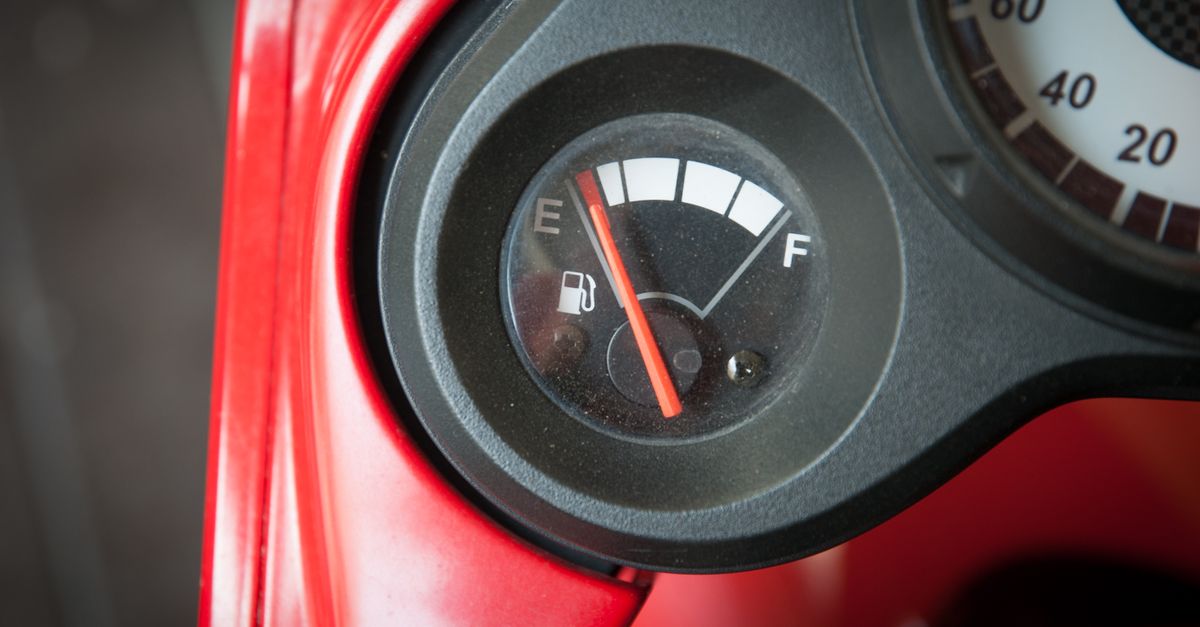
A low-fuel warning light is a prompt to refuel, not a countdown to an empty tank. It normally comes on with some fuel still available, but UK drivers cannot apply one guaranteed mileage figure to every car. Broad estimates of 30–50 miles may be useful for context, but the actual range depends on the vehicle and driving conditions. RAC and Confused.com both advise treating the warning as a signal to refuel as soon as possible.
What the fuel warning light really means
There is no single reserve level shared by all cars. The warning is triggered by each vehicle’s own fuel-level calibration, so it can illuminate with a different amount remaining in one model compared with another.
UK motoring guidance commonly puts the warning threshold at roughly 10–15% of the tank’s capacity. Published estimates also often suggest that around 30–50 miles may remain, but those figures are broad guides rather than a safety guarantee. A small, economical car travelling gently may manage more, while a larger vehicle or one being driven in demanding conditions may manage considerably less.
The important distinction is that the light does not usually mean the tank is already completely empty. It does mean the manufacturer expects the driver to find fuel soon.
Your handbook is more useful than a general mileage rule
The most reliable reserve figure is the one given for the specific vehicle in its handbook. For example, the cited Honda HR-V owner’s manual says the low-fuel indicator comes on with approximately 7.0 litres, or 1.54 Imperial gallons, remaining.
That is a model-specific figure from that manual, not a universal reserve for every Honda or every SUV. Owners should check the handbook for their particular model and year rather than assuming that a figure found online applies to their car.
Why the remaining-mileage display can be misleading
A distance-to-empty display is an estimate calculated from the vehicle’s systems and recent driving conditions. It is not a separate tank containing a fixed number of miles. A technical-service bulletin held in the US National Highway Traffic Safety Administration’s archive also describes this type of reading as an estimate, while the RAC warns that it should not be treated as guaranteed—particularly once the display reaches zero.
The figure can therefore change as the car’s fuel consumption changes. Treating a zero reading as permission to continue is especially risky: the display may have reached the limit of its calculation while the engine still has too little usable fuel for the journey ahead.
There are mechanical risks to running very low, too. The SEAT Mii UK owner’s handbook warns that fuel supply can become irregular, particularly on slopes, and advises against running the tank completely dry. If the engine stalls, power assistance and driver-assistance systems may be affected.
What to do when the light comes on
- Choose the nearest suitable filling station. Do not automatically aim for the station at your destination or assume the next one will be open. AutoTrader’s guidance recommends finding fuel promptly when the tank is empty or nearly empty.
- Drive smoothly. Avoid unnecessary acceleration and speed while maintaining a safe and legal pace. Hard acceleration and changing conditions can reduce the margin suggested by a general mileage estimate.
- Do not plan around 30–50 miles. Use that figure only as a broad indication of why some cars can travel a little farther after the light appears—not as a target or a promised range.
- Take a zero reading seriously. The car may still move, but there is no reliable distance remaining once the estimate has run out.
- Stop safely if the car judders or loses power. Do not keep trying to stretch the last few miles. Move to a safe location when possible and arrange roadside assistance if you cannot reach a filling station.
The bottom line for UK drivers
A fuel warning light usually means there is still a reserve, but there is no universal or guaranteed number of miles left. The commonly quoted 10–15% of tank capacity and 30–50 miles are broad estimates, not a safe travelling allowance.
The sensible assumption is simple: refuel as soon as possible, use the nearest suitable station and check the vehicle handbook for the only reserve figure that is specific to your car.
Source 1 · Source 2 · Source 3 · Source 4 · Source 5 · Source 6