
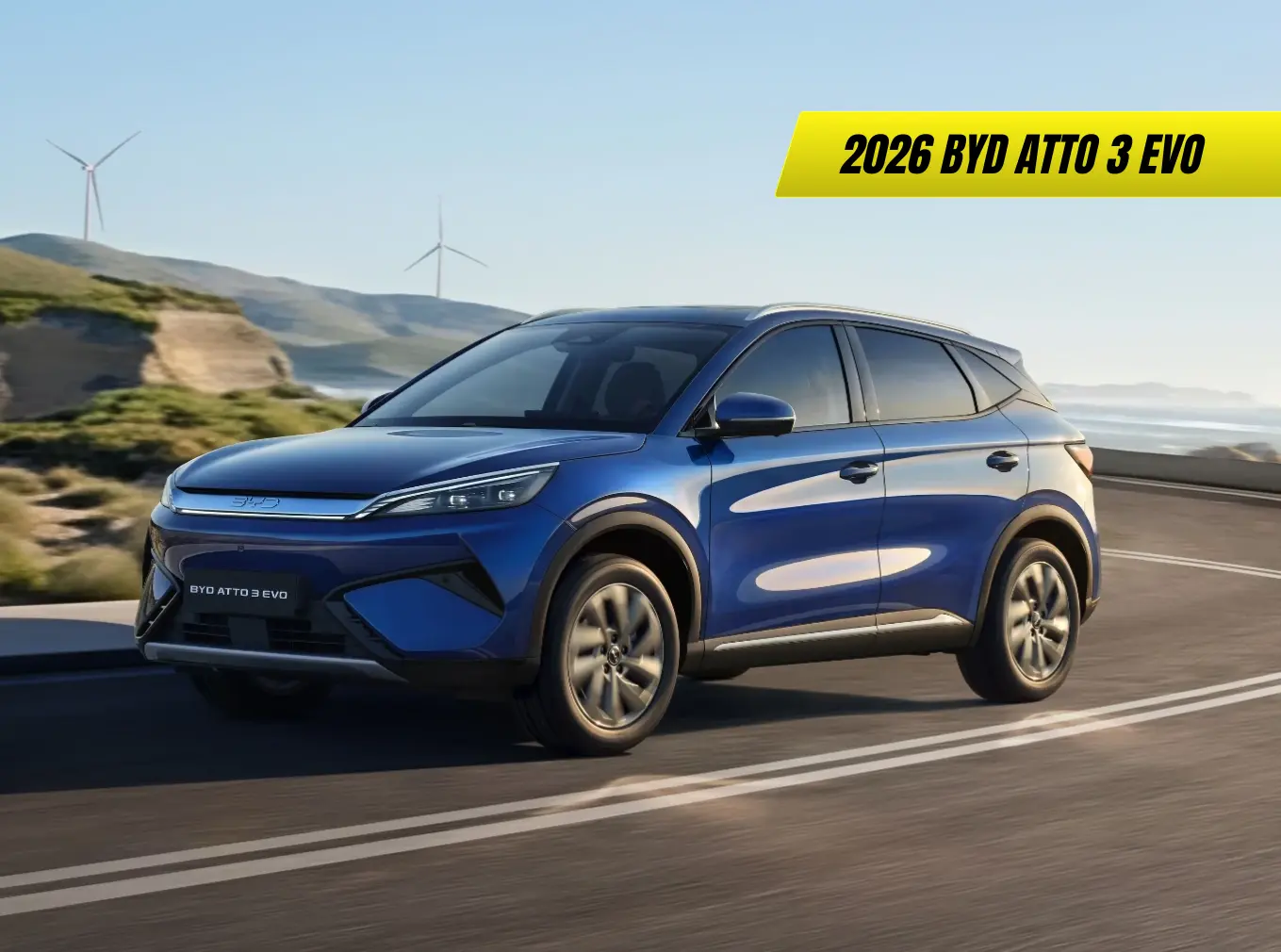
BYD has unveiled the refreshed Atto 3 Evo for European markets including the UK, featuring updated styling, enhanced interior quality, and competitive pricing from €38,990 (approximately £33,500-£35,000) when UK specifications are confirmed. The Chinese manufacturer’s best-selling electric SUV receives modest visual refinements, improved technology including a larger 15.6-inch rotating touchscreen, and maintains the 60.48kWh battery delivering 420km (261 miles) WLTP range, positioning it as one of the most affordable family electric SUVs available to British buyers seeking zero-emission motoring without premium brand pricing.
BYD Atto 3 Evo 2026 UK preview: refreshed electric SUV from £33,500 with 261-mile range, 15.6-inch screen & comprehensive equipment. Complete specifications guide.
Key Points:
- UK pricing expected £33,500-£35,000 when confirmed specifications arrive, maintaining competitive positioning against MG ZS EV and Nissan Ariya whilst undercutting premium rivals
- Refreshed exterior styling with new front bumper design, revised LED lighting signatures, and fresh colour options including Crystal White and Arctic Blue
- Enhanced interior technology featuring larger 15.6-inch rotating touchscreen, upgraded 5-inch digital instrument cluster, and improved cabin materials throughout
- 60.48kWh Blade Battery delivering 420km WLTP range (approximately 261 miles), maintaining BYD’s proven LFP chemistry offering enhanced safety and longevity
- Comprehensive standard equipment including heat pump climate control, panoramic glass roof, LED lighting, advanced driver assistance systems, and premium audio
- Limited UK availability confirmed with BYD’s selective dealer network expansion continuing through 2026, though right-hand-drive production ensures British market access
BYD Atto 3 Evo: Evolution Not Revolution
The 2026 Atto 3 Evo represents a mid-cycle refresh rather than complete generational replacement, following the model’s successful European launch in 2022 that established BYD’s presence in Western markets after decades dominating Chinese domestic sales. The “Evo” designation signals evolutionary improvements across styling, technology, and interior quality whilst maintaining the fundamental platform, battery technology, and powertrain that have proven commercially successful across multiple European markets including the UK.
BYD’s conservative approach makes commercial sense – the existing Atto 3 has carved a profitable niche as an affordable family electric SUV competing against established rivals including the MG ZS EV, Nissan Ariya, and Hyundai Kona Electric. Rather than risking radical changes that might alienate satisfied customers, BYD addresses specific criticisms around interior material quality and infotainment usability whilst maintaining competitive pricing that undercuts premium German alternatives by meaningful margins.
From my point of view, this restrained refresh demonstrates BYD’s growing maturity as a global manufacturer. Early Chinese brands entering European markets often attempted too many changes simultaneously, creating quality control issues and confusing positioning. BYD’s measured approach prioritises reliability and gradual improvement over dramatic transformation – a strategy that has served Japanese manufacturers including Toyota and Honda exceptionally well during their own European market establishment decades ago.
Exterior Design Updates and Visual Refinements
The Atto 3 Evo’s exterior changes focus primarily on the front fascia, where a redesigned bumper incorporates new air intake patterns, revised fog light positioning, and subtle aerodynamic refinements that marginally improve efficiency without dramatically altering the model’s recognisable character. The LED headlights receive updated internal graphics creating distinctive daytime running light signatures, whilst the grille area features chrome accents replacing some of the outgoing model’s black plastic trim for a more premium appearance.
The profile remains largely unchanged from the current model, maintaining the distinctive rising beltline, sculpted door panels, and black plastic body cladding that emphasises the SUV’s rugged character. New alloy wheel designs in 17-inch and 18-inch sizes provide visual differentiation, whilst fresh exterior colours including Crystal White, Arctic Blue, and Cosmos Black expand customer choice beyond the limited palette available at the Atto 3’s original UK launch.
The rear receives minimal changes – the existing LED taillight design carries over virtually unchanged, though internal light patterning receives subtle updates ensuring the Evo remains visually current against newer competitors. A revised rear bumper features updated reflector positioning and slightly altered black plastic trim distribution, but overall changes remain evolutionary rather than transformational. Those comparing Chinese alternatives should explore our comprehensive guide to best Chinese SUVs in the UK for broader market context.
Interior Upgrades and Technology Enhancements
BYD has concentrated its refresh efforts on the Atto 3 Evo’s interior, where the previous model received criticism for hard plastic surfaces, unintuitive infotainment systems, and material quality falling short of European expectations at the £35,000-£40,000 price point. The updated cabin features improved soft-touch materials across the dashboard top, door panels, and centre console, replacing the hard plastics that characterised early production units and undermined perceived quality.
The centrepiece of the interior transformation is a substantially larger 15.6-inch rotating touchscreen infotainment system, replacing the previous 12.8-inch unit. This display rotates between landscape and portrait orientations depending on specific function requirements – portrait for navigation where vertical scrolling proves more intuitive, landscape for media playback and vehicle settings where horizontal layouts better suit widescreen content. The system includes wireless Apple CarPlay and Android Auto connectivity as standard, eliminating cable clutter whilst providing seamless smartphone integration.
The digital instrument cluster grows from 5 inches to a more substantial display providing improved visibility and additional information density. Graphics receive complete redesigns with clearer iconography, more intuitive menu structures, and customisation options allowing drivers to prioritise specific information according to personal preferences. In my experience, previous BYD interfaces suffered from translation issues and counterintuitive menu hierarchies – the Evo’s updated systems should address these usability concerns that frustrated UK owners accustomed to polished German interfaces.
Comfort and Convenience Features
Standard equipment remains comprehensive across the Atto 3 Evo lineup, reflecting BYD’s value-focused positioning strategy. The panoramic glass roof extends across both front and rear passengers, creating an airy cabin ambience whilst incorporating electric sunshade for occasions when occupants prefer shade over natural light. The heat pump climate control system delivers more efficient heating and cooling compared to traditional resistive systems, extending real-world range by 10-15% during winter months when cabin heating typically drains battery capacity significantly.
Seating features cloth upholstery as standard with optional vegan leather upgrades available on higher trim levels. The front seats offer manual adjustment across height, lumbar support, and angle, though electric adjustment remains reserved for potential premium specifications not yet confirmed for UK market. Rear passengers benefit from generous legroom thanks to the 2,720mm wheelbase – comparable with considerably more expensive premium SUVs – along with USB charging ports, individual climate vents, and comfortable seatbacks suitable for longer journeys.
Boot capacity measures 440 litres with rear seats in place, expanding to approximately 1,340 litres with the 60:40 split-folding rear bench lowered. This provides adequate space for family requirements including weekly shopping, luggage for four passengers, or sports equipment including bicycles with front wheels removed. The load floor sits relatively high due to the floor-mounted battery pack, though this compromise affects all electric vehicles regardless of manufacturer or price point.
Blade Battery Technology and Range Capability
BYD’s proprietary Blade Battery technology represents one of the company’s key competitive advantages, utilizing lithium iron phosphate (LFP) chemistry that prioritises safety and longevity over maximum energy density. The blade-shaped cells integrate directly into the vehicle structure, serving dual purposes as both energy storage and structural reinforcement that enhances crash safety whilst reducing overall vehicle weight compared to conventional battery pack architectures.
The 60.48kWh capacity delivers 420km WLTP range (approximately 261 miles) – competitive against mainstream rivals including the MG ZS EV Long Range (273 miles) and Nissan Ariya 63kWh (250 miles) whilst falling short of premium alternatives like the Tesla Model Y Long Range (331 miles). Real-world UK range in mixed driving conditions typically achieves 220-240 miles, adequate for most daily driving patterns but requiring charging stops on longer motorway journeys exceeding 180-200 miles.
LFP chemistry offers specific advantages despite lower energy density compared to nickel-cobalt-manganese (NCM) alternatives used by most competitors. The technology delivers exceptional thermal stability reducing fire risk, supports routine charging to 100% capacity without accelerated degradation that affects NCM batteries, and utilises cobalt-free chemistry eliminating ethical concerns around cobalt mining practices. Battery longevity projections suggest minimal capacity loss even after 300,000+ miles or 10+ years of ownership – substantially better than NCM alternatives that typically show meaningful degradation after 150,000-200,000 miles.
DC Fast Charging Performance
The Atto 3 Evo supports DC fast charging up to 88kW maximum power – adequate though unspectacular compared to premium rivals supporting 150-350kW. At maximum charging speeds, the battery requires approximately 29 minutes for 30-80% charging, adding roughly 140-160 miles of range during a typical motorway break. Whilst this proves perfectly functional for occasional long-distance travel, it falls well short of the ultra-fast charging capabilities offered by 800-volt vehicles including the BMW i3 Neue Klasse and Mercedes CLA that charge three to four times faster.
Home charging using standard 7kW wallboxes requires approximately 8.5 hours for a complete 10-100% charge – easily accomplished overnight for UK drivers with off-street parking. The Atto 3 Evo supports three-phase AC charging up to 11kW, reducing full charge times to around 5.5 hours for drivers with appropriate electrical supply and charging equipment. However, single-phase 7kW installations remain most common in UK residential properties, making overnight charging the typical pattern for most owners.
From my point of view, the 88kW DC charging limitation represents the Atto 3 Evo’s most significant practical compromise. UK motorway networks feature increasingly comprehensive rapid charging infrastructure from providers including Gridserve, Ionity, and MFG EV Power, but the BYD cannot fully exploit these facilities’ 150-350kW capabilities. Buyers prioritising maximum charging flexibility should consider alternatives like the Hyundai Kona Electric (800V, 233kW charging) or options covered in our best plug-in hybrid cars UK guide for additional flexibility.
UK Pricing and Specification Levels
Official UK pricing for the BYD Atto 3 Evo remains unconfirmed at publication, though European market pricing starting at €38,990 suggests British prices around £33,500-£35,000 when right-hand-drive specifications reach UK showrooms. This positioning maintains competitiveness against the MG ZS EV Long Range (£33,495) whilst significantly undercutting premium rivals including the Audi Q4 e-tron (from £51,965) and Mercedes EQA (from £51,785).
BYD typically offers simplified trim structures compared to European manufacturers’ complex option lists and multiple specification grades. Expect two or three core variants differentiated primarily through equipment levels rather than powertrain variations – all Atto 3 Evo models feature the same 60.48kWh battery, single front-mounted motor producing 204hp, and front-wheel-drive architecture. Higher trim levels add premium features including vegan leather upholstery, upgraded audio systems, enhanced driver assistance technologies, and possibly panoramic camera systems providing 360-degree visibility.
| Expected UK Specification | Key Features | Estimated UK Price |
|---|---|---|
| Atto 3 Evo Comfort | 15.6″ touchscreen, panoramic roof, heat pump, LED lights, DAB radio, rear camera | £33,495-£34,995 |
| Atto 3 Evo Design | Adds vegan leather, premium audio, wireless charging, front parking sensors, larger alloys | £36,495-£37,995 |
| Atto 3 Evo Excellence | Adds 360° camera, adaptive cruise, upgraded driver aids, ambient lighting, premium trim | £38,995-£40,495 |
These pricing predictions position the Atto 3 Evo competitively within the affordable family electric SUV segment whilst maintaining sufficient margins below premium alternatives. Understanding UK regulations including UK toll roads and charges and speed camera regulations remains essential for all motorists.
UK Road Tax and Company Car Benefits
As a zero-emission electric vehicle, the BYD Atto 3 Evo qualifies for the £10 annual VED road tax rate applicable to EVs from April 2025 onwards. However, the £40,000 list price threshold for the additional £410 annual premium supplement becomes relevant for higher trim levels potentially exceeding this limit. Base Comfort specifications starting around £33,495-£34,995 avoid this supplement entirely, paying just £10 annually throughout ownership – remarkably affordable given the vehicle’s capabilities.
Company car drivers will find the Atto 3 Evo exceptionally attractive with just 2% Benefit-in-Kind taxation for the 2026/27 tax year, compared to 30-37% for equivalent petrol or diesel SUVs. For a higher-rate taxpayer, this dramatic difference saves approximately £5,000-£7,000 annually compared to combustion alternatives, making the electric BYD economically compelling within just 12-18 months despite higher purchase prices. This tax advantage represents one of electric vehicles’ most significant financial benefits for UK business users.
Insurance costs should remain moderate, with the Atto 3 Evo likely classified in Groups 25-30 depending on specification – substantially lower than premium electric SUVs in Groups 35-45. Annual premiums for 40-year-old drivers with clean records should range from £600-£900, though quotes vary significantly based on postcode, occupation, annual mileage, and individual insurer risk assessments. Specialist EV insurance providers may offer more competitive rates than mainstream insurers unfamiliar with Chinese brands and their repair costs.
Driving Dynamics and Real-World Performance
The BYD Atto 3 Evo features a single front-mounted electric motor producing 204hp (150kW) and 310Nm (229 lb-ft) of torque, delivering 0-62mph acceleration in 7.3 seconds – adequate though unremarkable compared to more powerful rivals. Top speed is electronically limited to 100mph (160km/h), reflecting the model’s family-focused positioning rather than attempting to rival performance-oriented alternatives. Front-wheel drive provides predictable handling characteristics familiar to UK buyers accustomed to mainstream SUVs, though it lacks the traction advantages of all-wheel-drive systems beneficial during adverse weather conditions.
The suspension employs MacPherson struts at the front and a multi-link rear setup, tuned for comfortable cruising rather than sporting dynamics. Ride quality proves compliant over UK roads including poorly maintained surfaces and speed bumps common throughout residential areas, absorbing impacts without excessive harshness transmitting into the cabin. However, body control during enthusiastic cornering remains less composed than European rivals – the Atto 3 Evo leans noticeably through direction changes, favouring comfort over dynamic precision.
From my experience, the Atto 3 Evo delivers perfectly adequate everyday driving dynamics for families prioritising practicality, economy, and value over sporting character. The instant torque delivery that electric motors provide ensures responsive acceleration from standstill, making urban driving and motorway merging effortless. However, enthusiast drivers seeking engaging handling should explore alternatives including the Nissan Qashqai e-Power or premium options offering superior chassis tuning and all-wheel-drive capability.
UK Dealer Network and Aftersales Support
BYD’s UK dealer network remains considerably smaller than established European and Japanese manufacturers, with approximately 30-40 locations across England, Scotland, and Wales as of early 2026. The company continues gradual expansion prioritising major population centres including London, Birmingham, Manchester, Glasgow, and Bristol, though rural coverage remains limited compared to mainstream brands operating 150-200+ dealerships nationwide.
This selective network creates potential challenges for buyers located far from their nearest BYD dealer, particularly regarding servicing convenience and warranty claim processing. However, BYD counters this limitation through comprehensive warranty coverage including 6 years / 93,000 miles on the vehicle, 8 years / 124,000 miles on the battery, and 12 years anti-corrosion protection – substantially more generous than many established competitors offering 3 years / 60,000 miles as standard.
Mobile servicing programmes are expanding across the UK, with BYD-trained technicians able to perform routine maintenance at customers’ homes or workplaces rather than requiring dealership visits. This partially addresses the limited dealer network, though more complex repairs and warranty work still necessitate dealership attendance. Prospective buyers should verify their nearest BYD dealer’s location and evaluate whether the distance proves acceptable for their requirements before committing to purchase.
How Atto 3 Evo Compares to UK Rivals
The BYD Atto 3 Evo competes primarily against affordable family electric SUVs rather than premium alternatives, with its closest rivals including the MG ZS EV, Nissan Ariya 63kWh, Hyundai Kona Electric, and Kia Niro EV. The BYD distinguishes itself through competitive pricing, comprehensive standard equipment, and generous warranty coverage that exceeds most competitors.
Against the MG ZS EV Long Range (£33,495, 273 miles range), the Atto 3 Evo offers superior interior technology through its larger rotating touchscreen, enhanced material quality, and more sophisticated design. However, the MG counters with slightly better range and an established UK dealer network exceeding 100 locations. The Nissan Ariya 63kWh (from £43,845) delivers premium positioning and stronger brand recognition but costs approximately £8,000-£10,000 more than comparable BYD specifications – a substantial premium that’s difficult to justify through incremental refinement improvements.
| Competitor | Battery | Range (WLTP) | Power | DC Charging | UK Price |
|---|---|---|---|---|---|
| BYD Atto 3 Evo | 60.5 kWh | 261 miles | 204 hp | 88 kW | £33,500-£35,000 |
| MG ZS EV LR | 72.6 kWh | 273 miles | 177 hp | 107 kW | £33,495 |
| Nissan Ariya 63kWh | 63 kWh | 250 miles | 218 hp | 130 kW | £43,845 |
| Hyundai Kona Electric | 65.4 kWh | 319 miles | 218 hp | 233 kW | £38,650 |
| Kia Niro EV | 64.8 kWh | 285 miles | 204 hp | 233 kW | £40,795 |
The Hyundai Kona Electric and Kia Niro EV command premiums of £3,000-£7,000 over the BYD but justify positioning through superior range, dramatically faster charging (233kW vs 88kW), established dealer networks, and stronger residual values. Those comparing broader segments should explore best SUVs under £40k and diesel SUVs for additional context.
UK Availability and Delivery Timeline
BYD has not officially confirmed UK launch timing for the Atto 3 Evo, though European market introductions suggest British deliveries could commence in Q2-Q3 2026 (April-September). Right-hand-drive production for the UK market requires specific engineering validation and Type Approval certification processes that typically extend 3-6 months beyond left-hand-drive European launches, making late summer or autumn 2026 the most realistic timeline for UK customer deliveries.
Order books will likely open 2-3 months before first deliveries, allowing customers to specify preferred trim levels, colours, and optional equipment ahead of production allocation. Initial UK allocation may prove limited as BYD prioritises larger European markets including Germany, France, and the Netherlands where the brand has established stronger market positions and larger dealer networks. I would recommend prospective buyers register interest through their nearest BYD dealer early to secure favourable delivery positions.
Finance packages will be available including Personal Contract Purchase (PCP) with typical deposits around £3,000-£5,000 and monthly payments from £350-£450 depending on specification, annual mileage allowance, and contract duration. Company car users should explore contract hire arrangements that may offer more favourable terms given the Atto 3 Evo’s extremely low 2% BIK taxation delivering substantial savings compared to combustion alternatives.
Frequently Asked Questions
When will the BYD Atto 3 Evo launch in the UK?
UK launch timing remains unconfirmed, though European market introductions suggest British deliveries could commence Q2-Q3 2026 (April-September). Right-hand-drive production requires additional validation and certification extending 3-6 months beyond European left-hand-drive launches.
How much will the BYD Atto 3 Evo cost in the UK?
Expected UK pricing should start around £33,500-£35,000 for base Comfort specifications, rising to £36,500-£38,000 for mid-range Design trim and £39,000-£41,000 for range-topping Excellence variants with comprehensive equipment and premium features.
What is the electric range of the BYD Atto 3 Evo?
The 60.48kWh Blade Battery delivers 420km WLTP range (approximately 261 miles), with real-world UK range in mixed driving conditions typically achieving 220-240 miles. Winter range decreases to approximately 180-200 miles when cabin heating is regularly used.
How fast does the BYD Atto 3 Evo charge?
The Atto 3 Evo supports DC fast charging up to 88kW maximum power, achieving 30-80% charging in approximately 29 minutes. Home charging using standard 7kW wallboxes requires approximately 8.5 hours for complete 10-100% charging, easily accomplished overnight.
Is the BYD Atto 3 Evo available with all-wheel drive?
No, all Atto 3 Evo models feature front-wheel drive through a single 204hp electric motor. BYD does not currently offer all-wheel-drive configurations in the Atto 3 range, though larger models including the Tang and Han provide dual-motor AWD options.
What warranty does BYD offer in the UK?
BYD provides comprehensive warranty coverage including 6 years / 93,000 miles on the vehicle, 8 years / 124,000 miles on the battery, and 12 years anti-corrosion protection – substantially more generous than most competitors offering 3 years / 60,000 miles as standard.
How does the Atto 3 Evo compare to the MG ZS EV?
The BYD offers superior interior technology with a larger 15.6-inch rotating touchscreen, enhanced material quality, and more sophisticated design. The MG ZS EV counters with slightly better range (273 vs 261 miles), faster DC charging (107kW vs 88kW), and a more established UK dealer network exceeding 100 locations.
The BYD Atto 3 Evo represents a sensible mid-cycle refresh that addresses specific criticisms of the original model whilst maintaining competitive pricing and comprehensive equipment levels. The enhanced interior technology including the larger rotating touchscreen, improved material quality throughout the cabin, and updated styling elements ensure the model remains visually current against newer competitors entering the increasingly crowded affordable electric SUV segment.
From my point of view, the Atto 3 Evo’s greatest strength lies in its value proposition – comprehensive standard equipment, generous warranty coverage, and competitive pricing create compelling ownership economics particularly for company car drivers benefiting from 2% BIK taxation. The 261-mile WLTP range proves adequate for typical UK driving patterns, whilst the LFP Blade Battery technology delivers exceptional safety and longevity exceeding conventional NCM alternatives used by most competitors.
However, prospective UK buyers must carefully consider the limitations. BYD’s restricted dealer network creates potential challenges for servicing convenience and warranty claim processing, particularly for buyers located far from major population centres. The 88kW DC charging maximum falls well short of premium rivals supporting 150-350kW, making the Atto 3 Evo less suitable for drivers regularly undertaking long-distance motorway journeys requiring frequent rapid charging stops.
For UK families prioritising value, practicality, and zero-emission motoring without premium brand pricing, the Atto 3 Evo deserves serious consideration alongside established rivals including the MG ZS EV and Nissan Ariya. However, those requiring maximum range, fastest charging, or most comprehensive dealer support should explore alternatives including the Hyundai Kona Electric, options covered in our best Chinese SUVs guide, or plug-in hybrid alternatives offering additional flexibility documented in our complete PHEV guide. The electric vehicle market continues evolving rapidly, and BYD’s gradual improvements position the Atto 3 Evo competitively within its affordable family SUV niche.





