
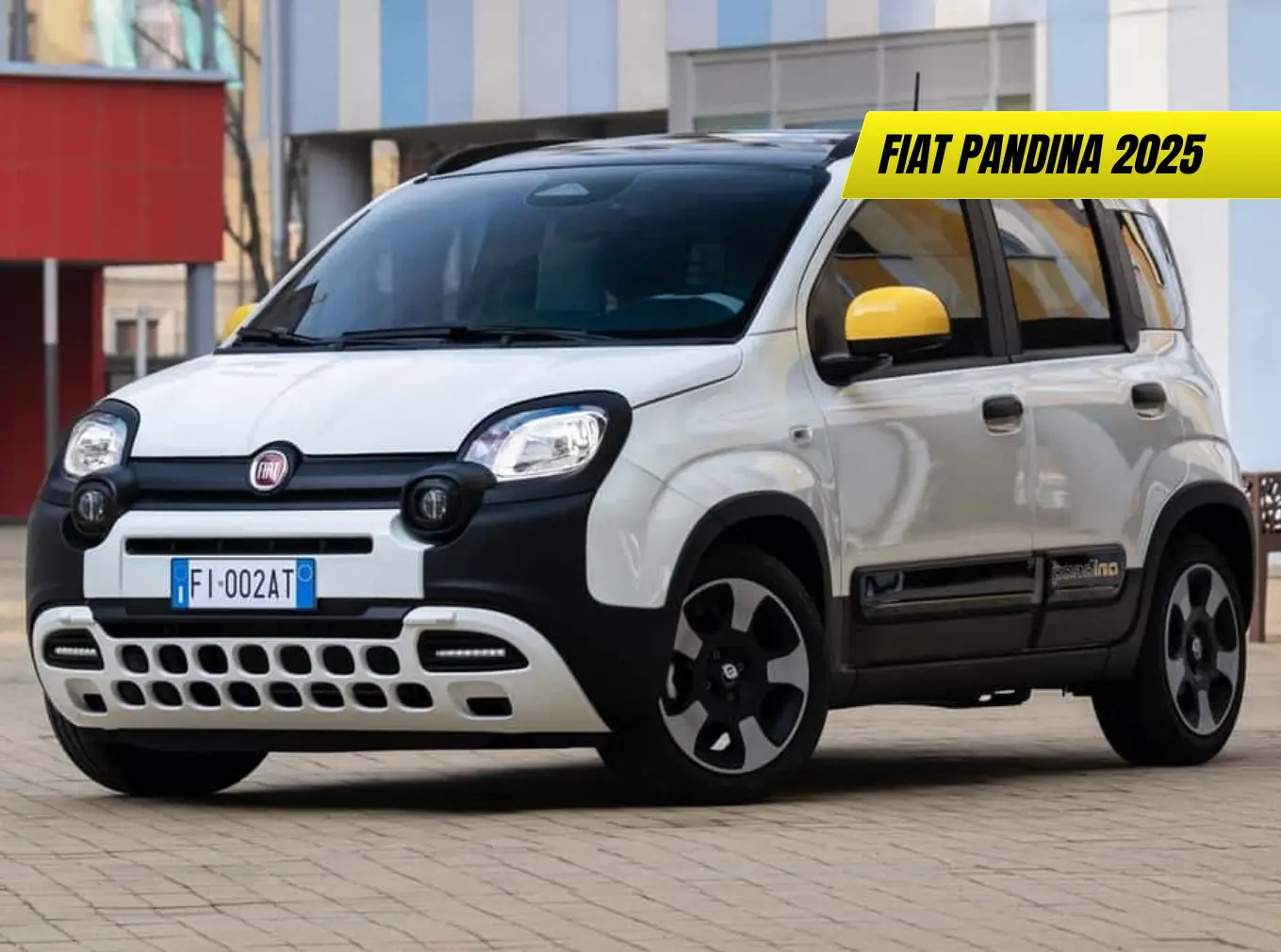
Fiat offers iconic Panda city car rebadged as “Pandina” with aggressive promotional pricing starting €9,950 for 1.0 Hybrid 70hp mild hybrid variant through January 2026 campaign combining €4,500 manufacturer discount plus €1,500 financing bonus representing 37% reduction from €15,950 list price targeting budget-conscious Italian buyers seeking Europe’s most affordable new hybrid vehicle.
Italian automotive icon Fiat launches aggressive “Stronger Than The Universe” promotional campaign January 2026 positioning legendary Panda city car (now marketed as “Pandina” emphasizing compact friendly character) as Europe’s most accessible hybrid vehicle through unprecedented €9,950 promotional pricing for base 1.0 FireFly 70hp mild hybrid POP trim representing dramatic €6,000 reduction from €15,950 official list price achieved through €4,500 immediate manufacturer discount plus €1,500 additional financing incentive requiring Stellantis Financial Services loan commitment. The aggressive pricing strategy targets stock clearance (“pronta consegna” in-stock vehicles only) requiring registration by January 28, 2026 amid transition toward new Grande Panda platformgradually replacing 14-year-old current-generation Panda as Fiat modernizes lineup around Stellantis Smart Car architecture, though classic Panda/Pandina continues production Pomigliano d’Arco facility through 2026-2027 serving budget segment Grande Panda’s €19,900+ pricing cannot address without undermining mainstream positioning. The 1.0-liter 3-cylinder FireFly mild hybrid system combines 70hp/92Nm gasoline engine (actual output 65hp base POP trim, 70hp in higher trims) with 12V belt-integrated starter generator providing modest electric assistance during acceleration and regenerative braking energy recovery delivering 4.9-5.1 l/100km WLTP consumption (~55 mpg) and 116 g/km CO₂ emissions meeting Euro 6.4 standards without expensive full hybrid complexity or battery weight compromising Panda’s legendary urban agility and 999kg base curb weight. The promotional pricing eliminates traditional barriers preventing first-time buyers, young drivers, and budget-constrained families accessing new vehicle ownership with comprehensive warranty coverage versus aging used car risks, positioning Pandina as Europe’s cheapest new hybrid undercutting Dacia Spring Electric (€20,000), Citroën Ami (€8,000 but quadricycle limited capability), and threatening Italian government incentive-dependent competitors unable matching Fiat’s manufacturer-subsidized aggressive discounting compensating Panda’s aging platform through price leadership maintaining segment dominance despite technical obsolescence versus modern competitors.
Pandina vs Panda: Naming Strategy and Market Segmentation
Understanding Fiat’s “Pandina” branding requires context regarding Stellantis’ strategy managing current-generation Panda alongside new Grande Panda platform twin.
Nomenclature Clarification
| Model Name | Platform | Launch Date | Market Positioning | Powertrain Options |
|---|---|---|---|---|
| Panda / Pandina | 312/319 (2011-present) | 2011 (facelifts 2016, 2021) | Budget city car €9,950-19,050 | 1.0 Mild Hybrid 70hp, 1.2 LPG 69hp, 1.2 Gasoline 69hp |
| Grande Panda | Smart Car / STLA Small | 2024 | Mainstream compact €19,900-29,900 | 1.2 Hybrid 100/110hp, Electric 113hp |
Why “Pandina” Branding?
The “Pandina” naming (Italian diminutive meaning “little Panda”) serves multiple strategic purposes:
- Differentiation: Distinguishes aging current-generation model from modern Grande Panda preventing customer confusion
- Affectionate positioning: Diminutive suffix creates emotional connection emphasizing cute, friendly, accessible character
- Value signaling: “Little” implies budget-friendly positioning versus “Grande” suggesting premium/larger
- Marketing flexibility: Enables parallel promotion campaigns without internal cannibalization concerns
- Transition management: Allows gradual current-generation phaseout without abruptly discontinuing beloved Panda nameplate
The strategy mirrors automotive precedent including:
- Fiat 500 vs 500X: Base vs enlarged crossover variants
- Mini Cooper vs Mini Countryman: City car vs SUV siblings
- Volkswagen Polo vs Golf: Size-based hierarchy
Platform Overlap Timeline
| Period | Pandina Status | Grande Panda Status | Strategic Rationale |
|---|---|---|---|
| 2024-2025 | Full production Pomigliano | Grande Panda launch ramp-up | Parallel offering covering €10k-30k price spectrum |
| 2026 | Stock clearance promotions | Volume production expanding | Aggressive discounting clearing inventory |
| 2027 | Likely discontinuation | Mainstream model established | Phase-out completing Panda generational transition |
The €9,950 promotional pricing represents end-of-lifecycle clearance strategy maximizing remaining current-generation stock value before inevitable discontinuation, similar to tactics discussed in Fiat 500e 2026.
Technical Specifications: Mild Hybrid System
The Pandina’s 1.0 FireFly mild hybrid represents entry-level electrification delivering modest efficiency improvements without expensive full hybrid complexity.
Powertrain Architecture
1.0-Liter FireFly 3-Cylinder Gasoline Engine
- Displacement: 999 cc (1.0 liter)
- Configuration: Inline-3, naturally-aspirated
- Bore × Stroke: 70.5 mm × 85.8 mm (undersquare for torque)
- Compression ratio: 11.5:1 (high for naturally-aspirated)
- Valvetrain: DOHC 12-valve (4 valves per cylinder, Twin-Cam Multiair)
- Peak power: 65 hp @ 6,000 rpm (POP trim) / 70 hp @ 6,000 rpm (higher trims)
- Peak torque: 92 Nm @ 3,250 rpm
- Redline: ~6,500 rpm estimated
12V Mild Hybrid System (Start-Stop)
| Component | Specification | Function |
|---|---|---|
| Belt-Integrated Starter Generator (BISG) | 12V electric motor/generator | Replaces traditional alternator and starter motor |
| Power output | ~2-3 kW (~3-4 hp) | Modest electric assistance during acceleration |
| Battery | 12V lithium-ion ~0.3 kWh | Small capacity sufficient start-stop and regenerative braking |
| Regenerative braking | Captures kinetic energy during deceleration | Recharges battery reducing fuel consumption |
| Start-stop system | Automatic engine shutdown at idle | Eliminates fuel consumption during traffic stops |
Mild Hybrid Benefits and Limitations
Advantages
- Cost-effective: €500-800 system cost versus €3,000-5,000 full hybrid
- Weight-efficient: <20kg added versus 50-100kg full hybrid systems
- Simple maintenance: No high-voltage components requiring specialist servicing
- Fuel economy improvement: 10-15% reduction versus non-hybrid equivalent
- Smooth start-stop: Silent restart versus traditional starter motor vibration
Limitations
- No electric-only driving: Cannot operate purely on electric power (unlike full hybrids)
- Minimal electric boost: 3-4 hp assistance barely perceptible versus 20-50 hp full hybrids
- Limited regenerative braking: Small battery capacity restricts energy recovery versus full hybrid systems
- Marketing confusion: “Hybrid” label misleads customers expecting substantial electric capability
The 12V mild hybrid positioning represents minimum viable electrification enabling “hybrid” marketing claims while avoiding expensive full hybrid investment unsuitable budget city car segment where every €100 manufacturing cost impacts affordability.
Performance and Efficiency
Acceleration and Speed
- 0-100 km/h: 14.1 seconds (65hp POP trim) / 13.2 seconds (70hp higher trims)
- Top speed: 158-164 km/h depending on trim and gearing
- Drivetrain: Front-wheel drive, 5-speed or 6-speed manual transmission
- Weight: 999-1,030 kg depending on trim and equipment
Fuel Consumption and Emissions
| Driving Cycle | Consumption (WLTP) | Real-World Estimate | Cost per 100km (€) |
|---|---|---|---|
| Urban | 5.9 l/100km | 6.5-7.0 l/100km | €11.38-12.25 @ €1.75/L gasoline |
| Extra-urban | 4.3 l/100km | 4.5-5.0 l/100km | €7.88-8.75 |
| Combined | 5.1 l/100km | 5.5-6.0 l/100km | €9.63-10.50 |
| CO₂ emissions | 116 g/km | ~125-130 g/km real-world | Euro 6.4 compliant |
The 5.1 l/100km combined WLTP (~55 mpg UK / ~46 mpg US) represents respectable efficiency for naturally-aspirated gasoline city car, though trailing full hybrid competitors achieving 4.0-4.5 l/100km and diesel alternatives (if still available) delivering similar consumption with superior highway performance.
Operating Cost Comparison (15,000 km annual driving)
| Model | Fuel Consumption | Annual Fuel Cost | Insurance | Total Annual Cost |
|---|---|---|---|---|
| Pandina 1.0 Hybrid | 5.5 l/100km | €1,444 | €600-800 | ~€2,044-2,244 |
| Dacia Sandero 1.0 TCe | 6.0 l/100km | €1,575 | €500-700 | ~€2,075-2,275 |
| Toyota Yaris Hybrid | 4.2 l/100km | €1,103 | €700-900 | ~€1,803-2,003 |
| Volkswagen Polo 1.0 TSI | 5.4 l/100km | €1,418 | €650-850 | ~€2,068-2,268 |
The Pandina’s operating costs prove competitive within budget segment, though Toyota’s superior full hybrid efficiency delivers €240-440 annual savings offsetting higher purchase price over 5+ year ownership period.
Trim Levels and Equipment
The promotional €9,950 pricing applies exclusively to base POP trim with minimal equipment, though higher specifications remain available at increased but still-discounted pricing.
POP Trim (€15,950 List / €11,450 Promo Cash / €9,950 With Financing)
Exterior Equipment
- 14-inch steel wheels with plastic wheel covers
- Body-colored bumpers and door handles
- Manual side mirrors (body-colored)
- Halogen headlights (no LED)
- Rear window wiper
Interior Features
- Cloth upholstery (basic fabric)
- Manual air conditioning
- 5-inch Uconnect touchscreen (basic infotainment)
- AM/FM radio with 2 speakers
- USB input for smartphone connectivity
- Manual windows (front and rear)
- Manual door locks (no remote central locking)
- Split-folding rear seat (50/50)
- Height-adjustable driver seat
Safety Equipment (Euro NCAP 0-star rating 2022 testing due to minimal ADAS)
- Driver and passenger front airbags (2 airbags only, no side/curtain airbags in base trim)
- ABS anti-lock brakes with EBD
- Electronic stability control (ESC)
- Hill holder (prevents rollback on inclines)
- Tire pressure monitoring system (TPMS)
The minimal equipment specification reflects extreme cost-cutting necessary achieving €9,950 promotional pricing, with notable absences including:
- No LED lighting (halogen headlights/taillights)
- No central locking remote (physical key only)
- No rear parking sensors
- No driver assistance systems (lane departure warning, autonomous emergency braking, etc.)
- Only 2 airbags (versus 6-7 typical modern vehicles)
Easy Trim (€17,450 List / ~€12,950-13,450 Promo Estimated)
Additional Equipment Over POP
- 14-inch alloy wheels (upgraded from steel)
- Remote central locking with 2 remote keys
- Electric front windows (rear remain manual)
- Electric and heated side mirrors
- 7-inch Uconnect touchscreen with DAB radio
- 4 speakers (upgraded from 2)
- Bluetooth hands-free calling
- USB and AUX inputs
- Air conditioning controls upgraded
- Interior storage improvements
Cross Trim (€19,050 List / ~€14,550-15,050 Promo Estimated)
Additional Equipment Over Easy
- Raised ride height (+20mm ground clearance)
- Black plastic body cladding (wheel arches, side skirts)
- Roof rails (styling element)
- Fog lights
- Unique Cross badging and styling
- Cross-specific interior trim and upholstery
- Additional storage compartments
Sport Trim (€18,550 List / ~€14,050-14,550 Promo Estimated)
Additional Equipment Over Easy
- 15-inch alloy wheels (sport design)
- Sport suspension tuning (stiffer damping)
- Sport seats with unique upholstery
- Leather steering wheel and gear knob
- Sport pedals (aluminum finish)
- Sport instrumentation graphics
- Unique Sport badging
Note: Higher trim promotional pricing estimated based on proportional discounting structure – confirm with dealers as financing incentives may vary by specification.
Promotional Campaign Strategy and Conditions
Understanding the €9,950 pricing requires examining fine print revealing substantial conditions limiting accessibility.
Discount Structure Breakdown
| Component | Amount | Conditions |
|---|---|---|
| List price | €15,950 | Base POP 1.0 Hybrid 70hp (IPT and PFU fees excluded) |
| Manufacturer discount | -€4,500 | Available to all buyers on in-stock vehicles |
| Financing bonus | -€1,500 | Requires Stellantis Financial Services loan approval |
| Net promotional price | €9,950 | Final price with financing commitment |
| Cash purchase price | €11,450 | Without financing (€1,500 higher than financed price) |
Financing Terms Example (Stellantis Financial Services)
Typical financing structure enabling €9,950 pricing:
- Down payment: €902 initial deposit
- Loan amount: €9,803 (financing €9,950 purchase after down payment minus incentive)
- Monthly payments: 35 monthly installments @ €99/month
- Final balloon payment: €7,933 (large residual payment at term end)
- Total term: 36 months
- APR: Variable (typically 6-8% depending on credit approval)
- Total cost: ~€12,368 including interest and fees (versus €9,950 headline price)
Financing Strategy Analysis
The €1,500 financing incentive represents Stellantis recovering costs through:
- Interest income: 6-8% APR generates €500-800 profit over loan term
- Insurance commissions: Mandatory gap insurance and payment protection generating additional revenue
- Residual value risk: €7,933 balloon payment creates refinancing or trade-in opportunities capturing future transactions
- Customer lifetime value: Initial financing relationship enables cross-selling additional services and future vehicles
The actual €1,500 bonus effectively costs Stellantis €700-1,000 net after interest income and commissions, explaining manufacturer’s willingness subsidizing financing route versus cash purchases.
Eligibility Restrictions
The promotional pricing includes substantial limitations:
- Stock vehicles only (“pronta consegna”): No factory orders, must accept available colors/equipment
- Registration deadline: Immatricolazione by January 28, 2026 – extremely tight timeline
- Financing approval: Subject to Stellantis Financial Services credit approval (may reject applicants with poor credit)
- Italian market: Promotion limited Italy initially, other European markets may receive different terms
- No trade-in required: Unlike many campaigns, €9,950 available without used car exchange (unusual generosity suggesting urgent inventory clearance)
Market Context and Competitive Landscape
The €9,950 Pandina pricing positions as Europe’s cheapest new hybrid vehicle creating unprecedented value proposition within budget city car segment.
Direct Budget Hybrid Competitors (European Market)
| Model | Powertrain | Power | Price | Key Difference |
|---|---|---|---|---|
| Fiat Pandina Hybrid | 1.0 mild hybrid | 70 hp | €9,950 promo | Cheapest new hybrid Europe |
| Dacia Sandero ECO-G | 1.0 LPG bi-fuel | 100 hp | €12,500-14,000 | LPG not hybrid, better performance |
| Suzuki Ignis Hybrid | 1.2 mild hybrid | 83 hp | €16,500-19,000 | Superior hybrid system, higher price |
| Toyota Aygo X | 1.0 gasoline only | 72 hp | €17,000-20,000 | No hybrid, modern platform |
| Kia Picanto | 1.0/1.2 gasoline | 67-84 hp | €13,000-17,000 | No hybrid, comprehensive warranty |
Budget City Car Alternatives
| Model | Type | Power | Price | Competitive Position |
|---|---|---|---|---|
| Fiat Pandina Hybrid | Mild hybrid | 70 hp | €9,950 | Absolute price leadership |
| Dacia Spring | Battery electric | 65 hp | €20,000 (post-incentive) | EV positioning, double price |
| Citroën C3 | Gasoline / hybrid | 100-136 hp | €16,500-23,000 | Modern platform, higher price |
| Renault Twingo | Gasoline only | 65-95 hp | €13,500-17,500 | Aging platform, no hybrid |
| Hyundai i10 | Gasoline only | 67-100 hp | €14,000-17,500 | Reliable, no electrification |
| Volkswagen Up! | Gasoline only | 65 hp | €14,000-17,000 | German quality, discontinued 2023 |
Value Proposition Analysis
The €9,950 Pandina delivers:
- €3,500-4,500 savings versus next-cheapest hybrid alternatives
- €4,000-7,000 savings versus conventional gasoline competitors with superior specifications
- €10,000+ savings versus entry-level electric vehicles (Dacia Spring €20,000+)
Strategic Rationale for Aggressive Discounting
Why Fiat accepts substantial losses per unit selling €15,950 vehicles for €9,950?
- Inventory clearance: Aging platform production ending soon requires clearing dealer stock before discontinuation
- Market share defense: Maintaining segment leadership versus Dacia’s budget dominance
- Brand visibility: €9,950 headline generates massive media coverage and showroom traffic
- Trade-up strategy: Entry buyers eventually upgrade to profitable Grande Panda or larger Fiat models
- Financing revenue: Stellantis Financial Services profits from 36-month loans offsetting vehicle discounts
- Government incentive capture: Italy offers additional eco-incentives potentially stacking with manufacturer discounts
Frequently Asked Questions
Is the €9,950 Fiat Pandina price real?
Yes, but with conditions. €9,950 requires Stellantis Financial Services financing (€11,450 cash purchase). Must accept in-stock vehicle registered by January 28, 2026. Total financing cost ~€12,368 including €902 down payment, 35×€99 monthly payments, and €7,933 final balloon payment over 36 months. Still represents exceptional value despite financing requirement.
What’s included in the €9,950 Pandina?
Base POP trim includes: 1.0 Hybrid 70hp mild hybrid powertrain, 14-inch steel wheels, manual air conditioning, 5-inch touchscreen, halogen headlights, 2 airbags, manual windows/locks. Minimal equipment reflecting extreme budget positioning – no remote locking, basic safety features only, no driver assistance systems. Higher trims available €14,000-15,000 with better equipment.
Can I buy Pandina without financing?
Yes, cash purchase price €11,450 (€1,500 more than financed €9,950 price). Still represents significant €4,500 discount from €15,950 list price. However, financing may prove cheaper if paying off loan early without prepayment penalties – consult Stellantis Financial Services regarding early repayment terms potentially enabling €9,950 effective price with minimal interest costs.
How does Pandina compare to Dacia Sandero?
Pandina advantages: €9,950 cheaper (Sandero €13,500+), mild hybrid technology (Sandero gasoline-only base), Fiat brand heritage. Sandero advantages: modern platform (2020 vs Pandina’s 2011 design), better performance (100hp turbo vs 70hp NA), superior equipment, 4-star Euro NCAP (vs Pandina’s 0-star). Choose Pandina for absolute budget priority, Sandero for better overall package accepting €3,500+ premium.
Is the Fiat Pandina safe?
Minimal safety equipment raises concerns. Base POP includes only 2 airbags (no side/curtain airbags), lacks autonomous emergency braking, lane keeping assistance, or modern driver aids. 2022 Euro NCAP testing awarded 0-star rating due to inadequate safety technology versus contemporary standards. However, meets minimum European legal requirements. Higher trims add side airbags improving protection. Buyers prioritizing safety should consider modern alternatives with comprehensive ADAS despite higher costs.
Will Pandina continue production after 2026?
Uncertain. Current-generation Panda/Pandina launched 2011 (15 years old by 2026) with Grande Panda replacing it mainstream lineup. Aggressive €9,950 clearance pricing suggests end-of-lifecycle inventory reduction before discontinuation 2027. However, strong budget demand may justify continued limited production serving €10,000-15,000 segment Grande Panda’s €19,900+ pricing cannot address without undermining positioning. Official Fiat statements pending.
Can I get the €9,950 Pandina outside Italy?
Promotion initially Italy-only (January 2026 campaign). Other European markets may receive similar discounting with localized terms and pricing – contact national Fiat distributors for availability. UK right-hand-drive availability uncertain given Fiat’s minimal British presence and LHD-focused production. Eastern European markets (Poland, Romania) likely receiving comparable campaigns given strong Fiat brand presence and budget segment importance those regions.
Should I buy Pandina or wait for Grande Panda discounts?
Depends on priorities and budget. Choose Pandina if: absolute minimum budget (€9,950 vs Grande Panda’s €19,900), prefer traditional simple mechanical systems, mainly urban driving not requiring modern technology, immediate availability needed. Choose Grande Panda if: willing paying double for modern platform, want contemporary styling and technology, prioritize safety (Grande Panda likely achieving 4-5 star Euro NCAP), can wait for inevitable future discounts reducing €19,900 starting price closer Pandina territory within 12-18 months.
Conclusion
The Fiat Pandina’s €9,950 January 2026 promotional pricing represents automotive industry’s most aggressive budget electrification strategy positioning 15-year-old platform as Europe’s cheapest new hybrid vehicle through €6,000 manufacturer discounting (€4,500 immediate plus €1,500 financing incentive) enabling first-time buyers, young drivers, and budget-constrained families accessing new vehicle ownership with mild hybrid technology, comprehensive warranty coverage, and Italian automotive icon heritage at prices previously restricted to aging used car market or compromised quadricycle alternatives like Citroën Ami. The unprecedented value proposition demonstrates Stellantis’ dual-track strategy maintaining current-generation Panda/Pandina production serving ultra-budget €10,000-15,000 segment alongside Grande Panda’s €19,900+ mainstream positioning preventing internal cannibalization while maximizing total addressable market spanning entry-level through mid-market buyers within expanding Fiat city car family.
For Italian and European budget buyers, the €9,950 Pandina delivers tangible transportation solution combining proven reliability from 14-year production run, adequate 70hp performance for urban environments, respectable 5.1 l/100km fuel economy, and legendary Panda character within accessible financing structure enabling €902 down payment plus 35×€99 monthly installments over 36 months – manageable for working-class families, students, and retirees prioritizing basic mobility over contemporary technology, premium materials, or comprehensive safety systems characterizing modern mainstream alternatives costing €20,000-30,000. However, the minimal equipment specification (2 airbags only, manual windows/locks, basic infotainment, 0-star Euro NCAP rating) raises legitimate concerns regarding occupant protection and feature adequacy versus contemporary expectations, suggesting Pandina suits buyers explicitly prioritizing price leadership accepting compromises versus those able stretching budgets €3,000-5,000 accessing superior alternatives from Dacia, Citroën, or Toyota offering modern platforms, comprehensive safety, and better overall ownership experiences justifying modest premiums through tangible quality, reliability, and resale value advantages.
Whether €9,950 Pandina represents genuine bargain or false economy depends on individual circumstances and priorities: those requiring immediate affordable transportation with new-car warranty protection find exceptional value enabling mobility previously unattainable within budget constraints, while those capable incremental financial flexibility likely better served investing additional €3,000-5,000 securing modern alternatives avoiding obsolete platform’s safety, technology, and long-term value limitations inherent 2011-vintage design rapidly approaching inevitable discontinuation as Stellantis completes Panda family transition toward Smart Car architecture defining next-generation affordable mobility throughout remainder decade and beyond.





