
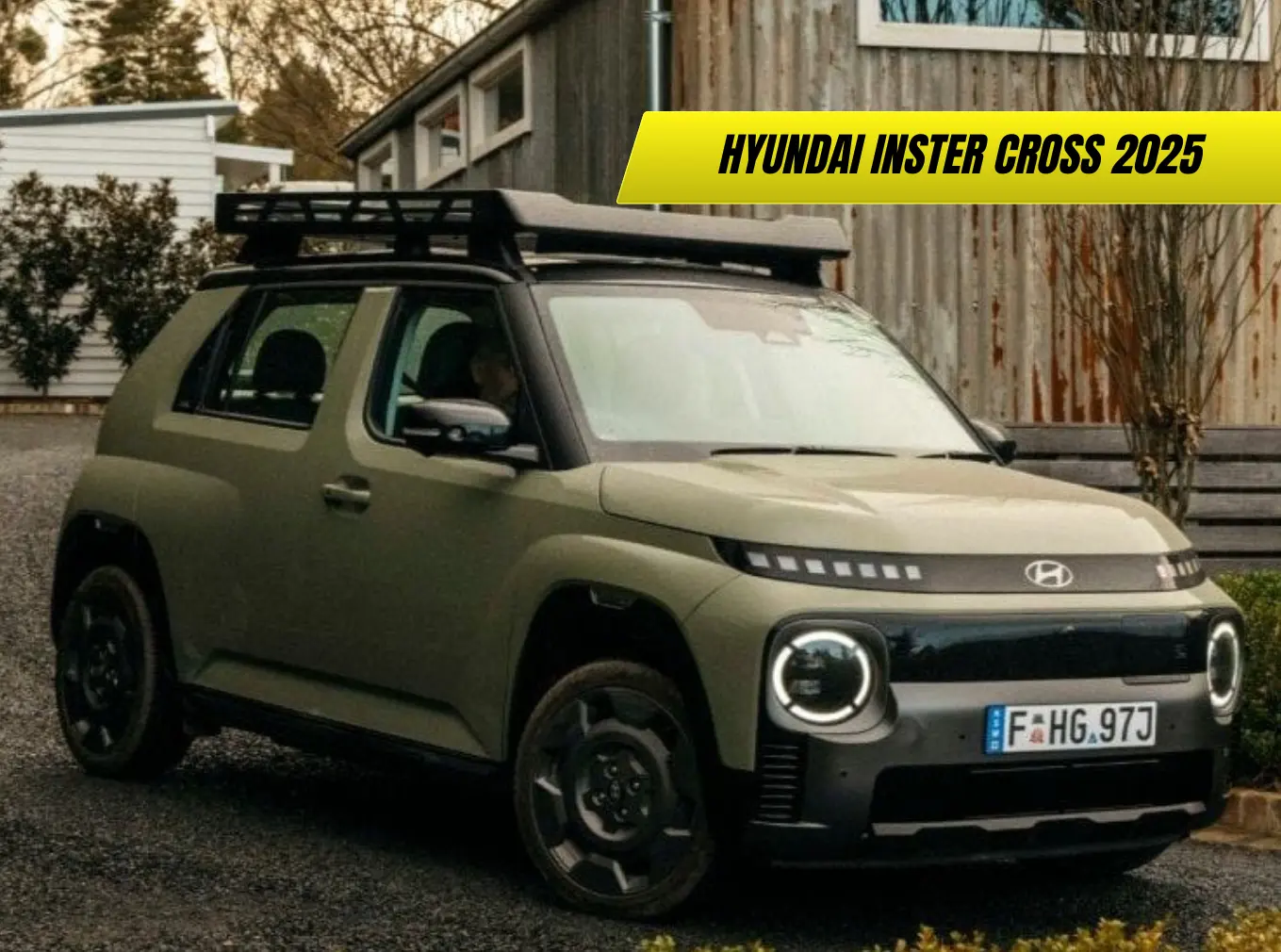
Hyundai Inster Cross 2025 UK review covering electric range, pricing from £28,745, compact city car practicality, and how it compares to rivals like Dacia Spring.
The Hyundai Inster Cross 2025 brings affordable electric mobility to the UK market with distinctive crossover styling and surprisingly generous equipment levels. As Hyundai’s smallest and most affordable electric vehicle, the Inster Cross targets urban drivers seeking zero-emission transport without compromising on technology or safety features. Priced from £28,745 for the 42 kWh version and £30,745 for the extended-range 49 kWh tested, it undercuts established rivals whilst offering Hyundai’s industry-leading five-year unlimited-mileage warranty and competitive real-world range figures.
Electric Powertrain and Performance
The Inster Cross employs a single front-mounted electric motor producing 113 bhp and 106 lb-ft of torque, powered by either a 42 kWh or 49 kWh lithium-ion battery pack. The larger battery tested delivers an official WLTP range of 229 miles, whilst the smaller capacity offers 203 miles between charges. Real-world testing across mixed UK driving conditions including urban routes, A-roads, and motorway sections achieved approximately 194 miles—a respectable 85% of the official claim.
From my perspective, the Inster Cross provides adequate performance for city driving and occasional motorway journeys, with instant electric torque delivering brisk acceleration from standstill. The zero-to-62 mph sprint takes 10.6 seconds with the larger battery, whilst top speed is electronically limited to 93 mph—sufficient for UK motorway limits with minimal reserve.
Hyundai Inster Cross Technical Specifications
| Specification | Value |
|---|---|
| Electric Motor | Front-Mounted / 113 bhp / 106 lb-ft |
| Battery Capacity | 42 kWh or 49 kWh |
| WLTP Range (49 kWh) | 229 miles |
| Real-World Range | 194 miles |
| 0-62 mph | 10.6 seconds (49 kWh) |
| Top Speed | 93 mph |
| DC Fast Charging | 10-80% in 30 minutes (80 kW) |
| AC Charging | 11 kW maximum |
| Energy Consumption | 3.5 mi/kWh (14.3 kWh/100km) |
DC fast charging at up to 80 kW allows 10-80% replenishment in approximately 30 minutes at compatible public chargers, whilst the 11 kW AC onboard charger enables overnight top-ups from home wallboxes in under five hours. This charging flexibility suits urban drivers with home charging access, though the modest DC charging speed trails faster-charging rivals when relying on public infrastructure during longer journeys.
Compact Dimensions and Urban Practicality
At just 3,825mm long, 1,610mm wide, and 1,575mm tall, the Inster Cross qualifies as a genuine city car, measuring shorter than a Volkswagen Polo whilst standing taller for improved visibility. The 2,580mm wheelbase maximizes interior space relative to external dimensions, creating surprisingly generous accommodation for four adults despite the compact footprint.
Boot capacity measures 280 litres with rear seats upright, expanding to 351 litres when loading to the roof, and 1,059 litres with rear seats folded flat. This exceeds many conventional city cars and proves genuinely useful for weekly shopping or occasional furniture collection. The square boot opening and minimal loading lip simplify cargo access, whilst underfloor storage houses charging cables without encroaching on usable space.
Ground clearance reaches 178mm—substantially more than conventional hatchbacks—allowing confident navigation of speed bumps, flooded roads, and rough car park surfaces that challenge lower vehicles. The raised driving position enhances visibility over surrounding traffic, a benefit particularly valued by urban drivers navigating congested city centers.
Cross-Inspired Design Elements
The Inster Cross distinguishes itself from standard Inster trim through rugged design additions including black body cladding surrounding the wheelarches and lower body, silver skid plates front and rear, and Cross-specific 17-inch alloy wheels. The raised ride height and chunky proportions create a miniature SUV appearance that appeals to buyers seeking character beyond anonymous hatchback shapes.
The front fascia features Hyundai’s signature pixelated LED headlight design—a motif borrowed from the larger Ioniq range—above circular LED daytime running lights integrated into the lower bumper. Black roof rails add visual height whilst providing genuine utility for roof box or bicycle carrier attachment during weekend adventures.
I would recommend the Cross specification specifically for buyers attracted to the crossover aesthetic and slightly raised driving position, as the mechanical package remains identical to standard Inster trim. The visual enhancements justify the modest premium for style-conscious city drivers, though purely practical buyers may prefer base specifications offering better value.
Interior Space and Technology
The cabin maximizes available space cleverly, with slim-backed front seats incorporating headrests and armrests without compromising rear passenger knee room. The flat floor aids rear-seat comfort, accommodating three children or two adults comfortably for urban journeys. Sliding rear seats adjust fore-aft to prioritize legroom or boot capacity depending on loading requirements—a flexibility rarely found in this size class.
Twin digital displays measure 10.25 inches each, serving digital instrumentation and infotainment functions with wireless Apple CarPlay and Android Auto compatibility. The touchscreen interface responds quickly with intuitive menu structures, though physical climate controls beneath the screen maintain usability whilst driving. A head-up display projects key information onto the windscreen, reducing the need to glance down at instruments—an unexpected feature at this price point.
Heated front seats, heated steering wheel, and dual-zone automatic climate control contribute to winter comfort, whilst multiple USB-C charging ports keep devices powered throughout the cabin. The minimalist interior design employs sustainable materials including recycled plastics, reflecting Hyundai’s environmental commitment beyond zero-emission propulsion.
Driving Dynamics and City Maneuverability
The Inster Cross excels at urban driving, with light steering and compact dimensions enabling effortless navigation through tight spaces and multi-story car parks. The turning circle measures just 10.4 metres—tighter than many larger vehicles—simplifying parallel parking and three-point turns on narrow streets. Parking sensors front and rear combine with a reversing camera to eliminate blind spots during tight maneuvers.
Regenerative braking offers adjustable levels via steering wheel paddles, allowing one-pedal driving that slows the vehicle to a complete stop when lifting off the accelerator. From my experience, maximum regeneration suits urban environments perfectly, minimizing brake pedal use whilst maximizing energy recovery to extend range. The system adapts to traffic conditions intelligently, avoiding overly aggressive deceleration that might unsettle passengers.
Ride comfort proves surprisingly accomplished for a small city car, with suspension tuning that absorbs Britain’s deteriorating road surfaces without excessive harshness. Some body movement occurs through tighter corners due to the raised center of gravity, though the electronic stability systems maintain composure admirably. Refinement stands out as a particular strength, with minimal wind noise or road roar even at motorway speeds—a benefit of electric propulsion eliminating engine vibration entirely. For drivers concerned about maintaining awareness of speed limits, our guide to UK speed camera regulations 2025 provides comprehensive information about current enforcement practices.
Safety and Driver Assistance Features
Hyundai equips the Inster Cross generously with active safety technology despite the affordable pricing. Autonomous emergency braking with pedestrian and cyclist detection, lane-keeping assistance, lane-following assist, and driver attention monitoring all come as standard across the range. Blind-spot collision avoidance assists with lane changes, whilst rear cross-traffic alert warns of approaching vehicles when reversing from parking spaces.
Adaptive cruise control maintains set distances from traffic ahead, working smoothly in stop-start urban conditions down to a complete halt. The system resumes automatically when traffic moves off, reducing driver fatigue during congested commutes. Highway Driving Assist combines adaptive cruise with lane-centering to provide semi-autonomous capability on motorways, though drivers must maintain attention and keep hands on the wheel.
Forward collision avoidance assists with junction turning, detecting oncoming traffic when making right turns across traffic flow—a scenario responsible for many UK collisions. The comprehensive safety package reflects Hyundai’s commitment to democratizing advanced technology across the model range, not reserving features exclusively for premium vehicles. UK drivers should familiarize themselves with the penalty point system outlined in our UK driving licence points guide to maintain clean records.
UK Pricing and Trim Levels
Hyundai positions the Inster Cross competitively with three trim levels spanning a narrow price range. Entry-level 01 specification with the 42 kWh battery starts at £28,745, rising to £30,745 for the extended-range 49 kWh version tested. Mid-range 02 trim adds equipment for £30,245 (42 kWh) or £32,245 (49 kWh), whilst flagship 03 specification tops the range at £32,745 with the larger battery.
Hyundai Inster Cross Range Comparison
| Trim Level | Battery | Price | Key Features |
|---|---|---|---|
| 01 | 42 kWh | £28,745 | 17-inch alloys, dual 10.25-inch displays, LED lights, safety pack |
| 01 | 49 kWh | £30,745 | Extended range, faster DC charging, otherwise identical |
| 02 | 42 kWh | £30,245 | Heated seats/wheel, head-up display, upgraded upholstery |
| 02 | 49 kWh | £32,245 | Extended range with 02 equipment |
| 03 | 49 kWh | £32,745 | Sunroof, ambient lighting, premium audio, V2L capability |
Vehicle-to-Load (V2L) functionality on top-specification models allows the Inster to power external devices including camping equipment, power tools, or even other electric vehicles via a 230V adapter. This capability transforms the car into a mobile power source useful for outdoor adventures or emergency situations—a feature increasingly valued by outdoor enthusiasts.
For UK buyers comparing small electric vehicles, the Dacia Spring offers lower pricing with reduced equipment and range, whilst the Renault Megane E-Tech targets a different segment with larger dimensions and premium positioning. Buyers seeking petrol alternatives might consider the Toyota Aygo X or Fiat Grande Panda, though these sacrifice zero-emission benefits.
Running Costs and Ownership Considerations
As a pure electric vehicle, the Inster Cross incurs zero road tax (VED) through March 2025, when new EV taxation rules introduce modest annual charges. Home charging at typical UK domestic electricity rates of 24p per kWh costs approximately £11.76 for a full 49 kWh battery replenishment, delivering nearly 200 miles of real-world range—equivalent to 5.9p per mile. Public rapid charging costs vary significantly, though typical rates of 65-85p per kWh increase costs to approximately 19-25p per mile.
Insurance grouping sits around 15-18 depending on specification, reflecting the Inster’s modest performance and comprehensive safety equipment. Servicing requirements remain minimal compared to petrol vehicles, with brake wear reduced dramatically through regenerative braking and no oil changes required. Hyundai specifies annual inspections primarily for software updates and general safety checks, with costs significantly lower than conventional vehicles.
Hyundai’s five-year unlimited-mileage manufacturer warranty leads the industry, providing peace of mind for high-mileage drivers without concern about exceeding distance limits. The battery warranty extends to eight years or 100,000 miles with a capacity guarantee maintaining at least 70% of original performance—industry-standard protection reflecting battery longevity confidence.
How It Compares to Electric City Car Rivals
The Inster Cross enters a growing but still limited small EV segment, competing primarily with the Dacia Spring, Fiat 500 Electric, and Smart #1. The Dacia offers lower entry pricing around £15,000 but with significantly reduced range (140 miles), basic equipment, and limited safety technology. The Fiat 500 Electric delivers superior styling and brand cachet whilst costing £30,000+ with similar range, making the Hyundai appear better value for practical-minded buyers.
The Smart #1 operates in a higher price bracket from £34,000, offering more power and premium positioning but reduced practicality for urban duties. Against petrol-powered city cars like the Toyota Yaris or Renault Clio, the Inster costs more upfront but delivers significantly lower running costs for drivers covering moderate annual mileages with home charging access.
From my assessment, the Inster Cross makes most sense for urban drivers seeking affordable electric mobility with generous equipment and Hyundai’s warranty reassurance. It sacrifices long-distance capability and rapid charging speed compared to larger EVs, but excels at the city driving duties where small electric vehicles naturally thrive.
Frequently Asked Questions
What is the real-world range of the Hyundai Inster Cross?
Real-world testing achieved approximately 194 miles from the 49 kWh battery across mixed UK driving including urban routes, A-roads, and motorway sections—about 85% of the official 229-mile WLTP claim. Urban driving maximizes range through frequent regenerative braking, whilst sustained motorway speeds at 70 mph reduce efficiency and overall distance between charges.
How long does the Inster Cross take to charge?
DC fast charging at 80 kW replenishes the 49 kWh battery from 10-80% in approximately 30 minutes at compatible public chargers. Home charging via an 11 kW wallbox requires under five hours for a complete charge from empty, whilst a standard domestic 3-pin plug takes around 20 hours—adequate for overnight top-ups but impractical as a primary charging solution.
Is the Inster Cross suitable for motorway driving?
The Inster Cross manages motorway driving adequately, with sufficient power for overtaking and merging, though the 93 mph top speed provides minimal reserve above UK speed limits. Range decreases noticeably during sustained high-speed cruising, with approximately 140-160 miles achievable on motorway-heavy journeys. For primarily urban use with occasional longer trips, it performs well, though regular long-distance drivers should consider larger EVs with faster charging capability.
How does the Inster Cross compare to the Dacia Spring?
The Hyundai offers substantially more range (229 miles vs 140 miles), superior safety equipment, advanced technology including head-up display, and Hyundai’s five-year warranty versus Dacia’s three years. The Spring undercuts the Inster by approximately £13,000, appealing to budget-conscious buyers accepting reduced capabilities. For most UK drivers, the Inster’s additional features and range justify the premium.
What warranty does Hyundai provide on the Inster Cross?
Hyundai offers an industry-leading five-year unlimited-mileage manufacturer warranty on the Inster Cross, with an eight-year/100,000-mile battery warranty guaranteeing at least 70% capacity retention. This exceeds most rivals and provides exceptional peace of mind for high-mileage drivers or those concerned about long-term battery degradation costs.
Can the Inster Cross power external devices?
Top-specification 03 trim includes Vehicle-to-Load (V2L) capability, allowing the car to power external devices via a 230V adapter. This provides up to 3 kW of output suitable for camping equipment, power tools, or emergency home backup. Lower trims lack this functionality, though aftermarket adapters may enable basic V2L features with reduced capabilities.
What are common dashboard warning lights I should know about?
Like all modern vehicles, the Inster Cross features comprehensive warning systems to alert drivers of maintenance needs or faults. UK motorists should familiarize themselves with indicators including the spanner warning light for service requirements and the handbrake warning light which may indicate brake system issues requiring immediate attention. For drivers exploring alternative powertrains, our best plug-in hybrid cars UK 2025 guide provides comprehensive comparisons.
The Hyundai Inster Cross 2025 delivers affordable electric mobility with surprising practicality and generous equipment that exceeds expectations for its price point. It suits urban drivers seeking zero-emission transport without compromising on safety technology or warranty coverage, though limited range and modest charging speeds restrict long-distance touring ambitions. For city-focused buyers with home charging access, the Inster Cross represents compelling value in the emerging small EV segment, backed by Hyundai’s reputation for reliability and industry-leading warranty protection.





