
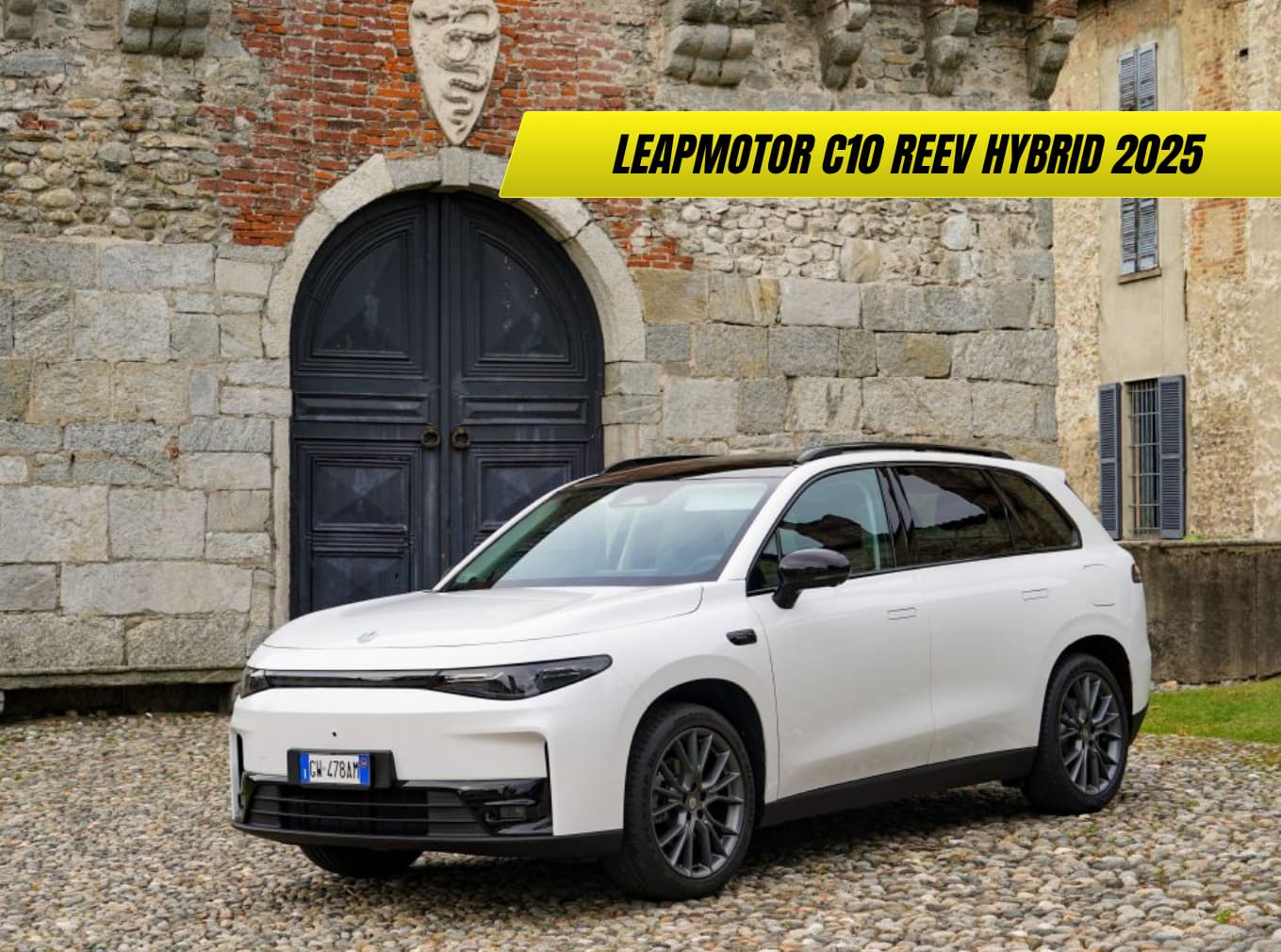
The Leapmotor C10 REEV Hybrid is a D-segment electric SUV with a range extender powertrain delivering up to 145 km of pure electric driving and a combined range of 970 km — priced from just €37,400, it challenges European rivals on every measurable dimension while offering a driving experience indistinguishable from a pure electric vehicle.
Leapmotor C10 REEV Hybrid: Key Highlights
- 215 hp electric motor driving the rear wheels via a rear-wheel drive layout; 1.5-litre petrol engine acts exclusively as a generator
- 145 km of pure electric WLTP range from a 28.4 kWh LFP battery — 59 km more than the smaller B10 REEV
- Combined range of 970 km with a full battery and full 50-litre fuel tank
- 0–100 km/h in 8.5 seconds and a top speed of 170 km/h
- DC fast charging at up to 65 kW (10–80% in approximately 40 minutes)
- Continental pricing from €37,400 (C10 REEV) and €38,900 (C10 REEV Design)
Design and Exterior: D-Segment Presence at a Compact SUV Price
At 4.74 metres long, 1.90 metres wide and 1.68 metres tall with a 2.83-metre wheelbase, the Leapmotor C10 REEV Hybrid occupies genuine D-segment territory — the same size class as the Volkswagen Tiguan, Hyundai Tucson and Toyota RAV4. Its exterior design is clean and contemporary: a closed front fascia communicating the car’s electrified character, a rising shoulder line that flows from the front wheel arch to the rear light cluster, and a slightly squared-off rear profile that maximises boot volume while keeping the overall silhouette aerodynamically resolved.
The wheel arch flares are pronounced but not theatrical, accommodating tyres appropriately sized for a vehicle of this weight and performance level. The overall impression is of a car that has been designed with discipline rather than showmanship — consistent with Leapmotor’s brand philosophy of substance over spectacle. The C10 REEV Hybrid’s exterior is distinguished from the standard C10 electric by minor detail differences, including badging. In the current European market, where many premium brand equivalents cost significantly more for comparable or smaller dimensions, the C10’s value proposition begins at the kerb.
Interior and Technology: More Space, More Refinement Than the B10
The C10 REEV Hybrid’s interior advances on the smaller B10 in several important respects. The cabin has been finished with greater attention to material quality — soft-touch surfaces extend more generously across the contact points of the dashboard, and the central console design has been revised with a slightly different graphic to the B10. Most significantly, the digital instrument cluster grows to a 10.25-inch display — a meaningful upgrade over the B10’s smaller unit — while the central infotainment touchscreen retains the B10’s excellent 14.6-inch panel, one of the largest in its class.
The Leap OS infotainment platform supports over-the-air software updates, 4G connectivity, wireless smartphone charging and voice command functionality. Physical controls are deliberately limited — consistent with Leapmotor’s interface philosophy — meaning the learning curve for new owners involves familiarising oneself with the touchscreen menu hierarchy before setting off for the first time. Shortcut buttons assist with the most frequently used functions, mitigating the depth of the menu structure in daily use. The wireless charging pad is well-positioned, and the driving interface ergonomics are logical once the initial orientation is complete.
Space and Practicality: A Genuine D-Segment Advantage
The C10’s 4.74-metre length translates directly into rear cabin space that compares favourably with established segment rivals. Adults up to 185 cm tall will find the rear cabin generously proportioned — both in terms of knee room, aided by the 2.83-metre wheelbase, and headroom, supported by the 1.68-metre overall height. The flat floor — a characteristic of the dedicated electric platform — removes the central tunnel intrusion common to ICE and hybrid-architecture cars, meaning all three rear-seat positions offer genuine comfort rather than the compromised central position that characterises many rivals.
The boot delivers a practical 435 litres — approximately 100 litres more than the B10 REEV Hybrid, and competitive with the full-hybrid rivals in this segment. The difference is attributable to the platform’s accommodation of both the 28.4 kWh battery pack and the 50-litre fuel tank beneath the floor, achieved without meaningfully intruding into the load area. Maximum luggage capacity with the rear seats folded reaches approximately 1,350 litres — a strong figure by any D-segment standard. For UK families comparing the C10 against more established alternatives, this combination of rear passenger space, boot volume and price is genuinely difficult to match in the current market.
Powertrain: How the REEV System Works in Practice
Understanding the Leapmotor C10 REEV Hybrid requires clarity on what “range extender” means in practice. The electric motor is the sole source of drive: it produces 215 hp and 320 Nm, powers the rear wheels exclusively through a rear-wheel drive layout, and delivers the instant-torque, silent, smooth acceleration characteristic of a pure electric vehicle in all normal driving conditions. The 1.5-litre naturally aspirated four-cylinder petrol engine — producing 67–88 hp depending on operating point — never drives the wheels directly. Its sole function is to act as a generator: recharging the LFP battery when charge level drops to 25%, extending the car’s range indefinitely as long as fuel is available.
The practical consequence of this architecture is that the C10 REEV Hybrid drives precisely like the standard C10 pure electric in every situation — quiet, smooth, responsive — but without the range anxiety of a pure BEV. A driver who charges at home each night will use the petrol engine rarely or not at all, operating almost entirely in zero-emission electric mode. A driver who lacks home charging can refuel at any petrol station and continue indefinitely, with the engine providing transparent range extension. The 970 km combined range — achievable with a full 28.4 kWh battery and full 50-litre fuel tank — is sufficient for London to Rome without a charging stop, relying only on fuel top-ups.
On the road, the C10 REEV Hybrid’s greater size and weight relative to the B10 translate into a noticeably more composed, settled driving character. Body control over undulations and through corners is superior to the B10, the suspension’s bump absorption is more effective, and the overall sense of solidity at motorway speeds is markedly better — qualities that are directly attributable to the stiffer platform and greater mass of the D-segment vehicle. The trade-off is the 8.5-second 0–100 km/h time, one second slower than the B10 — a small concession that will matter to very few buyers in this category.
| Specification | Detail |
|---|---|
| Electric motor | 215 hp (158 kW) / 320 Nm |
| Generator engine | 1.5-litre 4-cylinder petrol, 67–88 hp |
| Drivetrain | Rear-wheel drive |
| Battery | 28.4 kWh LFP |
| 0–100 km/h | 8.5 seconds |
| Top speed | 170 km/h |
| WLTP electric range | Up to 145 km |
| Combined range (full battery + full tank) | 970 km |
| Fuel tank | 50 litres |
| AC charging | Up to 6.6 kW |
| DC fast charging | Up to 65 kW |
| Boot volume | 435–1,350 litres |
| Kerb weight | ~2,025 kg |
| Length / width / height | 4,740 / 1,900 / 1,680 mm |
| Wheelbase | 2,830 mm |
| Continental price (from) | €37,400 |
Charging and Running Costs
The C10 REEV Hybrid’s charging capability is modest but practically adequate. AC charging at up to 6.6 kW means a full charge from empty takes approximately 5.5 hours on a home wallbox — perfectly suited to overnight charging for daily commuters. DC fast charging at up to 65 kWachieves a 10–80% recharge in approximately 40 minutes at a compatible rapid charger — slower than the Hyundai Inster (120 kW) or Audi Q8 e-tron (170 kW), but adequate for en-route top-ups on longer journeys where the petrol engine provides a seamless backup. The LFP (lithium iron phosphate) battery chemistry is inherently more durable than NMC alternatives, with significantly reduced degradation over high charge cycles — a meaningful long-term ownership benefit.
For UK drivers navigating ULEZ zones and clean air areas, the C10 REEV Hybrid qualifies as an ultra-low emission vehicle (ULEV) and is exempt from ULEZ charges when driven in electric mode. For a full overview of urban clean air zone costs and exemptions, our guide to UK toll roads and charges 2025 covers all current charges. For UK company car drivers, the REEV powertrain’s low CO2 emissions may place the C10 in a favourable Benefit-in-Kind band — confirm with your fleet manager or tax adviser based on the confirmed UK-homologated CO2 figure.
Leapmotor C10 REEV Hybrid vs. Key Rivals
| Model | Electric Range | Combined Range | Boot | Power | Price (from) |
|---|---|---|---|---|---|
| Leapmotor C10 REEV Hybrid | 145 km | 970 km | 435–1,350 l | 215 hp | €37,400 |
| Leapmotor B10 REEV Hybrid | 86 km | 900 km | 380 l | 217 hp | €30,100 |
| Toyota RAV4 PHEV AWD | ~75 km | ~900 km | 446–1,600 l | 309 hp | €53,700 |
| Volkswagen Tiguan eHybrid | ~90 km | ~900 km | 652–1,655 l | 272 hp | €50,000 |
| BYD Seal U DM-i | ~100 km | ~1,200 km | 425 l | 160 hp | €38,000 |
The C10 REEV Hybrid’s combined range of 970 km and 145 km of pure electric driving represent the strongest range credentials in its price bracket. The Toyota RAV4 PHEV AWD is more powerful and more refined, but costs €16,000 more. The Volkswagen Tiguan eHybrid offers a larger boot and conventional PHEV architecture but again at a substantially higher price. For UK buyers exploring Chinese brand SUVs in detail, our guide to the best Chinese SUVs in the UK for 2025 provides essential context alongside the best plug-in hybrid cars UK 2025 guide.
Is the Leapmotor C10 REEV Hybrid Available in the UK?
Leapmotor vehicles are distributed in Europe through the Stellantis dealer network, which includes Vauxhall dealers in the UK. The C10 REEV Hybrid is available or imminently available through this channel, with UK pricing expected to reflect the continental starting price of €37,400 — approximately £32,000–£33,000 at current exchange rates. For the latest UK pricing and availability, contact your nearest Stellantis-affiliated Leapmotor dealer or visit leapmotor.eu. For those also considering the smaller sibling, the Leapmotor B10 REEV Hybrid offers an entry point approximately £6,000 lower for buyers who require less space and electric range.
FAQ
What is a range extender electric vehicle (REEV)?
A REEV uses an electric motor as the sole source of drive — delivering the silence, smoothness and instant torque of a pure electric vehicle at all times. A petrol engine is present but never drives the wheels directly: it functions exclusively as a generator, recharging the battery when it reaches a set minimum state of charge. The driving experience is identical to a pure EV.
How far can the Leapmotor C10 REEV Hybrid travel on electricity alone?
The C10 REEV Hybrid offers up to 145 km of pure electric WLTP range from its 28.4 kWh LFP battery — 59 km more than the smaller B10 REEV Hybrid. In real-world urban driving conditions, figures close to the declared range are consistently achievable.
What is the total range of the Leapmotor C10 REEV Hybrid?
With a fully charged battery and a full 50-litre fuel tank, the C10 REEV Hybrid offers a combined range of up to 970 km — sufficient to drive from London to Rome without stopping at a charging point, relying only on occasional petrol station top-ups.
Does the Leapmotor C10 REEV Hybrid have rear-wheel drive?
Yes. The electric motor drives the rear wheels exclusively through a rear-wheel drive layout. There is no front motor or all-wheel drive option on the current C10 REEV Hybrid.
How does the Leapmotor C10 compare to the B10 REEV Hybrid?
The C10 is larger (4.74 metres vs 4.30 metres), offers a bigger boot (435 l vs 380 l), provides more electric range (145 km vs 86 km) and delivers a more settled, composed ride quality. The B10 is lighter, quicker (0–100 km/h in 7.5 seconds vs 8.5 seconds) and costs approximately €7,300 less. Both share the same petrol generator engine and overall REEV architecture.
Is the Leapmotor C10 REEV Hybrid exempt from UK ULEZ charges?
As an ultra-low emission vehicle with an electric drivetrain and sub-50 g/km CO2 emissions, the C10 REEV Hybrid is expected to qualify for ULEZ exemption in all current UK clean air zones when driven in electric mode. Confirm the precise ULEZ status with your dealer at the point of purchase.
What warranty does Leapmotor offer in the UK?
Leapmotor vehicles distributed through the Stellantis network in the UK carry a competitive manufacturer warranty. Confirm current UK warranty terms — including battery coverage — with your authorised Leapmotor dealer at the point of purchase.
The Leapmotor C10 REEV Hybrid 2025 makes a compelling and coherent case for the range extender architecture as the most practical electrification solution for the significant proportion of UK drivers who lack reliable home charging but want the zero-emission driving experience for their daily mileage. Its 145 km of electric range covers virtually every UK daily commute without touching the petrol engine, while the 970 km combined range removes long-distance anxiety entirely. The settled ride quality, generous D-segment interior space, 435-litre boot and competitive price of €37,400 complete a package that, from my point of view, deserves serious consideration from any buyer currently weighing up a PHEV or full hybrid in the £30,000–£40,000 bracket.





