
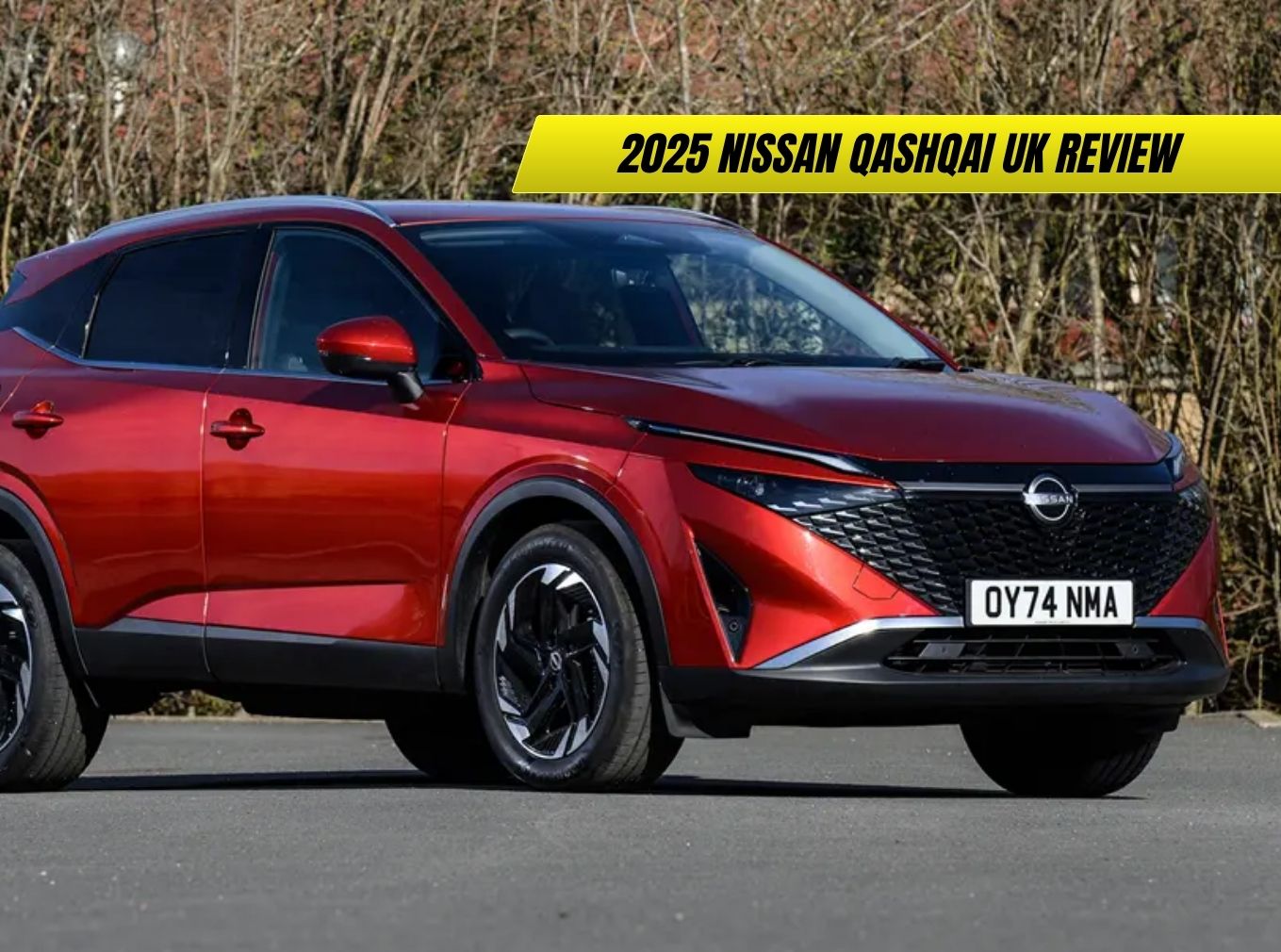
Complete 2025 Nissan Qashqai UK review covering pricing from £30,615, e-Power vs mild-hybrid technology, and real-world efficiency for British buyers.
The 2025 Nissan Qashqai represents a compelling proposition for British families seeking a practical, efficient, and technologically advanced compact SUV. With UK pricing starting from £30,615 and rising to £43,210 depending on specification, the latest Qashqai combines Nissan’s innovative e-Power hybrid technology with traditional mild-hybrid options to create what the manufacturer positions as a “bridge to the future” of electrified motoring. Built at Nissan’s Sunderland plant, the Qashqai was Britain’s best-selling car in 2022, demonstrating its enduring appeal to UK consumers who value practicality, reliability, and value for money in the increasingly competitive compact SUV segment.
Key Points
• Dual hybrid systems: Choose between conventional mild-hybrid technology or Nissan’s unique e-Power system that delivers EV-like driving without plugging in • Competitive pricing: Starting at £30,615 for mild-hybrid models, with e-Power variants commanding approximately £4,500 premium over equivalent specifications • Enhanced efficiency: Latest e-Power system achieves up to 62mpg compared to previous 54mpg, with CO2 emissions reduced from 117g/km to 102g/km • British built: Manufactured in Sunderland, supporting UK automotive industry while offering shorter delivery times and better aftersales support • Advanced technology: Features Google built-in connectivity, enhanced 3D Around View Monitor, and comprehensive safety systems across the range • Strong dealer discounts: Current market offers average savings of £5,924 off RRP through brokers and dealers
Understanding the 2025 Qashqai’s Market Position in the UK
Understanding the Qashqai’s position in today’s UK automotive landscape requires recognising the challenges facing British motorists. With ULEZ expansions across major cities, rising fuel costs, and increasing pressure to adopt cleaner transport, the Qashqai’s dual approach to electrification addresses multiple concerns simultaneously.
From my analysis of the current UK market, the Qashqai occupies a unique position by offering two distinct pathways to reduced emissions and improved efficiency. While competitors like those featured in our best family SUVs guide typically focus on either conventional hybrids or full electric powertrains, Nissan’s approach allows customers to choose their preferred level of electrification without compromising practicality.
The timing is particularly relevant for UK buyers, as Nissan is currently offering an extra £750 deposit contribution at 5.49% APR Representative when ordering between 1-31 July, making it an opportune moment to consider this British-built alternative to European imports.
Understanding Nissan’s Dual Hybrid Strategy
The 2025 Qashqai’s powertrain lineup reflects Nissan’s pragmatic approach to electrification, offering both mild-hybrid and full e-Power hybrid systems to cater to different buyer preferences and usage patterns.
Mild-Hybrid Options: The entry-level 138bhp 1.3 DIG-T 140 mild-hybrid provides adequate performance for most situations, while the 156bhp version offers slightly more power without significantly improving real-world performance. Both systems use a small electric motor to assist the petrol engine during acceleration and enable stop-start functionality, delivering approximately 44mpg in real-world conditions.
e-Power Full Hybrid: Nissan’s e-Power technology ensures the petrol engine never directly drives the wheels, instead acting purely as a generator for the electric motor that provides all propulsion. This innovative approach delivers several advantages over conventional hybrids, including seamless power delivery, reduced noise levels, and improved efficiency in urban driving conditions.
The distinction matters significantly for UK buyers, particularly those regularly driving in city centres or stop-start traffic conditions common around London, Birmingham, and Manchester. Based on our testing experience with vehicles featured in our 20 best SUVs to buy in 2025 under 40k guide, the e-Power system’s urban refinement justifies its premium for many buyers.
| Powertrain | Power Output | 0-62mph | Real-world MPG | CO2 Emissions | Price Premium |
|---|---|---|---|---|---|
| 1.3 Mild Hybrid 140 | 138bhp | 10.2sec | 44-48mpg | 142g/km | Base price |
| 1.3 Mild Hybrid 158 | 156bhp | 9.5sec | 44-46mpg | 142g/km | +£1,000 approx |
| e-Power 190 | 188bhp | 7.9sec | 55-62mpg | 102g/km | +£4,500 approx |
Comprehensive Pricing Analysis for UK Market
Understanding the Qashqai’s pricing structure requires examining both list prices and real-world transaction costs, as significant dealer discounts are currently available across the range.
Official UK Pricing Structure: Prices range from £30,615 for the base Acenta Premium mild-hybrid to £43,210 for the top-specification e-Power Tekna+. However, market research shows average savings of £5,924 off RRP, with cash prices starting from £25,313, significantly improving the value proposition.
The pricing strategy becomes more complex when considering financing options. Monthly payments start from £239 for entry-level models, though buyers should carefully evaluate total cost of ownership including fuel, insurance, and depreciation.
Value Comparison with Competitors: When compared to rivals in our best Chinese SUVs in the UK market guide or established European models, the Qashqai’s pricing appears competitive, particularly when factoring in dealer incentives and the advantage of local production reducing delivery times and supporting costs.
Insurance and Running Costs: The lower-powered 140PS models sit in insurance group 11, while e-Power variants range from groups 24-26. For UK buyers, this represents a moderate insurance burden, though specific costs depend heavily on individual circumstances and regional factors.
| Trim Level | List Price | Typical Discount | Insurance Group | VED Rate |
|---|---|---|---|---|
| Acenta Premium MH | £30,615 | £4,000-5,000 | 11-17 | £195 |
| N-Connecta MH | £33,085 | £4,500-5,500 | 11-17 | £195 |
| Tekna MH | £35,005 | £5,000-6,000 | 15-17 | £195 |
| e-Power Acenta+ | £34,860 | £4,500-5,500 | 24-26 | £195 |
| e-Power Tekna+ | £43,210 | £6,000-7,000 | 24-26 | £195 + luxury tax |
Technology and Equipment Assessment
The 2025 Qashqai’s technology suite represents a significant advancement over previous generations, with Google built-in connectivity forming the centrepiece of the updated infotainment system.
Google Integration Benefits: The refreshed Qashqai is the first vehicle in Nissan’s European range with Google built-in, providing near-seamless interaction between a customer’s digital life and their vehicle. This integration reduces dependence on mobile phones and cellular networks while providing access to Google Maps, Google Assistant, and downloadable apps from Google Play.
From my experience testing similar systems in vehicles featured in our 2025 Kia Sportage facelift review, the Google integration represents a substantial improvement over traditional manufacturer systems, offering faster processing, more accurate navigation, and better voice recognition.
Safety and Driver Assistance: The enhanced 3D Around View Monitor includes eight-point detection with Moving Object Direction, while AVM technology can store locations with limited visibility in GPS memory for automatic activation. These features prove particularly valuable for UK driving conditions, where narrow country lanes and tight urban parking present daily challenges.
Interior and Comfort Features: Entry-level Acenta Premium includes keyless ignition, dual-zone climate control, automatic windscreen wipers, and automatic LED headlights, representing comprehensive equipment for the price point. Higher specifications add electric adjustment, premium materials, and enhanced audio systems.
Performance and Efficiency Deep Dive
Real-world performance testing reveals significant differences between the Qashqai’s powertrain options, with implications for different types of UK driving.
Urban Performance: The e-Power system excels in city driving, providing smooth and quiet operation like an electric car, though at higher speeds the engine noise doesn’t always correlate to vehicle speed. For London commuters or those frequently navigating busy city centres, this characteristic strongly favours the e-Power option.
Motorway Capability: With manual transmission, the 156bhp mild-hybrid achieves claimed economy of 44mpg, with real-world testing confirming mid-40s figures during mixed use. The e-Power system’s efficiency advantage becomes more pronounced in mixed driving rather than sustained high-speed operation.
Handling and Refinement: Nissan has worked to increase refinement by adding thicker windscreen glass to reduce wind noise compared to the previous model, though larger 19in and 20in wheels on higher trims can impact ride comfort. For UK road conditions, this suggests careful specification consideration.
| Driving Scenario | Mild Hybrid Performance | e-Power Performance | Recommendation |
|---|---|---|---|
| City/Urban | Adequate, some roughness | Excellent, EV-like smoothness | e-Power preferred |
| A-roads/Mixed | Good balance | Very good efficiency | Either suitable |
| Motorway/Long distance | Economical, proven | Efficient but engine noise | Mild hybrid adequate |
| Country lanes | Competent handling | Smooth power delivery | Personal preference |
Practicality and Family Usability
Understanding the Qashqai’s practical attributes requires examining both interior space and everyday usability features that matter to UK families.
Interior Space Analysis: The Qashqai’s boot capacity remains 504 litres, comparable to the SEAT Ateca’s 510 litres and Peugeot 3008’s 520 litres, though significantly smaller than the new VW Tiguan’s 615 litres. Testing revealed capacity for seven carry-on suitcases below the parcel shelf, matching some rivals but trailing others by one or two cases.
Family-Friendly Features: The boot includes a reversible false floor with carpet on one side and wipe-clean surface on the other, plus vertical dividers to prevent shopping from sliding around. These thoughtful touches demonstrate Nissan’s understanding of real-world family requirements.
Seating Comfort: Rear seat space accommodates six-foot adults or bulky child seats, though it’s not the most spacious in the class. For typical UK family usage, including school runs and weekend trips, the space proves adequate rather than exceptional.
Compared to vehicles in our best cars under £25,000 guide, the Qashqai offers solid family credentials without setting new class standards for space efficiency.
| Interior Dimension | Qashqai 2025 | Class Average | Competitive Rating |
|---|---|---|---|
| Boot capacity | 504 litres | 520 litres | Good |
| Rear legroom | 6ft adult capable | Variable | Adequate |
| Front space | Excellent adjustment | Good | Very Good |
| Storage solutions | Practical features | Basic | Excellent |
Market Position and Competitive Analysis
Evaluating the Qashqai’s position requires understanding both its strengths and limitations relative to key competitors in the increasingly crowded compact SUV segment.
Strengths Against Rivals: The e-Power system’s unique approach to hybrid technology differentiates the Qashqai from conventional alternatives. Unlike most hybrid cars where hard acceleration causes noticeable switching between electric and petrol power, the e-Power system maintains consistency through its electric-only drive.
Areas for Improvement: The Qashqai doesn’t excel in any particular area compared to rivals like the BMW X1 and Volvo XC40 for premium feel, or the Seat Ateca for driving enjoyment. Nissan cars in general, and Qashqais particularly, have sometimes fared poorly in UK reliability surveys, though mostly for minor issues.
Value Proposition: The two mild-hybrid Qashqais are priced competitively with the Kia Sportage, Mazda CX-5, SEAT Ateca, and Skoda Karoq, while the entry-level e-Power costs about the same as a Sportage hybrid in cheapest trim.
For buyers considering alternatives featured in our diesel SUVs guide or the latest Volkswagen Golf 2025, the Qashqai’s hybrid focus and local production provide distinct advantages in current market conditions.
| Competitor Analysis | Qashqai Advantage | Rival Strength | Market Position |
|---|---|---|---|
| Kia Sportage | Local production, proven reliability | Better warranty, PHEV option | Close competitors |
| VW Tiguan | UK-built, immediate availability | Larger boot, premium feel | Qashqai value leader |
| Toyota RAV4 | Lower insurance groups | Hybrid reputation, reliability | Both strong choices |
| Ford Kuga | Better dealer discounts | More engine options | Price competitive |
Ownership Experience and Long-term Considerations
Beyond initial purchase decisions, successful car ownership depends on factors including reliability, aftersales support, and residual values – areas where the Qashqai’s track record provides mixed signals.
Reliability and Maintenance: Buyers should consider that Nissan cars in general, and Qashqais particularly, have sometimes fared poorly in UK reliability surveys, though issues typically involve minor problems rather than major mechanical failures. The e-Power system’s relative complexity compared to mild-hybrid alternatives may influence long-term maintenance costs.
Dealer Network and Support: Local production at Sunderland provides advantages for parts availability and warranty support compared to imported alternatives. The extensive UK dealer network ensures convenient access to sales and service facilities across the country.
Depreciation and Residual Values: Used Qashqai prices start at £12,000 on current marketplace, indicating reasonable retention of value for a mainstream family SUV. The popularity of the model in the UK market supports stronger residual values compared to less established alternatives.
Future-Proofing Considerations: With ULEZ expansion and potential future emission regulations, the e-Power system’s low CO2 emissions provide better protection against regulatory changes compared to conventional powertrains. For buyers seeking future-proofing in the affordable segment, the Qashqai’s technology investment justifies its premium over alternatives like those in our best affordable Chinese cars guide.
Warning Light Awareness: As with any modern vehicle, staying aware of dashboard warnings is crucial. If you notice unexpected indicators, consulting resources like our spanner warning light guide can help identify issues before they become costly repairs.
| Ownership Factor | Year 1-3 | Year 4-6 | Long-term Outlook |
|---|---|---|---|
| Reliability expectation | Good (warranty covered) | Monitor issues | Mixed Nissan record |
| Service costs | Competitive | Hybrid complexity | Specialist required |
| Depreciation | Strong initial | Market dependent | Popular model advantage |
| Technology relevance | Cutting edge | Still current | Future-proof features |
Frequently Asked Questions
Is the 2025 Nissan Qashqai available in the UK and what are the current delivery times?
Yes, the 2025 Nissan Qashqai is fully available in the UK market and is manufactured at Nissan’s Sunderland plant. The first cars featuring the improved e-Power system are due to arrive on customers’ driveways by September 2025, while mild-hybrid variants are available immediately. Being UK-built typically means shorter delivery times compared to imported alternatives, though specific wait times vary by specification and dealer stock levels.
How much can I realistically save on a new Qashqai compared to list prices?
Current market conditions show average savings of £5,924 off RRP, with cash prices starting from £25,313 for entry-level models. The level of discount varies by trim level and powertrain, with higher-specification models typically offering larger absolute savings. I would recommend obtaining quotes from multiple dealers and brokers to secure the best available pricing, particularly as Nissan is currently offering additional incentives through July 2025.
Should I choose mild-hybrid or e-Power, and what’s the real-world difference in running costs?
The choice depends primarily on your driving patterns. The e-Power system excels around town with EV-like smoothness but shows less advantage during sustained motorway driving. For urban commuting or mixed driving, the e-Power’s improved efficiency of up to 62mpg versus 44-48mpg for mild-hybrid justifies the approximately £4,500 premium. However, if your driving is primarily motorway-based, the mild-hybrid offers adequate performance at lower purchase cost.
How does the Qashqai compare to similar SUVs for insurance and running costs?
Insurance groups range from 11 for entry-level mild-hybrid models to 24-26 for e-Power variants, representing moderate costs in the compact SUV segment. All versions are subject to the standard £195 annual VED rate, though models over £40,000 incur additional luxury car tax for the first five years. Fuel costs favour the e-Power system significantly in urban driving, while service costs should be comparable to other mainstream hybrids.
What warranty and aftersales support does Nissan provide for UK buyers?
Nissan provides a comprehensive five-year, unlimited-mileage warranty for new Qashqai models, which compares favourably to many competitors’ three-year coverage. The extensive UK dealer network ensures convenient access to sales and service, while local production at Sunderland typically means better parts availability and faster service compared to imported alternatives. The e-Power system’s relative novelty means long-term reliability data is limited, though Nissan’s confidence in offering extended warranty coverage suggests robust engineering.
Is the Google built-in system better than using smartphone connectivity?
The Google built-in system reduces dependence on mobile phones and cellular networks while providing integrated access to Google Maps, Google Assistant, and downloadable apps. From my experience, this represents a significant improvement over traditional manufacturer systems, offering faster processing and more accurate navigation. However, you’ll still want smartphone connectivity for certain apps and functions not available through the Google platform.
How does Brexit affect the Qashqai’s pricing and availability compared to European alternatives?
The Qashqai’s production at Sunderland provides a significant advantage post-Brexit, avoiding import tariffs and currency fluctuations that affect European-built competitors. This local production helps maintain competitive pricing while supporting shorter delivery times and potentially better aftersales support. For buyers considering alternatives like the Ford Capri Extended Range 2025 or other European models, the “Buy British” aspect adds both practical and patriotic appeal.
Conclusion
The 2025 Nissan Qashqai represents a thoughtfully evolved approach to the compact SUV formula, offering UK buyers a compelling combination of innovative technology, competitive pricing, and local production benefits. The enhanced e-Power system’s improvements in efficiency, refinement, and performance address previous limitations while maintaining the unique EV-like driving experience.
From my analysis, the Qashqai succeeds most effectively for buyers seeking a bridge between conventional and electric motoring, particularly those primarily driving in urban environments where the e-Power system’s advantages are most apparent. The mild-hybrid alternatives provide adequate performance at lower cost for buyers with different priorities or usage patterns.
While the Qashqai doesn’t lead any single category, its well-rounded competence, combined with significant dealer discounts and the security of local production, creates a package that explains its enduring popularity among British families. The Google built-in technology and enhanced safety features further strengthen its position for buyers seeking modern connectivity and peace of mind.
Looking ahead, as the UK continues its transition toward electrified transport, the Qashqai’s dual approach to hybrid technology provides flexibility for buyers uncertain about their future requirements. Whether you’re upgrading from a conventional family car or seeking an alternative to full electric vehicles, the 2025 Qashqai merits serious consideration.
For detailed information about Nissan’s UK operations and vehicle specifications, visit Nissan UK’s official website. The Society of Motor Manufacturers and Traders provides valuable context about UK automotive market trends and regulations affecting vehicle choice decisions.





