
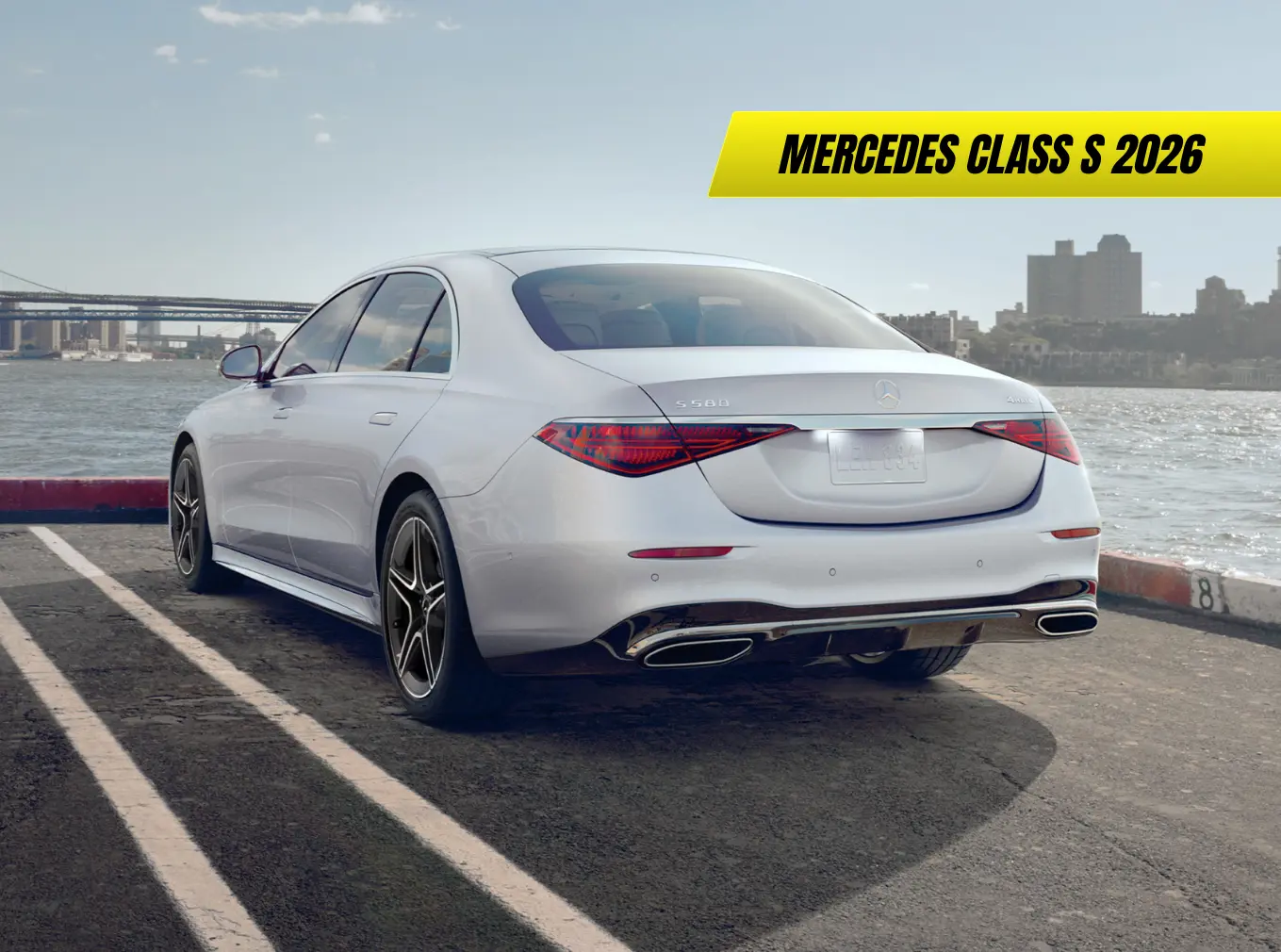
Mercedes S-Class 2026 facelift debuts January 29 with flat-plane crank V8 (537hp), MBUX Superscreen, Neue Klasse-inspired design. UK pricing from £95,000 estimated. Full specs and technology detailed.
Mercedes-Benz S-Class 2026 facelift revealed January 29, 2026: W223 mid-cycle update introduces flat-plane V8, MBUX Superscreen, revised exterior, advanced suspension technology, UK spring 2026 deliveries.
Mercedes-Benz unveils comprehensive S-Class W223 facelift at Stuttgart museum January 29, 2026, introducing revolutionary flat-plane crankshaft 4.0-litre V8 producing 537hp and 750Nm in flagship S 580 variant (up from 503hp/700Nm cross-plane predecessor), MBUX Superscreen replacing portrait touchscreen with E-Class-derived integrated 14.4-inch central display plus 12.3-inch passenger screen under single glass panel, and Neue Klasse-inspired design elements including illuminated star bonnet ornament, quad-star headlights, and gloss black grille frame adapted from EQ electric series aesthetic. The mid-cycle refresh addresses criticism regarding aging interior technology while maintaining W223’s fundamental luxury positioning, adding fourth-generation MBUX with MB.OS architecture, Google Maps integration, ChatGPT/Google Gemini voice assistant support, and advanced E-Active Body Control suspension managing individual wheel damping through 48-volt system enabling unprecedented ride quality. UK deliveries commence spring 2026 with estimated pricing £95,000-145,000 spanning S 450 4Matic entry through S 580 V8 flagship and S 580e plug-in hybrid offering 100km electric range, positioning updated flagship against revised BMW 7 Series G70 and Audi A8 D5 competitors increasingly challenged by Chinese luxury entrants including NIO ET7 and Hongqi H9 offering comparable specifications at substantially lower pricing threatening traditional German dominance in premium sedan segment.
Flat-Plane Crankshaft V8: Ferrari-Style Engine Architecture for S 580
The 2026 S-Class facelift’s headline technical advancement centers on the flagship S 580’s adoption of flat-plane crankshaft architecture for its 4.0-litre twin-turbocharged V8, representing fundamental departure from traditional Mercedes V8 engineering philosophy and marking the brand’s most significant powertrain evolution since hybrid technology integration began a decade ago.
Crankshaft Architecture Comparison
| Configuration | Traditional Cross-Plane | New Flat-Plane (S 580) |
|---|---|---|
| Firing order | Uneven 90° intervals | Even 180° intervals |
| Acoustic character | Deep V8 rumble | High-pitched exotic scream |
| Redline | 6,500-7,000 rpm typical | 7,200+ rpm achievable |
| Crankshaft weight | Heavier (requires counterweights) | 10-15% lighter rotating mass |
| Power density | Standard output | Enhanced high-rpm performance |
| Vibration | Inherently balanced | Secondary vibrations require management |
| Examples (other brands) | Most Mercedes V8s, AMG 63 series | Ferrari V8s, McLaren, Corvette Z06, AMG Black Series |
Technical Specifications: M177 Evo Flat-Plane V8
| Specification | S 580 (2026 Flat-Plane) | Previous S 580 (Cross-Plane) | Improvement |
|---|---|---|---|
| Engine code | M177 Evo (flat-plane) | M176 (cross-plane) | Architecture change |
| Displacement | 4.0 litres (3,982cc) | 4.0 litres | Unchanged |
| Configuration | 90° V8, twin-turbo | 90° V8, twin-turbo | Crankshaft only |
| Power output | 537hp (400 kW) | 503hp (375 kW) | +34hp (+6.8%) |
| Torque | 750Nm (553 lb-ft) | 700Nm (516 lb-ft) | +50Nm (+7.1%) |
| Redline | 7,200 rpm (estimated) | 6,800 rpm | +400 rpm |
| Mild hybrid | 48V ISG, 23hp boost | 48V ISG, 23hp boost | Carried over |
| Emissions | Euro 7 compliant | Euro 6d | Tighter standards met |
The 537hp output positions the S 580 substantially above its 503hp predecessor while remaining comfortably below AMG S 63 E Performance’s plug-in hybrid system delivering 791hp. This deliberate positioning maintains clear hierarchy between mainstream luxury and AMG performance variants, ensuring S 580 doesn’t cannibalize more expensive AMG sales while still offering compelling performance for customers prioritizing refinement over ultimate acceleration.
Engineering Modifications Enabling Flat-Plane Adoption
Implementing flat-plane crankshaft architecture required comprehensive engineering changes beyond simply swapping the crankshaft itself:
Revised Intake System
- Modified intake camshafts optimizing valve timing for even-firing characteristics
- Redesigned injection system managing fuel delivery across altered combustion cycle
- Optimized intake ports improving airflow and combustion efficiency
Enhanced Turbocharging
- Improved compressor wheels with revised blade angles and materials
- Upgraded turbocharger housings managing higher exhaust gas temperatures
- Optimized wastegate control enabling precise boost pressure across wider rpm range
Vibration Management
- Advanced engine mounts with hydraulic damping isolating cabin from secondary vibrations
- Additional structural reinforcement in engine block and crankcase
- Sophisticated balance shaft system (if employed) counteracting inherent flat-plane vibration characteristics
Emissions Compliance
- Heated catalytic converters achieving operating temperature faster during cold starts
- Improved exhaust gas recirculation (EGR) systems reducing NOx emissions
- Pressurized fuel tank (now standard globally) preventing evaporative emissions
These modifications enable the S-Class to combine exotic flat-plane V8 performance with the refinement and emissions compliance expected in luxury flagship sedans – engineering challenge that limited flat-plane adoption primarily to uncompromising supercars willing sacrificing comfort for performance.
Why Flat-Plane Now?
Mercedes’ decision adopting flat-plane architecture for mainstream S-Class (versus restricting it to AMG Black Series limited editions) reflects several strategic considerations:
- Differentiation from competition: BMW and Audi continue using traditional V8 architectures; flat-plane provides acoustic and performance distinction
- Emissions optimization: Higher-revving engines can optimize catalytic converter efficiency meeting stringent Euro 7 regulations
- Power density without displacement increase: Extract more power from 4.0L without adding cylinders or forced induction escalation
- Technology showcase: Demonstrates Mercedes engineering prowess translating racing/supercar technology to luxury applications
- Electrification hedge: Creates compelling combustion offering before inevitable full electrification makes ICE flagship variants extinct
The flat-plane S 580 essentially represents Mercedes’ answer to the question: “What does the ultimate combustion-powered luxury sedan sound and perform like before EVs replace everything?” It’s a technological swan song celebrating internal combustion sophistication before regulatory and market forces render such engines obsolete.
For perspective similar to other luxury performance developments, buyers comparing Mercedes electric GLC 2026 see how Stuttgart balances electrification with combustion excellence across its portfolio.
MBUX Superscreen: Interior Technology Transformation
The 2026 S-Class facelift abandons its distinctive portrait-orientation central touchscreen in favor of the MBUX Superscreen architecture debuting in the E-Class, representing significant philosophical shift in Mercedes’ flagship cabin design language and acknowledging market preferences for integrated widescreen displays over separate standalone units.
Display Configuration and Layout
Previous W223 S-Class (2021-2025)
- 12.8-inch portrait central touchscreen (vertical orientation, tablet-style)
- 12.3-inch digital instrument cluster
- Optional 12.3-inch front passenger display (separate unit)
- Total: Three independent displays with visible bezels and mounting hardware
2026 S-Class Facelift MBUX Superscreen
- 12.3-inch freestanding digital instrument cluster (driver-focused, optional 3D effect)
- 14.4-inch central touchscreen (landscape orientation, increased size from previous 12.8-inch)
- 12.3-inch front passenger display (entertainment and navigation)
- Integration: Central and passenger displays unified under single curved glass panel creating seamless appearance
| Display Element | Screen Size | Primary Functions | User Access |
|---|---|---|---|
| Driver cluster | 12.3 inches | Speedometer, navigation, ADAS status, trip computer | Driver only |
| Central touchscreen | 14.4 inches | Infotainment, vehicle settings, climate, navigation | Driver and front passenger |
| Passenger display | 12.3 inches | Media playback, navigation viewing, streaming content | Front passenger only |
The unified glass panel spanning central and passenger displays creates visual cohesion eliminating the disjointed appearance of multiple separate screens characteristic of previous generation. However, the driver’s instrument cluster remains physically separate – a deliberate design choice ensuring critical driving information remains in driver’s direct sight line without competing for attention with passenger entertainment content.
MB.OS Fourth-Generation MBUX Software
The hardware transformation accompanies comprehensive software overhaul introducing Mercedes-Benz Operating System (MB.OS) with fourth-generation MBUX interface featuring enhanced processing power, improved responsiveness, and expanded connectivity:
Google Integration
- Google Maps navigation replacing Mercedes’ proprietary system (optional, traditional nav remains available)
- Real-time traffic data and route optimization leveraging Google’s extensive user data
- Search integration enabling natural language location queries
- Points of interest with user reviews, photos, and business information
Generative AI Voice Assistants
- “Hey Mercedes” voice control enhanced with ChatGPT and Google Gemini integration
- Natural conversation capability understanding context and complex multi-step requests
- Proactive suggestions based on calendar appointments, traffic conditions, and user habits
- MBUX Notes feature enabling hands-free dictation and organization
Enhanced User Experience
- Faster processor reducing input lag and screen transitions
- Improved gesture control recognizing swipes, pinches, and hand movements
- Customizable home screens with widget placement and app organization
- Over-the-air update capability delivering continuous improvements and new features
Physical Control Refinements
Despite increased screen dominance, Mercedes maintains essential physical controls addressing widespread criticism of touch-only interfaces frustrating users accustomed to tactile feedback:
- Steering wheel controls: New rocker and roller switches replacing capacitive surfaces that frustrated users
- Climate controls: Dedicated physical buttons and dials for temperature, fan speed, and seat heating/cooling
- Center console: Redesigned with dual Qi wireless chargers (100W USB-C ports), illuminated cupholders, and traditional gear selector
- Door controls: Physical window switches and mirror adjustments (rejecting touch-only trend)
These physical controls represent course correction after customer backlash against Mercedes’ earlier enthusiasm for touch-sensitive surfaces that proved counterproductive in moving vehicles where blind operation and immediate tactile feedback prove essential for safety and user satisfaction.
For context similar to other luxury interior evolutions, those exploring Renault Clio 6 2026 or premium models see how mainstream and luxury manufacturers balance digital integration with usability across price segments.
Exterior Design: Neue Klasse Influence and Illuminated Luxury
The S-Class facelift’s exterior modifications pursue dual objectives: refreshing the aging W223 design approaching its fifth year while incorporating Neue Klasse-inspired elements establishing visual connection to Mercedes’ upcoming electric vehicle architecture without radically departing from established luxury sedan proportions.
Front Fascia Evolution
The most noticeable changes concentrate on the front end where Mercedes attempts modernizing the S-Class’s appearance while maintaining unmistakable three-pointed star identity:
Grille and Lighting Integration
- Gloss black frame connecting headlights to central grille (adapted from W214 E-Class and EQ electric series)
- Slimmer LED headlight units featuring quad-star illumination pattern (four three-pointed stars per headlamp)
- Illuminated bonnet ornament available as option (continuation of trend started with Maybach models)
- Central grille maintains traditional upright Mercedes proportion but with refined mesh pattern
Front Bumper Configuration
- Standard design: Slim center air intake with diagonal chrome-trimmed inlets flanking main grille
- AMG Line specification: Larger “nacelle” openings at bumper corners, increased gloss black trim replacing chrome
- Revised lower splitter improving aerodynamic efficiency and reducing lift
Side Profile Modifications
Side view changes remain modest given mid-cycle refresh constraints, focusing on detailing rather than fundamental proportional alterations:
- New wheel designs ranging 19-21 inches diameter, including intricate 20-inch high-pressure-cast alloys with 50 cross spokes
- Revised side mirror housings with improved aerodynamic efficiency
- Updated chrome trim strips or gloss black accents depending on specification level
- Additional exterior paint colors expanding customization options
Rear Design Updates
The rear fascia receives similar treatment as the front – evolutionary refinement rather than revolutionary redesign:
- Updated LED taillights with revised light signatures maintaining horizontal emphasis
- Chrome strips integrating taillights with rear bumper creating visual width
- Dual integrated exhaust outlets on standard models (quad outlets on AMG variants)
- Revised rear bumper with cleaner surfacing and improved aerodynamic diffuser
Dimensional Specifications
The W223 facelift maintains identical external dimensions to the outgoing model, ensuring compatibility with existing production tooling and preserving the S-Class’s established proportions:
| Dimension | S-Class Standard Wheelbase | S-Class Long Wheelbase |
|---|---|---|
| Length | 5,179mm (203.9 inches) | 5,289mm (208.2 inches) |
| Width | 1,921mm (75.6 inches) | 1,921mm (75.6 inches) |
| Height | 1,503mm (59.2 inches) | 1,503mm (59.2 inches) |
| Wheelbase | 3,106mm (122.3 inches) | 3,216mm (126.6 inches) |
| Drag coefficient | 0.22 Cd (estimated improvement) | 0.22 Cd |
The 0.22 Cd drag coefficient represents marginal improvement over the pre-facelift model’s 0.22-0.23 Cd, achieved through subtle aerodynamic refinements including optimized wheel designs, revised mirror housings, and improved underbody paneling. While not revolutionary, these incremental gains contribute to improved efficiency and reduced wind noise at highway speeds.
E-Active Body Control: Advanced Suspension Technology
Beyond powertrains and infotainment, the 2026 S-Class facelift introduces E-Active Body Control suspension technology representing Mercedes’ most sophisticated chassis engineering applied to the flagship sedan, building on innovations debuting in the EQS electric flagship and GLS SUV.
System Architecture and Components
E-Active Body Control operates through 48-volt electrical architecture enabling individual control of each wheel’s suspension damping and spring rate in real-time:
Hardware Components
- Hydropneumatic spring-damper units at all four corners
- Individual control valves managing hydraulic fluid flow per wheel
- 48-volt electric hydraulic pump pressurizing system
- Stereo camera system scanning road surface ahead (up to 15 meters forward)
- Multiple sensors measuring body roll, pitch, yaw, and individual wheel position
Operational Capabilities
- Individual wheel adjustment: Each corner controlled independently optimizing contact patch and ride quality
- Predictive adaptation: Camera pre-scans road surface preparing suspension for imperfections before wheels encounter them
- Roll and pitch compensation: Counteracts body lean in corners and dive/squat under acceleration/braking
- Road surface leveling: Maintains consistent body height and attitude regardless of surface undulations
Driving Mode Integration
The suspension system integrates with selectable driving modes tailoring behavior to different scenarios:
| Drive Mode | Suspension Character | Use Case |
|---|---|---|
| Comfort | Maximum compliance, body motion prioritized over flat handling | Smooth highway cruising, urban pothole absorption |
| Sport | Firmer damping, reduced body roll, sharper responses | Spirited driving on smooth roads |
| Sport+ | Stiffest setting, minimal body motion, maximum cornering grip | Track or mountain road driving (rarely used S-Class context) |
| Eco | Optimized for efficiency, moderate firmness balancing comfort and aerodynamics | Long-distance fuel economy maximization |
| Individual | User-customized combining preferred settings from each mode | Personal preference combinations |
Unique S-Class Functions
Beyond standard damping control, the S-Class implementation includes luxury-oriented features unavailable on other Mercedes models:
E-Active Body Control Curve Function
- Lean into corners like motorcycles, tilting body up to 3° towards turn direction
- Creates more natural cornering sensation reducing lateral g-forces felt by passengers
- Particularly effective on highway on-ramps and sweeping curves
E-Active Body Control Road Surface Scan
- Stereo camera identifies speed bumps, potholes, and rough sections ahead
- Suspension pre-emptively adjusts each wheel’s damping preparing for impacts
- Significantly reduces harshness transmitting into cabin compared to reactive systems
Rear Axle Steering Integration
- Coordinates with up to 10° rear-wheel steering (depending on specification)
- Improves low-speed maneuverability (rear wheels turn opposite direction, reducing turning circle)
- Enhances high-speed stability (rear wheels turn same direction, improving lane-change composure)
These technologies combine creating the most sophisticated ride quality management system available in any production sedan, enabling the S-Class to simultaneously achieve sports car-like handling precision and ultra-luxury isolation from road imperfections – traditionally mutually exclusive characteristics.
For reference, buyers comparing suspension sophistication across segments might explore handbrake warning light troubleshooting and other dashboard warning systems understanding how advanced vehicle systems communicate with drivers.
Powertrain Range and Electrification Options
While the flat-plane V8 garners headlines, the 2026 S-Class facelift offers comprehensive powertrain portfolio spanning mild hybrids, plug-in hybrids, and diesels addressing diverse global markets and regulatory requirements:
Complete Powertrain Lineup
| Model | Engine | Power | Torque | Electrification | 0-62mph | UK Availability |
|---|---|---|---|---|---|---|
| S 350d | 3.0L I6 diesel | TBC | TBC | 48V mild hybrid | ~6.0s | Yes (diesel demand) |
| S 450 4Matic | 3.0L I6 petrol | TBC | 640Nm overboost | 48V mild hybrid | ~5.1s | Yes (volume model) |
| S 450d 4Matic | 3.0L I6 diesel | TBC | TBC | 48V mild hybrid | ~5.5s | Yes (executive fleet) |
| S 450e | 3.0L I6 PHEV | TBC | TBC | 28kWh battery, 100km EV | ~5.2s | Yes (company car tax) |
| S 580 | 4.0L V8 flat-plane | 537hp | 750Nm | 48V mild hybrid | ~4.4s | Yes (flagship petrol) |
| S 580e 4Matic | 3.0L I6 PHEV | TBC | TBC | 28kWh battery, 100km EV | ~5.2s | Yes (eco-luxury) |
Mild Hybrid Technology (48V System)
All non-plug-in variants utilize Mercedes’ second-generation 48-volt mild hybrid system featuring:
- Integrated Starter-Generator (ISG) replacing conventional alternator
- 23hp (17kW) electric motor assistance during acceleration
- Engine-off coasting capability at highway speeds reducing fuel consumption
- Enhanced start-stop system with smoother engine restarts
- Recuperation during deceleration capturing energy typically lost as brake heat
The system doesn’t enable electric-only driving but reduces fuel consumption by 10-15% in real-world conditions through intelligent engine management and energy recuperation – meaningful efficiency gains without the cost and complexity of full hybrid systems.
Plug-In Hybrid Options (S 450e / S 580e)
The PHEV variants continue using Mercedes’ established M256 Evo 3.0-litre turbocharged inline-six paired with electric motor and battery:
PHEV Specifications
- Battery capacity: 28kWh (usable, approximately 31kWh total)
- Electric motor: 140hp (105kW) integrated within 9-speed automatic transmission
- Combined system output: TBC (likely 440-460hp depending on variant)
- Pure electric range: 100km (62 miles) WLTP – class-leading for luxury PHEV sedan
- AC charging: 11kW onboard charger (0-100% in approximately 3 hours)
- DC fast charging: Not supported (common PHEV limitation)
The 100km electric range represents substantial improvement over previous S-Class PHEV generations, enabling most daily commutes on electricity alone while maintaining long-distance capability through the combustion engine – compelling proposition for UK company car drivers benefiting from ultra-low 8% Benefit-in-Kind tax rate (versus 37% for pure combustion equivalents).
For context on plug-in hybrid benefits, UK buyers can reference comprehensive PHEV guides understanding taxation, running costs, and usage patterns maximizing electric driving.
Diesel Persistence
Despite declining European diesel demand, Mercedes maintains S 350d and S 450d variants recognizing continued viability in specific segments:
- Executive fleet buyers: Long-distance business travel where diesel efficiency outweighs charging infrastructure concerns
- Continental Europe: Germany, France, and Eastern European markets where diesel remains popular
- Taxi and chauffeur services: High-mileage professional use where diesel’s superior fuel economy provides tangible operating cost advantages
The updated OM656 Evo diesel features heated catalytic converters and improved exhaust gas recirculation meeting Euro 7 emissions standards without sacrificing the torque and efficiency characteristics that maintain diesel’s niche appeal among high-mileage users.
UK Pricing and Market Positioning
Official UK pricing awaits announcement closer to spring 2026 delivery commencement, but French and German pricing provides guidance for estimated British market positioning:
Estimated UK Pricing Structure
| Model Variant | Estimated UK Price | Key Competitors |
|---|---|---|
| S 350d | £95,000-100,000 | BMW 740d, Audi A8 50 TDI |
| S 450 4Matic | £100,000-105,000 | BMW 740i, Audi A8 55 TFSI |
| S 450e PHEV | £110,000-115,000 | BMW 750e xDrive, Audi A8 TFSI e |
| S 580 V8 | £130,000-140,000 | BMW 760i xDrive, Audi S8 |
| S 580e PHEV | £135,000-145,000 | BMW 750e xDrive (top spec) |
| AMG S 63 E Performance | £165,000-175,000 | BMW M760e xDrive, Audi RS e-tron GT |
These estimates assume modest pricing increases over outgoing models reflecting substantial technology upgrades (MBUX Superscreen, E-Active Body Control, flat-plane V8) while maintaining competitive positioning versus direct German rivals.
Company Car Tax Considerations
UK business users represent significant S-Class customer segment, making Benefit-in-Kind (BIK) taxation critical to model selection:
| Powertrain Type | BIK Rate 2026-27 | Annual Tax (40% taxpayer, £110k P11D) | Monthly Cost |
|---|---|---|---|
| Diesel (S 350d) | 37% | £16,280 | £1,357 |
| Petrol mild hybrid (S 450/S 580) | 37% | £16,280 | £1,357 |
| PHEV (S 450e/S 580e) | 8% | £3,520 | £293 |
The dramatic £12,760 annual tax saving (£1,064 monthly) for PHEV variants explains why plug-in S-Class models dominate UK company car sales despite higher purchase prices – the tax advantage overwhelms upfront premiums within 18-24 months of ownership for higher-rate taxpayers.
This taxation structure strongly incentivizes S 450e and S 580e selection among corporate buyers, potentially relegating the headline-grabbing flat-plane V8 S 580 to private buyers unaffected by BIK considerations or ultra-wealthy individuals for whom £13,000 annual tax differences prove immaterial.
Depreciation and Total Cost of Ownership
Luxury sedan depreciation significantly impacts total ownership costs, with S-Class historically losing 50-55% of original value within three years:
Three-Year Depreciation Projection (£110,000 S 450e Example)
- Purchase price: £110,000
- Three-year residual (estimate): £50,000-55,000 (45-50% retention)
- Depreciation cost: £55,000-60,000
- Monthly depreciation: £1,528-1,667
Additional ownership costs include:
- Insurance: £1,200-2,000 annually (depending on postcode, driver age, no-claims bonus)
- Servicing: £800-1,200 annually (Mercedes franchise servicing)
- Tyres: £1,200-1,800 per set (20-inch performance rubber, replaced every 20,000 miles)
- VED (road tax): £0 first year, £180 subsequently (PHEV), £600+ (petrol/diesel including luxury car supplement)
Total cost of ownership for typical three-year lease: £2,500-3,000 monthly including depreciation, servicing, insurance, and taxation – positioning S-Class as significant financial commitment even before fuel costs consideration.
For buyers managing vehicle costs, understanding UK toll roads and charges and speed camera regulations helps budgeting total motoring expenses.
Frequently Asked Questions
When does the Mercedes S-Class 2026 facelift launch in the UK?
The updated S-Class officially debuts January 29, 2026 at Mercedes-Benz Museum Stuttgart, with UK deliveries commencing spring 2026 (April-June). Order books likely open February-March 2026 with initial deliveries prioritizing customers upgrading from existing S-Class or EQS models. Long-wheelbase and Maybach variants follow standard models by several months.
How much does the 2026 S-Class cost?
Official UK pricing unconfirmed but estimated £95,000-145,000 spanning S 350d diesel entry through S 580e PHEV flagship. Base S 450 4Matic likely costs £100,000-105,000, flat-plane V8 S 580 approximately £130,000-140,000. Final pricing announced closer to UK launch incorporating specification details and equipment levels.
What’s special about the flat-plane V8 engine?
The S 580’s new flat-plane crankshaft 4.0L V8 produces 537hp/750Nm (up from 503hp/700Nm), features even-firing 180° intervals creating exotic high-pitched exhaust note similar to Ferrari V8s, and enables higher 7,200rpm redline. The architecture reduces rotating mass by 10-15% improving responsiveness while meeting stringent Euro 7 emissions standards through enhanced combustion efficiency and optimized catalytic converter operation.
Is the new MBUX Superscreen better than the old portrait screen?
The MBUX Superscreen offers larger displays (14.4-inch central vs previous 12.8-inch), faster MB.OS processing eliminating lag, Google Maps integration, ChatGPT/Gemini AI assistants, and unified glass panel creating seamless appearance. However, portrait orientation fans may prefer previous vertical layout. The change primarily addresses market preferences for widescreen formats matching E-Class, EQS, and competitor designs rather than objective superiority.
Should I buy the S 450e PHEV or S 580 V8?
For UK company car users: S 450e overwhelmingly superior due to 8% BIK tax rate versus 37% for S 580, saving £12,760 annually (40% taxpayer). For private buyers: S 580 offers exotic flat-plane V8 experience and superior performance, while S 450e provides 100km electric range enabling emission-free daily driving with combustion backup. Decision depends on taxation status, environmental priorities, and enthusiasm for final-generation combustion flagship technology before inevitable full electrification.
Does the 2026 S-Class have rear-wheel steering?
Rear axle steering remains optional equipment offering up to 10° rear wheel angle. Low speeds: rear wheels turn opposite direction reducing turning circle from 12.1m to 10.9m improving parking maneuverability. High speeds: rear wheels turn same direction enhancing stability during lane changes and highway driving. The system coordinates with E-Active Body Control suspension providing unprecedented agility for 5.2m-long luxury sedan.
What’s E-Active Body Control suspension?
Mercedes’ most advanced suspension system using 48-volt hydraulic pumps independently controlling each wheel’s damping and spring rate. Stereo camera scans road ahead preparing suspension for imperfections before encountering them. System enables lean into corners (tilting body 3° towards turn), virtually eliminates body roll/pitch/dive, and delivers magic carpet ride quality while maintaining sports car handling precision when desired. Optional on lower S-Class variants, standard on S 580/Maybach models.
Is the S-Class better than BMW 7 Series or Audi A8?
Subjective comparison depends on priorities. S-Class advantages: MBUX Superscreen technology, E-Active Body Control suspension sophistication, exclusive flat-plane V8, 100km PHEV range (class-leading). BMW 7 Series advantages: iDrive interface preferred by some, rear-wheel drive dynamics feel, established Sport/Luxury variant choice. Audi A8 advantages: Quattro AWD traction, understated exterior design, value pricing. Test drive all three determining personal preference as objective superiority claims prove meaningless at this performance/luxury level.
Conclusion
The Mercedes-Benz S-Class 2026 facelift represents comprehensive mid-cycle enhancement addressing technological gaps while introducing headline innovations including Ferrari-inspired flat-plane crankshaft V8 producing 537hp, MBUX Superscreen integrated display architecture abandoning distinctive portrait touchscreen for widescreen E-Class-derived format, and E-Active Body Control suspension delivering unprecedented ride quality through 48-volt hydraulic management. The W223 refresh maintains the S-Class’s flagship positioning through meaningful improvements rather than superficial cosmetic updates, with fourth-generation MBUX incorporating Google Maps integration, ChatGPT/Gemini AI voice assistants, and over-the-air update capability bringing Stuttgart’s luxury sedan into contemporary connectivity expectations.
For UK buyers, spring 2026 deliveries offer compelling specification at estimated £95,000-145,000 pricing spanning diesel, petrol mild hybrid, PHEV, and V8 flagship variants addressing diverse taxation considerations and usage patterns. Company car users overwhelmingly benefit from S 450e or S 580e PHEV models delivering 8% Benefit-in-Kind rates (versus 37% combustion equivalents) saving £12,000+ annually for higher-rate taxpayers, while private buyers prioritizing performance and exclusivity gravitate toward the flat-plane V8 S 580 representing final-generation combustion flagship before inevitable electrification renders such engines extinct.
The fundamental question facing potential S-Class buyers in 2026 involves timing: purchase the comprehensively-updated W223 facelift enjoying cutting-edge combustion technology before it disappears, or await the next-generation W224 likely debuting 2028-2029 as predominantly-electric platform potentially offering only token combustion variants satisfying regulatory holdout markets? Those valuing the ultimate refined V8 experience, exotic flat-plane acoustic character, and Mercedes’ most sophisticated suspension technology should acquire the 2026 facelift securing these attributes before they vanish from flagship sedan segment forever.
Competitors including BMW’s revised 7 Series G70 and Audi’s updated A8 D5 offer capable alternatives, while Chinese luxury entrants like NIO ET7 and Hongqi H9 provide comparable specifications at substantially lower pricing threatening traditional German dominance. However, the S-Class maintains intangible prestige, established dealer support infrastructure, and proven long-term reliability that newcomers cannot instantly replicate regardless of specification sheets – advantages justifying price premiums for customers prioritizing peace of mind over raw value calculations.
Ultimately, the 2026 S-Class facelift succeeds at its primary objective: maintaining flagship relevance through mid-cycle refresh while introducing genuinely innovative technologies ensuring Mercedes’ luxury sedan remains segment benchmark against increasingly competitive alternatives from established Germans, aspirational Chinese, and disruptive electric specialists challenging century-old hierarchies.





