
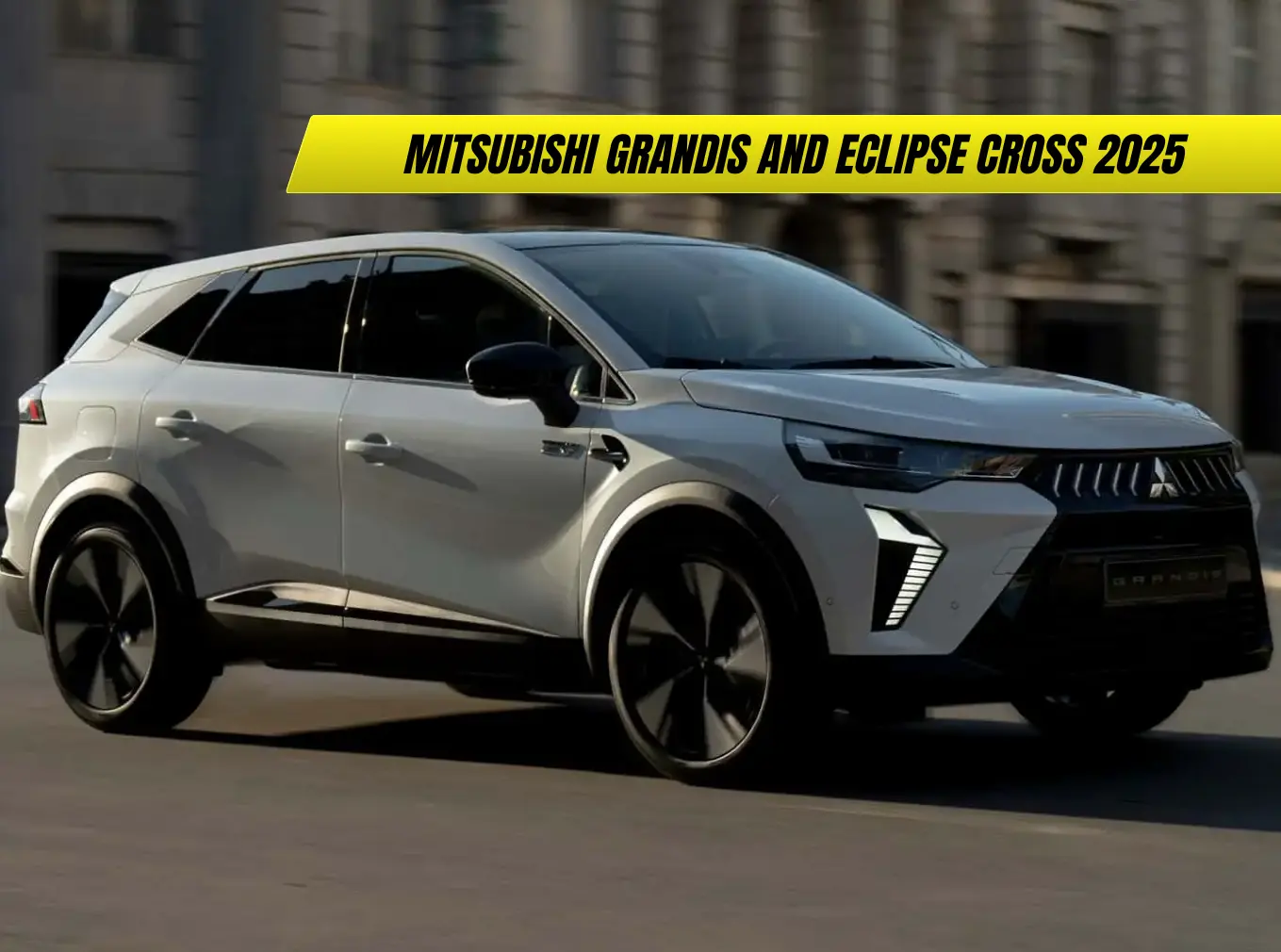
Mitsubishi Grandis and Eclipse Cross 2025 UK pricing revealed. Hybrid and electric SUVs built on Renault platforms. Complete guide to specs, features and availability.
Mitsubishi’s return to relevance in the European market takes an unexpected turn with the announcement of two new models sharing Renault underpinnings: the Grandis and Eclipse Cross for 2025. This partnership represents a significant strategic shift for Mitsubishi, which has struggled in recent years to maintain competitive products in the UK and broader European markets. The Grandis arrives as a seven-seater family SUV built on the same platform as the Renault Grand Scenic, whilst the Eclipse Cross receives a comprehensive redesign utilising Renault’s Austral architecture. For UK buyers, this collaboration promises modern hybrid and potentially electric powertrains wrapped in Mitsubishi styling—but questions remain about pricing, specification, and whether these rebadged models can compete in Britain’s fiercely competitive SUV marketplace.
Key Points:
- Mitsubishi Grandis 2025 is a seven-seater SUV based on Renault Grand Scenic E-Tech platform, expected in UK from late 2025
- Eclipse Cross 2025 receives complete redesign on Renault Austral platform with hybrid powertrains
- Grandis likely priced from £38,000-£42,000, competing with Peugeot 5008 and Hyundai Santa Fe
- Eclipse Cross anticipated pricing from £32,000-£36,000, rivalling Nissan Qashqai and Honda CR-V
- Both models expected to offer E-Tech full hybrid powertrains with potential plug-in hybrid variants
- UK availability confirmed but specific launch dates and final specifications remain under announcement
- Partnership reflects Mitsubishi’s strategy to leverage Renault-Nissan Alliance technology for European competitiveness
Mitsubishi’s Strategic Partnership with Renault
Before examining these specific models, understanding the context of Mitsubishi’s partnership with Renault proves essential. Mitsubishi has been part of the Renault-Nissan-Mitsubishi Alliance since 2016, but the relationship has deepened significantly in recent years as the Japanese manufacturer has withdrawn from several markets and streamlined its European operations.
The decision to base new Mitsubishi models on Renault platforms represents pragmatic economics. Developing entirely new vehicle architectures costs billions of pounds, resources that Mitsubishi—having withdrawn from Europe once before—simply cannot justify for relatively modest sales volumes. By sharing Renault’s CMF (Common Module Family) platforms, Mitsubishi gains access to modern, efficient architectures incorporating the latest hybrid and electric powertrains without bearing full development costs.
For UK buyers, this arrangement mirrors established practices in the automotive industry. The Volkswagen Group shares platforms across multiple brands, Stellantis does likewise with Peugeot, Citroën, Vauxhall and others, and Toyota collaborates with various manufacturers. The question becomes whether Mitsubishi can differentiate these models sufficiently to justify their existence alongside their Renault counterparts. From my point of view, success will depend heavily on pricing strategy, equipment levels, and whether Mitsubishi’s dealer network can provide compelling reasons to choose their badge over the mechanically similar Renault alternatives.
Mitsubishi Grandis 2025: Seven-Seater Family SUV Specifications
The Grandis nameplate returns after a lengthy absence—the original Grandis was a conventional MPV sold until 2011. This 2025 iteration transforms into a large SUV-styled seven-seater built on the Renault Grand Scenic E-Tech platform, which itself represents Renault’s most sophisticated family vehicle offering.
Expected to measure approximately 4.7-4.8 metres in length, the Grandis will provide three rows of seating with genuine accommodation for adults in the second row and adequate space for children in the third. This positions it directly against established seven-seaters in the UK market including the Peugeot 5008, Hyundai Santa Fe, and Kia Sorento—all proven sellers to British families requiring maximum passenger capacity.
The powertrain lineup should mirror the Renault Grand Scenic E-Tech, offering a full hybrid system combining a 1.2-litre three-cylinder turbocharged petrol engine with electric motors and a small battery pack. Total system output likely reaches around 200 bhp, delivering adequate performance for family duties with claimed fuel economy approaching 55-60 mpg on the combined cycle. For those considering family transport options, our guide to 7-seater cars in 2025provides comprehensive comparisons across the segment.
There’s also potential for a plug-in hybrid variant, utilising Renault’s E-Tech plug-in system with approximately 12-15 kWh battery capacity enabling 30-40 miles of pure electric range. If offered, this PHEV version would appeal strongly to UK company car drivers benefiting from reduced BIK tax rates. Our detailed plug-in hybrid guide for UK drivers explains the financial advantages comprehensively.
SpecificationMitsubishi Grandis 2025 (expected)Renault Grand Scenic E-TechPeugeot 5008Hyundai Santa FeLength4.7-4.8m4.72m4.64m4.83mSeating7 seats7 seats5 or 7 seats7 seatsPowertrainFull Hybrid / PHEVFull Hybrid / PHEVHybrid / PHEVHybrid / PHEVPower Output~200 bhp200 bhp136-225 bhp215-235 bhpExpected UK Price£38,000-£42,000£39,000-£45,000£35,000-£43,000£45,000-£55,000
Mitsubishi Eclipse Cross 2025: Redesigned Compact SUV Details
The Eclipse Cross name continues but receives a complete transformation for 2025, abandoning its previous platform for Renault Austral underpinnings. The current Eclipse Cross has struggled in the UK market against stronger competitors, so this redesign represents Mitsubishi’s opportunity to field a genuinely competitive compact SUV.
Dimensionally, expect the new Eclipse Cross to measure around 4.5 metres in length, positioning it squarely in the highly competitive compact SUV segment dominated by models like the Nissan Qashqai, Honda CR-V, and Mazda CX-5. This segment represents the absolute heartland of UK SUV sales, where even small advantages in space, economy, or equipment can significantly impact success.
Following the Renault Austral’s technical specification, the Eclipse Cross should offer Renault’s E-Tech full hybrid system as standard, potentially with higher-output variants available. The base full hybrid combines a turbocharged petrol engine with electric motors for around 160-200 bhp total system output, delivering claimed economy of 50-55 mpg with CO2 emissions below 120 g/km—crucial for company car taxation.
From my experience with Renault’s E-Tech hybrid system in various applications, it delivers smooth operation in urban environments whilst maintaining adequate performance for motorway driving. The system’s clever multi-mode gearbox enables the combustion engine to run at optimal efficiency more consistently than conventional automatic transmissions, translating into real-world fuel economy that often meets or exceeds official claims—unusual in the automotive industry.
For those specifically interested in compact SUVs combining practicality with efficiency, our article covering mid-size SUVs in the UK provides detailed comparisons of the most popular models in this crucial segment.
UK Pricing Strategy and Market Positioning
Pricing will prove absolutely critical to both models’ success in the UK market. Mitsubishi cannot simply match Renault’s pricing—buyers choosing a Renault benefit from a stronger dealer network, better brand perception in Europe, and established residual values. Mitsubishi must undercut Renault or provide significantly superior equipment to justify their existence.
For the Grandis, I anticipate UK pricing starting around £38,000-£42,000 for the full hybrid, potentially extending to £45,000-£48,000 for a plug-in hybrid variant if offered. This would position it below the Hyundai Santa Fe (from £45,000) but competing directly with the Peugeot 5008 (from £35,000). The challenge lies in convincing buyers that a Mitsubishi offers better value or capability than established alternatives.
The Eclipse Cross needs even more aggressive pricing given the segment’s competitiveness. Starting prices around £32,000-£36,000 for the base full hybrid would position it competitively against the Nissan Qashqai E-Power (from £33,000) whilst undercutting the Honda CR-V hybrid (from £40,000). Higher specifications might reach £38,000-£40,000, but exceeding £40,000 would price the Eclipse Cross into premium territory where its Renault-based credentials may not justify the cost.
These pricing estimates assume Mitsubishi equips both models generously to offset potential concerns about badge prestige. Standard equipment should include LED lighting, digital driver displays, comprehensive safety systems, and smartphone connectivity as minimum expectations for UK buyers. For those working within specific budget constraints, our guide to the best cars under £25,000 covers more affordable alternatives, though neither Mitsubishi is likely to fit that category.
Design Language and UK Market Appeal
Whilst official images remain limited, both models should incorporate Mitsubishi’s Dynamic Shield design language—the bold front-end styling featuring prominent grille and angular lighting elements that has defined recent Mitsubishi products. The challenge will be distinguishing these models visually from their Renault counterparts sufficiently that buyers perceive them as distinct products rather than simple rebadges.
Interior design represents another crucial battleground. Renault’s recent interiors have received praise for their modern, clean aesthetics and improved material quality. Mitsubishi’s challenge involves either matching this standard or potentially exceeding it through superior equipment or more premium materials. From my point of view, the interiors will likely remain very similar to the Renault originals with primarily cosmetic changes to trim finishes, upholstery patterns, and digital interface graphics.
Boot capacity should prove competitive within respective segments. The Grandis should offer around 200-220 litres with all seven seats in use, expanding to 600-700 litres with the third row folded and potentially 1,800-2,000 litres with all rear seats down. The Eclipse Cross should provide approximately 500-550 litres with rear seats up, extending to 1,500-1,600 litres with seats folded—adequate for most UK family requirements.
For British buyers, practical considerations matter enormously. Interior space, boot capacity, ease of child seat installation, and visibility all factor heavily into purchasing decisions. Both Mitsubishi models should perform competently in these areas, matching or exceeding their Renault platform donors.
Hybrid Technology and Real-World Performance
Renault’s E-Tech full hybrid system represents sophisticated engineering, utilising a clever multi-mode gearbox that enables seamless transitions between pure electric, hybrid, and combustion-only operation. The system incorporates two electric motors—a larger traction motor and smaller high-voltage starter-generator—working alongside a petrol engine through a unique gearbox design eliminating the need for a conventional clutch.
In practical UK driving conditions, this technology delivers several advantages. Urban and suburban driving allows frequent electric-only operation, reducing fuel consumption and emissions where they matter most—in congested areas and around schools and residential zones. The system’s ability to start and stop silently in traffic proves particularly appreciated by British drivers facing typical commuter conditions.
Motorway performance remains adequate rather than exceptional. The relatively modest battery capacity (around 2 kWh for the full hybrid system) means sustained high-speed cruising relies primarily on the combustion engine, with the electric motors providing supplementary assistance during acceleration. Fuel economy at steady 70 mph cruising typically falls to 45-50 mpg—respectable but not revolutionary.
For those specifically interested in hybrid technology variations, our comprehensive guide to the best hybrid cars in 2025 explains the differences between full hybrids, mild hybrids, and plug-in hybrids, helping buyers understand which technology best suits their driving patterns.
If Mitsubishi offers plug-in hybrid variants, the benefits increase substantially for specific user groups. The anticipated 30-40 mile electric range covers most UK daily commutes entirely on electric power, with the petrol engine available for longer journeys. Company car drivers particularly benefit from PHEV taxation advantages, with BiK rates of just 8% for 2025/26 compared with 29-37% for conventional petrol or diesel models.
Safety Features and UK Regulatory Compliance
Both Mitsubishi models should arrive comprehensively equipped with active safety technologies meeting current UK and European regulatory requirements. Expect Mitsubishi to incorporate their updated safety suite including:
- Autonomous emergency braking with pedestrian and cyclist detection
- Adaptive cruise control with stop-and-go functionality for traffic jams
- Lane departure warning and lane keeping assistance
- Blind spot monitoring and rear cross-traffic alert
- Traffic sign recognition adapting to UK road signage
- Intelligent speed assistance responding to posted speed limits
These systems align with evolving UK speed camera regulations for 2025, which increasingly emphasise intelligent speed adaptation and connected safety features. Modern vehicles must incorporate technologies helping drivers comply with speed limits and avoid penalties.
Euro NCAP crash testing should yield strong results given the proven safety performance of the Renault platforms. Both the Grand Scenic and Austral have achieved five-star Euro NCAP ratings, and the Mitsubishi variants should match these scores with appropriate UK-specific adaptations.
UK Running Costs and Ownership Considerations
For British buyers, total cost of ownership extends well beyond purchase price. Running costs, depreciation, insurance, and maintenance all factor into the financial equation, particularly for families keeping vehicles for extended periods.
Fuel economy should prove competitive, with both models likely achieving 50-60 mpg on the official combined cycle. Real-world UK driving typically yields 10-15% lower figures, so expect 45-55 mpg in typical mixed driving—substantially better than equivalent petrol or diesel models from just a few years ago. If plug-in hybrid variants materialise, drivers with regular charging access could achieve triple-digit MPGe figures for daily commuting.
VED (road tax) for both models should fall into the lower bands given their hybrid powertrains and sub-130 g/km CO2 emissions. First-year VED depends on emissions, potentially £185-£270, with standard rate VED of £190 from the second year onwards. Plug-in hybrids with sub-50 g/km emissions would pay even less initially, though the standard £190 rate applies from year two regardless of emissions.
Understanding UK road costs extends beyond VED. For those regularly travelling specific routes, our guide to UK toll roads and charges provides comprehensive coverage of additional journey costs that affect overall running expenses.
Insurance costs will likely fall into groups 18-23 for the Eclipse Cross and 20-25 for the Grandis, broadly competitive with similar vehicles. Mitsubishi’s relatively modest theft rates and reasonable repair costs should help maintain affordable premiums, though the brand’s weaker UK presence compared with mainstream alternatives may result in slightly higher quotes from some insurers unfamiliar with the models.
Depreciation represents the biggest unknown. Mitsubishi’s UK sales volumes have declined substantially in recent years, which historically predicts weak residual values. However, if these models prove genuinely competitive and the brand rebuilds its UK presence, residual values could surprise positively. I would recommend approaching residual value predictions cautiously until real-world market data emerges.
Comparison with Direct Competitors
Understanding how these Mitsubishis compare with established alternatives helps UK buyers make informed decisions. The compact SUV and seven-seater segments offer numerous choices, each with distinct advantages.
For seven-seater alternatives to the Grandis:
Peugeot 5008: Stylish design, distinctive interior, proven reliability, prices from £35,000. However, third-row space compromised compared with larger rivals.
Hyundai Santa Fe: Generous equipment, excellent warranty (5 years unlimited mileage), spacious interior, from £45,000. Premium pricing but exceptional value proposition.
Kia Sorento: Similar to Santa Fe with shared platform, 7-year warranty, from £44,000. Proven UK reliability and dealer support.
Skoda Kodiaq: Volkswagen Group quality, practical interior, competitive pricing from £35,000. Strong residual values and dealer network.
For compact SUV alternatives to the Eclipse Cross:
Nissan Qashqai E-Power: UK’s best-selling SUV, proven reliability, innovative series-hybrid technology, from £33,000. Dominant market position and strong residuals.
Honda CR-V Hybrid: Spacious interior, bulletproof reliability reputation, hybrid as standard, from £40,000. Premium pricing but excellent ownership experience.
Mazda CX-5: Engaging dynamics, premium interior, mild-hybrid or PHEV options, from £33,000. Appeals to driving enthusiasts seeking SUV practicality.
Toyota RAV4 Hybrid: Industry-leading hybrid reliability, strong residuals, comprehensive warranty, from £35,000. Our detailed Toyota RAV4 2026 coverage explores this perennial favourite comprehensively.
UK Dealer Network and Aftersales Support
Mitsubishi’s UK dealer network has contracted substantially in recent years, which presents genuine concerns for potential buyers. Convenient local dealer access matters for servicing, warranty work, and addressing any issues arising during ownership. Before committing to either Mitsubishi, I strongly recommend verifying your nearest dealer location and researching their reputation through online reviews and local recommendations.
Service intervals should follow typical modern hybrid patterns—annual or 12,500-mile checks covering conventional maintenance items plus hybrid system diagnostics. Service costs should prove competitive, potentially undercutting premium brands whilst remaining slightly higher than budget alternatives. Mitsubishi’s warranty will likely match or exceed mainstream competitors, potentially offering 5 years or 62,500 miles coverage to offset concerns about brand strength.
Understanding vehicle warning systems becomes important for any ownership experience. Modern cars feature comprehensive diagnostic systems alerting drivers to potential issues. Resources covering the spanner warning lightand other dashboard indicators help owners understand when professional attention becomes necessary versus minor alerts requiring simple responses.
Should UK Buyers Consider These Mitsubishis?
This question demands honest assessment. Both the Grandis and Eclipse Cross arrive with modern technology, efficient powertrains, and presumably competitive pricing. However, they face established competitors with proven track records, stronger dealer networks, and better brand perception in the UK market.
I would recommend considering these Mitsubishis if:
- Mitsubishi prices them significantly below equivalent Renault and mainstream alternatives (£2,000-£3,000 minimum discount)
- Your local Mitsubishi dealer has excellent reputation and convenient location
- You value Mitsubishi’s brand history and want to support their UK return
- Specific equipment or styling elements appeal more than mechanically similar alternatives
- Competitive finance or leasing deals make total cost of ownership compelling
I would recommend alternative choices if:
- Brand prestige and residual values concern you significantly
- Nearest Mitsubishi dealer sits inconveniently distant
- Equivalent Renault models offer similar specifications at comparable prices (buy the Renault)
- You prioritise proven reliability and established ownership communities
- Other manufacturers offer substantially better warranties or aftersales support
For those considering whether to focus on used rather than new vehicles, our guide to the best used SUVs in 2025explores excellent value alternatives in the second-hand market that may provide better value than brand-new models with uncertain futures.
Electric Future: Will Fully Electric Variants Arrive?
Renault offers fully electric versions of both the Grand Scenic (as E-Tech Electric) and is developing electric variants across its range. The question becomes whether Mitsubishi will offer electric versions of the Grandis and Eclipse Cross for the UK market.
Mitsubishi’s electric vehicle strategy remains somewhat unclear for Europe. The brand has electric vehicles in other markets but has not committed strongly to UK electric offerings beyond gradual electrification. Given the investment required to federalise and homologate electric variants specifically for UK/European sale, I suspect Mitsubishi may initially focus on hybrid variants only, potentially adding electric options if sales volumes justify the investment.
For UK buyers specifically seeking electric SUVs, numerous excellent alternatives exist now rather than waiting for uncertain future Mitsubishi offerings. Our comprehensive guide to the best electric cars in 2025 covers all segments and price points, providing detailed comparisons to help identify the right electric vehicle for your needs.
When will the Mitsubishi Grandis and Eclipse Cross be available in UK dealerships?
Mitsubishi has confirmed both models for UK sale but has not announced specific release dates. Based on French market information suggesting 2025 launches, UK availability likely falls in late 2025 for the Eclipse Cross and possibly early 2026 for the Grandis. Contact your local Mitsubishi dealer for confirmed timing and pre-order opportunities as official announcements emerge.
What is the expected fuel economy for these Mitsubishi hybrid models?
Both models should achieve approximately 50-60 mpg on the official WLTP combined cycle, with real-world UK driving typically yielding 45-55 mpg in mixed conditions. Urban driving should deliver the best results (55-65 mpg) given the hybrid system’s efficiency in stop-start traffic, whilst sustained motorway cruising at 70 mph will reduce economy to around 45-50 mpg.
Will Mitsubishi offer plug-in hybrid versions for UK buyers?
Plug-in hybrid variants remain unconfirmed but appear likely given that Renault offers PHEV versions of the platform donors. If offered, expect approximately 30-40 miles of electric-only range with 12-15 kWh battery capacity, delivering significant benefits for UK company car drivers through reduced BIK taxation and potential for all-electric daily commuting.
How does Mitsubishi’s warranty compare with competitors?
Mitsubishi will likely offer 5 years or 62,500 miles warranty to match mainstream competitors, though final UK warranty terms await official confirmation. This compares with Hyundai and Kia’s industry-leading 5-7 year warranties but exceeds most European manufacturers’ 3-year coverage. The hybrid system components should receive extended 8-year or 100,000-mile battery warranty standard across the industry.
Are these Mitsubishis suitable for towing caravans and trailers?
Based on the Renault platform capabilities, both models should offer reasonable towing capacity. The Grandis might achieve 1,500-1,750 kg braked towing capacity, adequate for medium-sized caravans and larger trailers. The Eclipse Cross could offer 1,300-1,500 kg capacity, suitable for smaller caravans and utility trailers. Official UK towing ratings will be confirmed upon launch—always verify specifications before purchasing if towing represents essential requirement.
What happens to my UK driving licence points if I’m caught speeding in these vehicles?
Speed limit compliance applies equally regardless of vehicle type. Getting caught speeding results in penalty points on your UK driving licence following standard procedures. Our detailed guide to UK driving licence points explains the penalty system, consequences of accumulating 12 points, and how to check your current total. Both Mitsubishi models should feature intelligent speed assistance helping drivers comply with posted limits.
Should I buy a Mitsubishi or the equivalent Renault model?
This depends on pricing and equipment. If the Mitsubishi offers substantially better value (£2,000+ cheaper) or superior equipment at similar prices, it may represent the better choice. However, if pricing proves similar, the Renault likely offers better residual values, stronger dealer network, and more established brand presence in the UK. Compare final specifications, pricing, and local dealer quality before deciding.
Conclusion: Competent But Unproven Contenders
The Mitsubishi Grandis and Eclipse Cross 2025 arrive as technically competent vehicles built on proven Renault platforms with efficient hybrid powertrains well-suited to UK driving conditions. Both should deliver adequate space, reasonable economy, and comprehensive equipment at potentially competitive prices. For British buyers specifically loyal to Mitsubishi or finding compelling dealer offers, these models deserve serious consideration.
However, honest assessment requires acknowledging the challenges these vehicles face. Mitsubishi’s contracted UK presence, uncertain residual values, and the abundance of established alternatives create significant headwinds. The Grandis competes against proven seven-seaters from Hyundai, Kia, Peugeot, and Skoda—each offering distinct advantages. The Eclipse Cross battles the Nissan Qashqai, Honda CR-V, and Toyota RAV4 in Britain’s most competitive SUV segment.
From my point of view, these Mitsubishis represent sensible choices only if pricing and equipment justify choosing them over mechanically superior or more established alternatives. Wait for official UK specifications, compare them rigorously against competitors, verify your local dealer quality, and honestly assess whether Mitsubishi’s brand value matters to you. Sometimes the unfamiliar choice offers genuine value, but sometimes the popular choice achieves that status for good reasons. These Mitsubishis must prove they belong in the former category to succeed in Britain’s discerning, competitive SUV market.





